








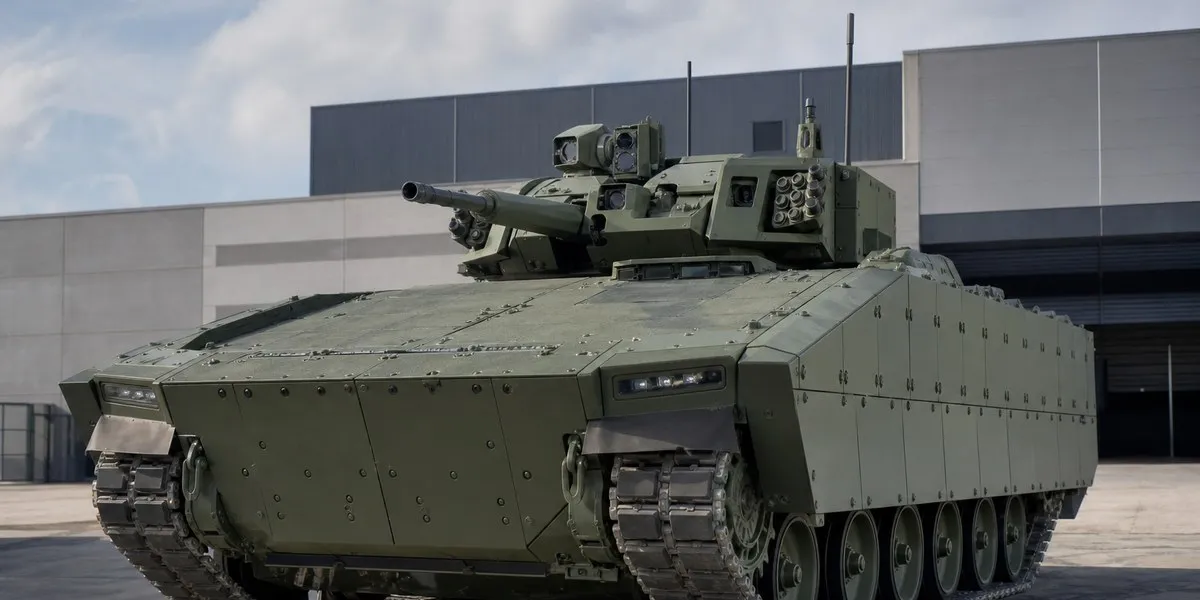
American Rheinmetall Pitches Lynx XM30 as Future Replacement for Aging Bradley Fighting Vehicle
The U.S. Army’s longstanding effort to modernize its armored fleet has reached a pivotal juncture as American Rheinmetall officially positions its Lynx XM30 infantry fighting vehicle as the primary successor to the venerable M2 Bradley. With the Army officially halting further major modernization efforts for the Bradley platform, military officials and contractors are looking toward a “clean-sheet” design capable of meeting the demands of modern, high-intensity conflict.
According to industry assessments, the Bradley has reached the absolute ceiling of its utility. The platform’s primary challenge is not a lack of firepower, but a fundamental exhaustion of its physical capacity. Decades of incremental upgrades have left the vehicle with no room to support additional weight, increased electrical power demands, or the sophisticated computing suites required for contemporary electronic warfare.
Jim Schirmer, senior vice president for programs at American Rheinmetall, emphasized that the Lynx XM30 was engineered specifically to solve the “growth” problem that has plagued the Bradley.
“The Lynx XM30 is designed with a service life of 30 years or more in mind,” Schirmer stated. The vehicle’s chassis, structure, and suspension are intentionally over-engineered to support significantly more weight than the base model requires at the time of delivery. Furthermore, the engine and transmission are built to maintain tactical mobility even as new armor, sensors, and weapons systems are bolted on over the coming decades.
A critical feature of the Lynx is its reserve electrical capacity. Recognizing that future combat vehicles will require immense power for advanced directed-energy weapons and electronic warfare suites, Rheinmetall has integrated an internal power-distribution architecture designed to accommodate new equipment without requiring a total redesign of the platform. The vehicle also boasts significant “headroom” in its onboard computing units, ensuring it can handle future software-defined upgrades.
This forward-thinking approach mirrors the lessons learned during the Iraq War, where upgrades like slat armor and CREW electronic warfare systems were rapidly fitted to Abrams and Bradleys to combat improvised explosive devices. Those emergency patches consumed the last of the platforms’ available power and weight margins. The Lynx aims to eliminate that scramble by building in “excess” capacity from the start.
In alignment with the Army’s “Ground Combat Systems’ Common Infrastructure Architecture” (GCIA), the Lynx utilizes an open-systems design. This standard mandates specific interfaces and data structures, allowing the military to integrate third-party hardware and software without being locked into a proprietary cycle with the original manufacturer.
Beyond technical specifications, American Rheinmetall has prioritized ergonomics, utilizing direct feedback from active-duty soldiers and retired gunners to refine the vehicle’s interior. The crew stations have been redesigned to allow for more intuitive control, while the seating arrangement now allows two crew members to operate the vehicle and fire the main armament interchangeably. As the Army seeks to replace its legacy fleet, the Lynx XM30 is presenting itself as a modular, future-proof solution ready for the next generation of warfare.
Disclaimer: This content is auto-generated for informational purposes only.
Source: Read Original News