







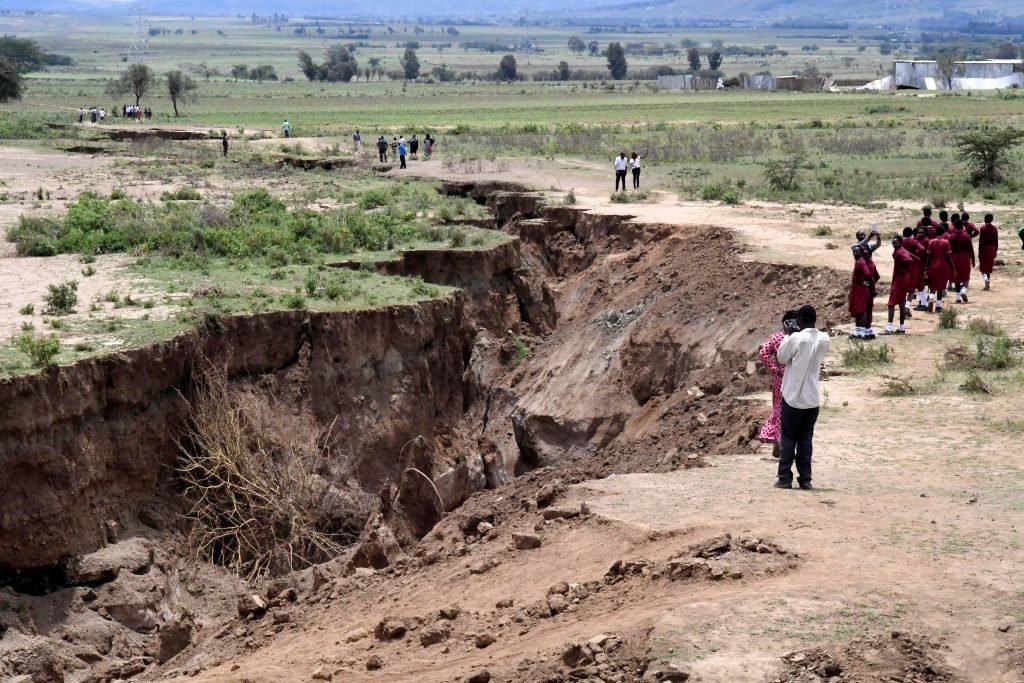
Published in the journal Nature Communications, the findings show that the crust between the Turkana Rift, a 500-kilometre-long section of the vast East African Rift System that stretches from Ethiopia to Mozambique has thinned dramatically and at a faster rate than previously expected.
This tectonic boundary marks the slow separation of the African Plate from the Somali Plate, a process that has been underway for tens of millions of years.
Researchers found that the plates have been moving apart at a rate of around 4.7 millimetres per year. As the crust stretches, it fractures and sinks, creating pathways for magma to rise from deep within the Earth and fuel volcanic activity across the region.
By analysing a rare set of high-resolution seismic data collected, researchers were able to create one of the most detailed pictures yet of the crust beneath the rift. Their findings revealed that the crust along the rift’s centre has thinned to just 13 kilometres in places, compared with more than 35 kilometres outside the rift zone.
“We found that rifting in this zone is more advanced, and the crust is thinner, than anyone had recognised,” said lead author Christian Rowan, a PhD student at Columbia University’s Lamont-Doherty Earth Observatory. “Eastern Africa has progressed further in the rifting process than previously thought.”
The team attributes this extreme thinning to a process known as “necking”, in which the crust stretches and narrows in a way similar to a piece of pulled taffy. As the crust becomes thinner, it weakens, making further stretching easier and increasing the likelihood that the continent will eventually split apart.
“We’ve reached that critical threshold of crustal breakdown,” said co-author Anne Bécel, a geophysicist at Lamont-Doherty. “We think this is why it is more prone to separate.”
Although the process is geologically significant, it remains slow. The Turkana Rift began forming around 45 million years ago, and researchers estimate it could take several million more years before the region enters the next stage of development, when new oceanic crust begins forming and seawater may eventually flood into the rift.
Beyond tectonics, the findings could help explain why the Turkana Basin contains one of the world’s richest collections of early human fossils. The region has yielded more than 1,200 hominin fossils dating back four million years—around a third of all such discoveries in Africa.
The researchers suggest that widespread volcanic activity followed by crustal thinning caused the land to subside around four million years ago, creating basins where fine-grained sediments accumulated rapidly, producing ideal conditions for preserving bones and other remains.