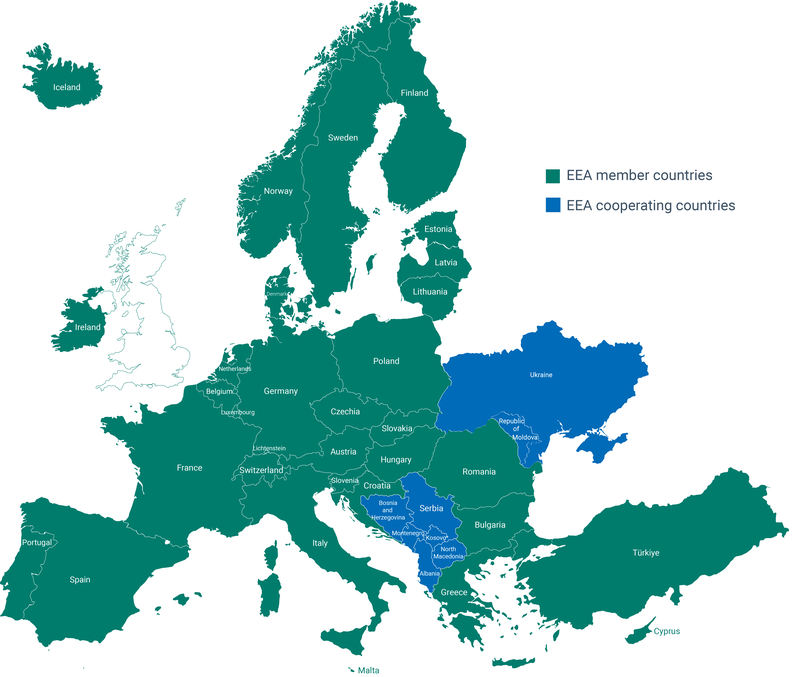
The European Environment Agency (EEA) and its European Environment Information and Observation Network (Eionet) today welcomed Ukraine as a cooperating country, extending the EEA’s country network to 32 member and 8 cooperating countries across Europe.
The EEA Management Board formally endorsed Ukraine today as a cooperating country to the EEA and Eionet. Ukraine becomes the eighth EEA cooperating country, joining the Republic of Moldova and the Western Balkan partners Albania, Bosnia and Herzegovina, North Macedonia, Montenegro, Serbia and Kosovo.
Like all European countries, Ukraine faces pressing environmental challenges — from climate change and air pollution to the loss of biodiversity and the protection of its water resources. In addition to immense human suffering and loss of life in Ukraine, Russia’s ongoing war of aggression has caused extensive damage to its land, water systems, air quality and protected areas. The destruction of livelihoods and of the natural environment are inseparable consequences of the conflict — and the impacts do not remain within national borders. Addressing them is a shared European concern, and this cooperation reflects that reality.
This cooperation is grounded in the EU–Ukraine Association Agreement and the EU enlargement framework. Ukraine applied for European Union membership in February 2022 and was officially recognised as an EU membership candidate in June 2022. The EEA Management Board agreed to grant Ukraine cooperating country status, supported by dedicated funding by the European Commission. Building on earlier project-based collaboration (2010-2020), including Ukraine’s participation as a Contracting Party to the Energy Community since 2011, today’s endorsement marks a new phase of structured cooperation within the EEA and Eionet.
Oleksii Sobolev, Minister of Economy, Environment and Agriculture of Ukraine commented:
Today is an important day for Ukraine. We are pleased to join the European Environment Agency and the Eionet network as a coperating country and become part of the European environmental community. This comes at a particularly important moment, as Ukraine moves forward in its EU accession negotiations and confidently continues on its path toward European integration. Despite the enormous challenges caused by ongoing Russian aggression, Ukraine continues to implement environmental reforms and strengthen its institutions. Cooperation with the EEA will help us improve our environmental monitoring and information systems, implement EU environmental legislation, and deepen Ukraine’s integration into the European space. We are thankful to the European Commission, the EEA, and the Member States for their trust, solidarity, and continued support.
Minister of Economy, Environment and Agriculture of Ukraine
Jessika Roswall, European Commissioner for Environment, Water Resilience and a Competitive Circular Economy, praised Ukraine’s commitment to European integration:
Ukraine’s path to European integration is one of the most powerful demonstrations of European values we have seen in recent years. Welcoming Ukraine into the EEA/Eionet family is a recognition of that commitment and a practical investment in the environmental resilience of the whole continent.
Now that the EU has taken a major step forward and officially opened accession negotiations with Ukraine there is a lot of work ahead, especially with Ukraine’s resources strained by the ongoing war conflict. Timely preparation, resource sharing, closer cooperation and integration in existing processes represent a big step forward in this respect, and I believe that cooperation with the EEA will further support evidence-based processes and institutional capacity-building. A country that continues to advance its alignment with EU environmental standards while enduring the devastation of war deserves our full support.
European Commissioner for Environment, Water Resilience and a Competitive Circular Economy
Leena Ylä-Mononen, EEA Executive Director, welcomed Ukraine as an EEA/Eionet cooperating country:
We are very pleased to welcome Ukraine as a cooperating country of the European Environment Agency. Environmental challenges know no borders, and cooperation is essential to address them effectively. We have already been working closely with Ukrainian colleagues under the Energy Community framework and in earlier regional projects, and we look forward to building on that foundation. The environmental damage caused by the war is a concern for all of us, and joint work on monitoring, data and assessment will be an important part of what this cooperation delivers.
André Weidenhaupt, Chair of the EEA Management Board, welcomed Ukraine on behalf of EEA member and cooperting countries:
On behalf of all the countries in our network, I am delighted to welcome Ukraine as the newest member of the Eionet family. This step brings us closer than ever to a truly united European environmental community—one that now spans the 27 EU Member States, our five EEA countries, the Western Balkans, Moldova, and now Ukraine. Eionet thrives on the principle that shared knowledge leads to better outcomes for people and for nature. Ukraine’s participation will not only strengthen our collective efforts but also provide vital support as the country works to protect and restore its environment, even in the face of extraordinary challenges. Together, we are building a resilient foundation for evidence-based policymaking across Europe.
Chair of the EEA Management Board
Roadmap for integration to the EEA
Cooperating countries can engage in the Agency’s activities and become part of Eionet. Similar to member countries, they contribute to and benefit from shared environmental data, assessments and capacity-building activities, supporting improved environmental governance and evidence-based policymaking across Europe. Eionet consists of the EEA’s member and cooperating countries. The 32 member countries include the 27 European Union Member States, Iceland, Liechtenstein, Norway, Switzerland and Türkiye.
Cooperation between the EEA and Ukraine aims to support Ukraine in building the institutional and technical foundations for future Eionet integration, to provide a roadmap for environmental data reporting in line with the approximation to the EU environmental acquis, and to facilitate Ukraine’s progressive participation in EEA systems, networks and knowledge platforms.