








A record-breaking May heat wave in Europe, and another prolonged stretch of extreme temperatures this week, highlight the challenges for the continent in dealing with a hotter future.
Advocates say there’s a natural building material that could be part of the solution. Hemp, which comes from cannabis plants that have minimal amounts of the psychoactive substance tetrahydrocannabinol (THC), can act as a thermal regulator when used to insulate buildings.
“The summers are getting hotter,” says Olivier Beghin, the co-founder of IsoHemp, a Belgium-based company that makes hemp blocks. “We have a good solution in order to insulate against the heat.”
Today, only around 20% of homes in Europe have air conditioning. Even so, around 40% of the energy consumed in the European Union (EU) is used in buildings, mostly for heating, cooling and hot water. The EU says the building sector will be key to achieving its aim of carbon-neutrality by 2050, and that “hemp can play a significant role in reaching this objective.”
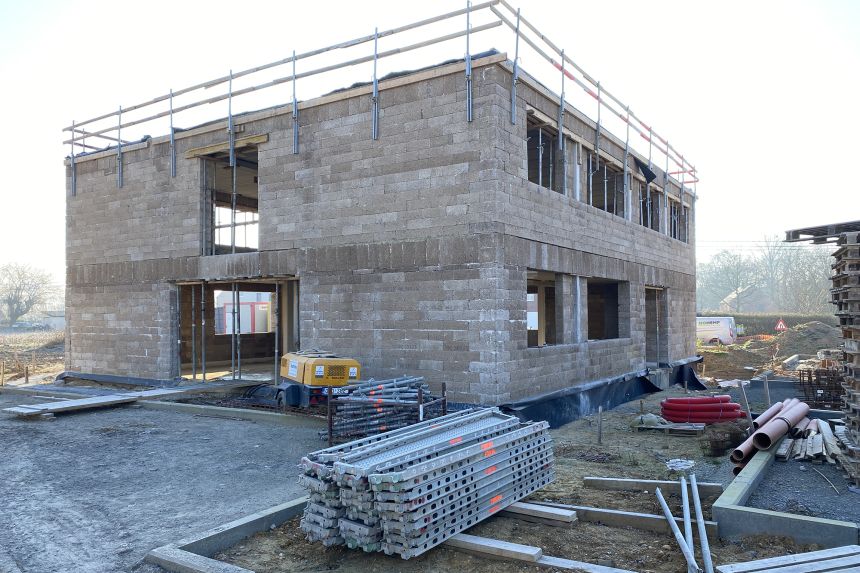
IsoHemp’s blocks, made out of hemp and lime binders, can be integrated into load-bearing structures, and are suitable for both interior and exterior walls. The company’s blocks will be used in more than 2,000 projects this year, says Beghin.
They have already been used to renovate and build structures ranging from public housing in Belgium to a six-story building of 100 apartments in France and a 17th-century monument in Versailles.

Beghin says that older buildings are its biggest market. Around 30% of buildings in Europe were built before 1945, and they are typically poorly insulated. Adding internal insulation on the external walls of older buildings could create an energy savings of 15 to 20%, but traditional insulation can cause mold issues. “They need a product that can still breathe,” says Beghin.
In addition to its ability to regulate moisture, hempcrete is resistant to pests and fire. Because it’s made from natural materials, it’s generally recyclable and biodegradable, unlike some petroleum-based insulation.
And perhaps most importantly, hempcrete can be carbon neutral or even carbon negative, depending on its composition. By some estimates, fast-growing hemp can absorb twice as much CO2 as trees.
In the EU, new buildings owned by public bodies will be required to be “zero-emissions” by 2028, and all other new buildings will have to meet the standard by 2030. Some countries are setting ambitious targets. The Netherlands has a goal to build 30% of new homes with 30% bio-based materials by 2030. France’s RE2020 regulation, which aims to improve the energy efficiency and reduce the carbon footprint of buildings, encourages new public buildings to include bio-based materials.
A 2025 academic review noted some disadvantages of hempcrete in construction: It’s not strong enough to use as a load-bearing material, so must be integrated into a supporting frame, and spray-on hempcrete can take up to eight weeks to dry, which is why blocks made by IsoHemp and others are precast.
Beghin says the cost of using hemp for insulation depends on the market and use. “I would say that we are in the middle-upper range of price,” he adds, compared to other materials that might be used.
Supply chains and scaling
Statistics on the use of hemp for construction are sparse, but hemp buildings are largely concentrated in France and the UK, Steve Allin, the director of the International Hemp Building Association, tells CNN via email. Greencore Homes plans to build 10,000 homes with hempcrete panels in the UK by 2035, helped by £8 million ($10.6 million) in funding from the government.
The production of hemp in the EU — used for everything from textiles to food to construction — grew by around 84%, from about 21,000 hectares (52,000 acres) in 2015 to 33,000 hectares (82,000 acres), in 2022. France accounts for more than 60% of production and the majority of IsoHemp’s hemp comes from around the French city of Troyes.

Beghin says that when IsoHemp was founded, in 2011, “there were really no industrial companies that were developing the product.” This year, IsoHemp expects to produce 1.5 to 1.6 million hemp blocks. That makes it the market leader in Europe, according to Beghin, mostly selling to France, Belgium, the Netherlands, Germany and Luxembourg.
The global market for thermal insulation materials of all kinds is expected to reach $38.7 billion by 2027, with Europe being the largest market. There are several other hemp brick companies on the continent, and others working on hemp-related innovation, like a German company making stuffing wool for hard-to-reach places.
Francesco Mirizzi, managing director of the European Industrial Hemp Association, tells CNN via email that there is demand from architects and builders for the material. The challenge, he says, is the development of processing capacity, regional supply chains, and quality standards — and how quickly industrial scale production can be built up to make hemp-based construction materials available at scale.
He is seeing growth. For example, he says that La Chanvrière, Europe’s largest hemp processor, is building a second processing facility that will increase its production capacity by more than 60%. Investments like this and others expanding industrial capacity could support an additional 10,000 hectares (25,000 acres) of hemp cultivation in France alone within the next five years, he says.
Mirizzi adds that ambitious public procurement objectives and financial incentives would be helpful to build value chains and the market. The EU is currently overhauling its public procurement rules to support its priorities, including sustainability.
“The future of hemp depends less on promoting hemp as a ‘miracle crop’ and more on demonstrating viable business cases at scale,” he says.