






Entries are rolling in for the 2026 edition of Ireland’s Greenest Places, a competition run by The Irish Times in association with Electric Ireland, seeking to shine a light on individuals and communities implementing green strategies around the country.
Last year’s category winners are exempt from claiming another title this year, so Dún Laoghaire in Co Dublin; Inagh in Co Clare; Skerries, Co Dublin; the Dysart River Project in the midlands and overall 2025 winner, the Dingle Peninsula, are all off the table.
[ Where are Ireland’s Greenest Places 2026? Cast your vote hereOpens in new window ]
One of the most enjoyable parts of the judges’ work at this early stage of the competition is leafing through submissions and encountering such a wide variety of projects of all sizes. The handful of early entries documented here showcase a community garden, an island nature reserve and an entire university.
Ireland’s Greenest Places hopes to uncover all manner of green initiatives, so don’t hesitate to put a project forward. So far, the entries have been largely based around places, meaning there may be a gap for Ireland’s Net Zero Hero candidates.
This is a new category for someone who stands out for their exemplary work in driving a particular project, in inspiring others to act, in co-ordinating community efforts – or all of the above.
[ The search for Ireland’s Greenest Places begins, with two new judges on boardOpens in new window ]
Their work will be in the spirit of the Net Zero ambition – aiming to reduce greenhouse gas emissions and increase natural carbon capture, replenishing the land and nature so that whatever is taken from it is repaid with interest, or helping build climate resilience.
Entry: Headlands Estate Community Garden
Bray, Co Wicklow
In 2015, neighbours of the Headlands estate in Bray got together to embark on a community garden on a green area in the midst of duplex apartments.
One of them was Hannah Quinn, who says it began as a means to “grow food together and teach our kids where food comes [from]”. In the years since, a grant from Grow It Yourself Ireland (GIY) facilitated the planting of 35 fruit trees, 40 fruit bushes, 10 raised beds, three beehives, a meadow and about 100 native Irish trees as shelter belts.
During summer, the neighbours gather for barbecues and street festivals, sharing their own strawberries and raspberries, and spotting rare meadow flowers. In the autumn they harvest apples and pears and host a juicing day, where everyone brings their own bottles to take a share of the 200 litres they have extracted.
Golden honey from the garden’s native Irish black bees is harvested, shared and sold in the community. In winter, Quinn says, “it’s peaceful and calm for walks and stillness, smelling of earthy hibernation.”
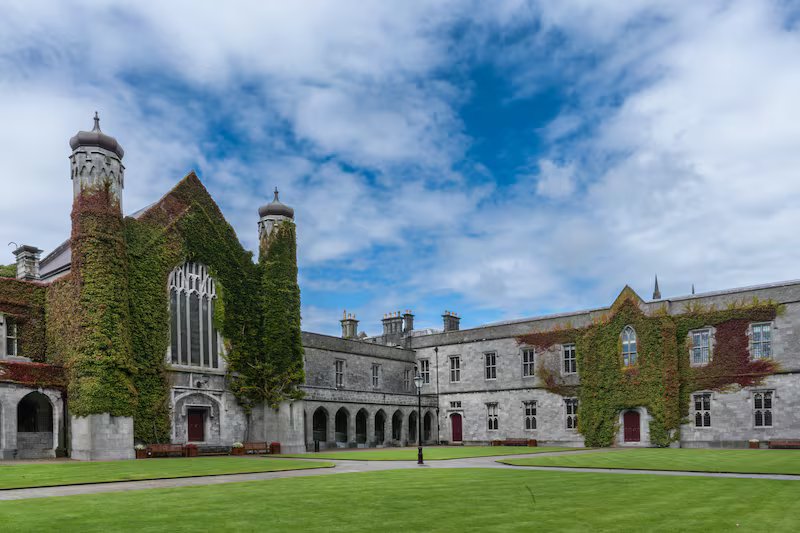
Entry: University of Galway
Co Galway

Dr Richard Manton is the director of sustainability at University of Galway (UG), which he says is Ireland’s most biodiverse campus and home to 628 species on the banks of the river Corrib.
Policy-wise, UG implements a biodiversity action plan, a pollinator plan, nature-based research projects and a biodiversity trail that is free of charge and open for public use. Manton says the university is ambitiously reducing its energy and greenhouse gas emissions, and, according to the Sustainable Energy Authority of Ireland, has halved its emissions in the past eight years.
“This has been achieved through retrofitting buildings, energy management, solar PV and electrifying the fleet,” Manton says. “Drawing on the expertise of its community and a ‘living lab’ approach, the university is adopting several innovative energy systems, including geothermal and hydroelectricity.”
A circular economy and waste reduction are other key factors. Manton says UG is one of the only communities in Ireland to have eliminated single-use coffee cups. Many of the sustainability initiatives, such as Spéir (a pantry for surplus food) and Glassary (a household waste reduction campaign) are student led.
Neighbourhood groups such as Terryland Forest Park also contribute to maintenance of the grounds, which are close to Galway city and constitute a green amenity for those inside and outside of the university.
Entry: Harper’s Island Wetlands
Co Cork

Near Glounthaune in Cork Harbour, Harper’s Island Wetlands is a refuge for plant and animal life, housing a large variety of waterbird species and providing food and shelter for insects, bats and other mammals.
Ailbe Ryan, who lives near the island, nominated the space for its abundance of thriving “birdlife, flora and fauna, insect, animal and fish life”. The nature reserve was acquired by Cork County Council in the 1980s; since then, BirdWatch Ireland, Glounthaune Tidy Towns and the local men’s shed have all helped contribute to its upkeep.
“It has become renowned among ornithologists to record and document the numbers and breeding patterns of a large species of migratory birds,” Ryan says, adding that projects of note on the island include the building of three “world-class bird hides” by the men’s shed and the planting of 480 native trees by local boy scouts in 2018.
Tidy Towns organised for a herd of horses to “graze down the briars, brambles and gorse, thus mitigating the need for machinery”, he adds, with a solar-powered water pump installed to keep them hydrated.
The geography and zoology departments at University College Cork have carried out studies on Harper’s Island, and there are plans for a new pathway through the reserve, allowing for greater public access.
What are the judges expecting from Ireland’s Greenest Places?

This year’s judging panel for Ireland’s Greenest Places introduced two new faces: biologist, author, presenter and environmental consultant Éanna Ní Lamhna, and sustainability consultant and “de-influencer” Shannen Healy, who goes by @_greengal on Instagram and other platforms.
Ní Lamhna says she expects to be “pleasantly surprised by all the work that is going on all around the country to improve where we live”. Much of that work, she says, goes under the radar as it is “the objectors and the vegetation burnings and other bad news that gets all the attention – unfairly so”.
“Community-led environmental work in Ireland is vital, because the people who live there now have skin in the game,” Ní Lamhna adds. “They know what will work – and, more importantly – they are behind such actions. This is the way to do things and to get things done.”
Returning to the panel are Eamon Ryan, the former Green Party leader and ex-minister for the environment and climate; environmental consultant and former Irish Times environment editor Kevin O’Sullivan; Irish Times senior features writer Rosita Boland; and Lisa Browne, head of marketing and customer insights at ESB.
Ryan says: “I hope we can uncover great work going on around the country and celebrate that, both as a reward for local leaders and as an inspiration for others to follow suit.
“I think such recognition helps us realise we are not the worst in the world, that there is real change happening for the good and that some positive tipping points might not be so far away.”
Boland hopes to see people “acknowledging and caretaking any particular element of their locality, whether that’s providing a safe environment for endangered species like corncrakes; or making the most of natural amenities such as rivers; or being proactive in advocating for more sustainable methods of transport”.
[ Where are Ireland’s Greenest Places 2026? Cast your vote hereOpens in new window ]
The places we live in, she says, are only a collection of buildings without the contributions of the people who reside there.
“Community is the catalyst that can create change, mobilise others and focus attention on topics that otherwise might slide, such as work around the local environment,” Boland says. “Within those communities are almost always particular people who initiate, organise and lead the activity. They deserve to be better known beyond their own local communities.”
For O’Sullivan, there are “many hundreds” of Irish communities “getting on with efforts to make a real impact on their place”. He expects to see people driven by determination to be “genuinely green”.
“[This means] to restore nature, especially waterways, to build resilience or to embrace renewables locally,” O’Sullivan says. “I look forward to seeing more pioneers who are making great progress on this front, sometimes with little recognition, but – above all – showing ways forward for us all.”
One of the key functions of Ireland’s Greenest Places is shining a light on community-led environment work in Ireland. O’Sullivan believes the people engaged at a community level in sustainable living and the collective interest “make up the great antidote to despair over climate inaction and biodiversity loss, amid incessant deployment of fossil fuels”.
“They counter stifling pessimism on getting to a better place,” he says.
O’Sullivan cites Rebecca Solnit, the American writer and activist whose work touches on feminism, politics and place as well as the environment.
“Solnit reminds us that true societal transformation rarely hinges on a single leader; rather, it is built by collectives, movements and everyday people looking out for one another,” he says. “Recognising their efforts not only encourages them to stay the course, but empowers others in pursuing transformative actions.”