








Retail Inflation Edges Up to 4.45% in July, Food Prices Remain Key Driver
Price pressures remain stronger in rural India (4.8%), up from 4.7% in June.
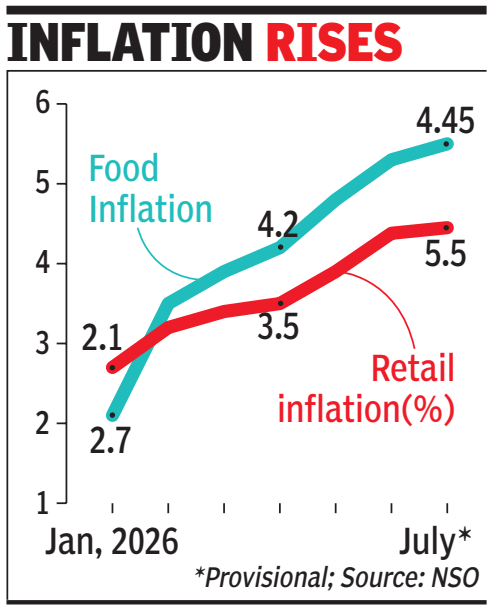
NEW DELHI: India’s retail inflation, measured by the Consumer Price Index (CPI), saw an increase to 4.45% in July, primarily fueled by the rising costs of essential kitchen staples. This marks the second consecutive month that price inflation has remained above the Reserve Bank of India’s (RBI) median target, according to recently released government data.
The July figure represents a slight uptick from June’s retail inflation rate of 4.38%. Notably, this reading is the highest recorded since the new CPI series, which adopted 2024 as its base year, came into effect in January.
Transportation costs climbed to 4.4% from 4.3%, while restaurant prices saw inflation rise to 7.7% from 6.9%.
A deeper dive into the data from the National Statistics Office (NSO) reveals that food inflation significantly contributed to the overall rise, increasing to 5.52% in July from 5.32% in the previous month. Specific commodities saw particularly sharp spikes. Inflation in onions surged dramatically to 22.54% in July, a substantial leap from 4.73% in June. Similarly, the rate of price increase for ginger shot up by an alarming 83.62%, and garlic also experienced a significant rise in its price index.
Conversely, some food items offered a measure of relief, with inflation in potatoes, ladyfinger, peas, and tomatoes remaining in negative territory, indicating a fall in their prices.
Earlier this month, Reserve Bank Governor Sanjay Malhotra acknowledged that the higher inflation was predominantly attributable to fuel and food prices. He noted that there were, so far, few signs of a widespread generalization of price pressures across the economy. Furthermore, core inflation, which excludes volatile precious metals, continues to demonstrate benign trends.
Governor Malhotra had previously projected that headline inflation would likely continue its ascent in the near term, peaking in Q3 of the 2026-27 fiscal year. This anticipated peak is primarily due to persistent food and fuel price pressures, with moderation expected thereafter. The central bank has set its CPI inflation projection for 2026-27 at 5%, a marginal decrease from its June estimate.
The government has tasked the Reserve Bank of India with maintaining retail inflation at 4%, allowing for a permissible fluctuation of 2% on either side.
Further analysis of the NSO data highlights a notable disparity between urban and rural inflation rates. While the national average retail inflation stood at 4.45% (provisional) in July, rural areas experienced a higher CPI rate of 4.84%, compared to 3.96% in urban centers. This suggests that price pressures are more acutely felt in rural India, a trend observed in previous months as well.
Geographically, Telangana recorded the highest inflation rate at 6.32% in July, whereas Mizoram registered the lowest at 1.84%, according to the NSO findings.
Commenting on the latest figures, Dipti Deshpande, Senior Director and Principal Economist at Crisil, noted that “July brought some relief on the inflation front as food inflation saw a slower rise and non-food inflation remained steady.” This suggests that while food prices continue to be a concern, the broader inflationary environment might be showing early signs of stability in other sectors.