









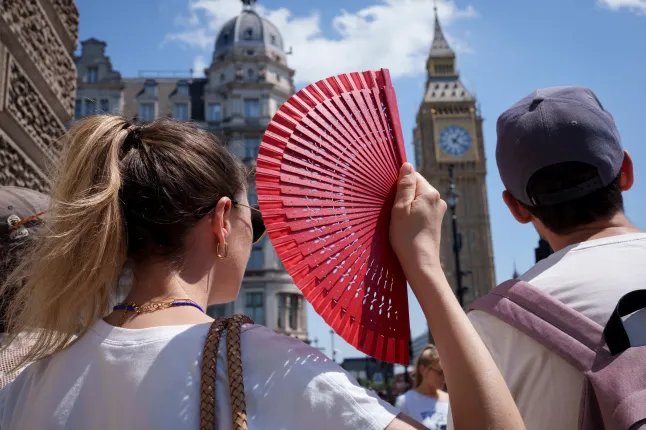
The blistering June heatwave that forced the UK to its knees has hardly passed when another one may be lurking around the corner.
Temperature records were smashed on three consecutive days last week, while people endured travel disruption on the railways and at Heathrow and Gatwick as the sweltering spell gripped western Europe.
The 37C conditions bit especially deep in cities like London and Paris, amplified by concrete, narrow streets and badly insulated homes turning into heat traps.
Over 1,300 excess deaths were linked to the latest hot spell on the continent, and at least seven people drowned in the UK’s open waters.

Sign up for all of the latest stories
Start your day informed with Metro’s News Updates newsletter or get Breaking News alerts the moment it happens.
Temperatures in the UK topped those in Death Valley last week, one of the hottest places on Earth.
And extreme weather is set to be the new normal, driven by climate change that could see average global temperatures rise more rapidly than predicted.
What can be done to stop heatwaves?
It all comes down to adapting and mitigating, while not taking our eyes off the main culprit, climate change and fossil fuel dependency, Jim Dale, the founder of the British Weather Services, said.
He told Metro: ‘Heatwaves have happened since time immemorial, but they are exacerbated by climate change – 35C becomes 37C, and 37C becomes 40C, that’s what we have had with these plumes.’
To adapt and mitigate, the focus needs to be on big cities where the heat is felt the strongest, and educating all sections of society because this is ‘the end of the world as we know it’ as temperatures continue to surge, he said.
Painting houses white to reflect heat, ultra-low emission zones to target pollution from fossil fuels like in London, and increasing green canopy coverage for natural protection will go some way to help, Mr Dale said.
But air conditioning and using AI for new renewable solutions can be ‘a catch-22’ as they can release more emissions back into the air if powered by fossil fuels.
Meanwhile, the fight against climate change is focused on the 1.5C target, a threshold to limit the average greenhouse gas effect and global warming on average.
How do you feel about potentially having another heatwave this weekend?
-
Worried, I haven’t recovered from the last
-
I’m looking forward to it, the hotter the better
-
I don’t mind either way, the weather doesn’t affect me
However, Mr Dale warned that the dangerous tipping point of 2C is no longer a dystopian nightmare, driven by ongoing fossil fuel use, warming seas and melting glaciers.
It could be reached before the predicted 2050, bringing more deaths along with floods, droughts and food shortages, Mr Dale warned.
Met Office scientists say the UK reaching 45C regularly is a plausible scenario.
Professor Stephen Belcher, Met Office’s chief scientist, said phenomenon like the latest June heatwave have become more intense and likely due to ‘human induced climate change.’
‘To see temperatures like this in the UK in June is sobering. Events like this bring home the implications of climate change, with very high temperatures and humidity bringing significant health implications from heat stress, as well as impacts to a range of sectors such as transport, energy and water supply,’ he added.
London mayor Sadiq Khan revealed the city’s first heat emergency plan last week, inspired by the US desert city, Phoenix, and how it is coping with extreme heat.
When could another heatwave start?

If you were hoping for the summer heatwaves to be done with, brace for more – another warm weather front could be hitting the UK over the weekend and into next week.
At the moment, the UK can take a breath of fresh air as temperatures remain below 25C even in London and the South East, the area in the eye of the heatwave where a rare extreme heat warning was in place.
There will be patches of rain in northern England and Scotland over the next couple of days.
Weather forecast this week after UK heatwave
The Met Office forecasts a turn into warmer weather again from Wednesday, with dry and bright for most, while the west and north will see spells of rain and average temperatures.
A high-pressure area will linger from the Azores in the Atlantic at the end of the week, and it could settle over the UK and western Europe this weekend and early next week.
While exact predictions will take shape later, early modelling is showing temperatures in London and the surrounding areas could reach 30C by Tuesday.
However, the areas most desperate for rainfall in the south will remain dry, risking drought and another hosepipe ban or the Kent ban being extended, Mr Dale said.
The majority of Kent is under an official hosepipe ban until Friday to preserve the water supply, and breaking it carries a fine of up to £1,000.
The heatwaves we are seeing are not ‘a one-off’ and they are becoming more frequent and intense, Mr Dale said.
‘We are not a tropical climate, but we are vying with desert worlds, so you know there’s something not right,’ he added.
Get in touch with our news team by emailing us at webnews@metro.co.uk.
For more stories like this, check our news page.
MORE: Two boys found dead at British air base after ‘being left to sleep’ in hot car
MORE: Best anti-chafing products for summer 2026 – stay sweat-free in the heat
MORE: UK heatwave latest: Weather maps show when next hot spell will hit UK