





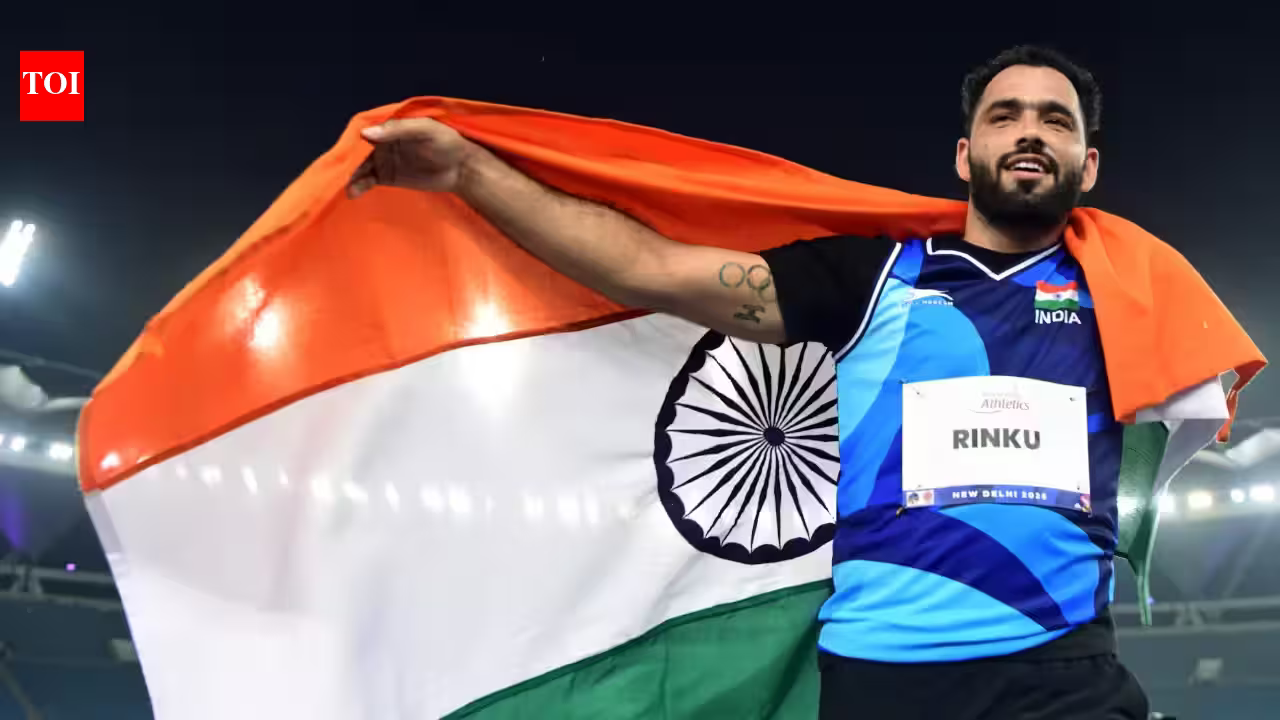
HANGZHOU — In the world of high-performance athletics, success is typically measured in meters, seconds, and points. But for Indian para-javelin thrower Rinku Hooda, the gold medal he secured at the Asian Para Games represented something far more profound: a sacred promise kept amidst the deepest personal sorrow.
As Hooda stepped into the arena, the weight of the competition was amplified by the absence of his greatest supporter. His mother, who had been the bedrock of his career, passed away on August 8. While the scoreboard would eventually show a winning distance of 65.11 meters, the victory lap was run for a much higher purpose.
“I was a little disturbed in the last two months,” Hooda admitted, his voice reflecting a quiet, lingering ache. “My mother passed away in August. I am still disturbed. It is okay from the outside, but it is not the same inside. I wanted to win this gold medal for my mother. So, I would like to dedicate this gold to her.”
## A Race Against Grief and Injury
The timeline of Hooda’s preparation for the Games was nothing short of heroic. Following the mandatory 13-day mourning period after his mother’s death, Hooda returned to the Rajiv Gandhi Stadium in Rohtak on August 19. The transition from bereavement to high-intensity athletic training was grueling, compounded further by a physical setback that nearly derailed his campaign.
During his training block, Hooda sustained a Grade 1 shoulder tear, an injury that forced him to halt all activity for three weeks. In the fragile, precision-based world of javelin throwing, such an injury can be career-altering. Yet, through disciplined rehabilitation and protective taping, Hooda managed to heal just in time for the continental showdown.
“I had an injury on my shoulder, a Grade 1 tear,” Hooda explained. “Then I rested for around 20 days. I have fully recovered. I still use taping as a precaution, but I didn’t feel any pain when it mattered most.”
On the field, that resilience proved absolute. In a high-stakes duel, Hooda narrowly edged out his compatriot, Ajeet Singh, who secured the silver with a throw of 65.02 meters. Indonesia’s R. Saktyono rounded out the podium with a 55.30-meter effort. For Hooda, the nine-centimeter margin between gold and silver was the culmination of a summer defined by grit.
## From the Farm to the Global Stage
Hooda’s path to the gold medal podium is a testament to the power of human spirit. Born into a modest farming family, his life was forever altered at the age of three when he lost his left arm in a horrific accident involving a paddy-sowing machine. Rather than being defined by his amputation, Hooda leaned into the challenge.
His early days were spent assisting his father on the farm, a demanding labor that likely forged the raw, functional strength he would later translate into technical excellence. His talent was eventually spotted and nurtured by Amit Kumar Saroha, a titan in Indian para-athletics who recognized the fire in the young athlete’s eyes.
Hooda’s trajectory has been one of consistent, upward mobility. Since his international debut at the 2015 Youth Asian Games, he has evolved from a raw, promising talent into a battle-tested veteran. Having competed in the 2016 Rio Paralympics at just 18, he has spent nearly a decade accumulating accolades, including bronze at the 2018 Asian Para Games and a world title in 2025.
The F46 category—designed for athletes with upper-limb impairments—has become his domain, one he dominates with a blend of power and a technical refinement that belies the physical limitations of his event.
## The Eyes Set on Los Angeles
With the Asian Para Games gold now secured, the narrative of Hooda’s career enters its next chapter. While his continental and world-level achievements have cemented his status as a star in para-athletics, a glaring hole remains in his trophy cabinet: a Paralympic medal.
After finishing a heartbreaking fifth at the 2024 Paris Paralympics, Hooda’s focus has shifted entirely toward the 2028 Los Angeles Games. He views his previous near-misses not as failures, but as necessary fuel for his final evolution as an athlete.
“I have not won a medal in the Paralympics,” Hooda said. “So, that is my target now. I will focus more on that. The qualification for the 2028 Paralympics will start five to six months before the Games.”
For a man who has already overcome the loss of a limb and the loss of a parent, the road to Los Angeles is not daunting—it is a destination. If his performance at the Asian Para Games is any indication, the rest of the world should take notice: Rinku Hooda is not just competing for hardware anymore; he is competing for a legacy. And after the performance he delivered in the face of such profound adversity, betting against him would be a fool’s errand.
Disclaimer: This content is auto-generated for informational purposes only.
Source: Read Original News