








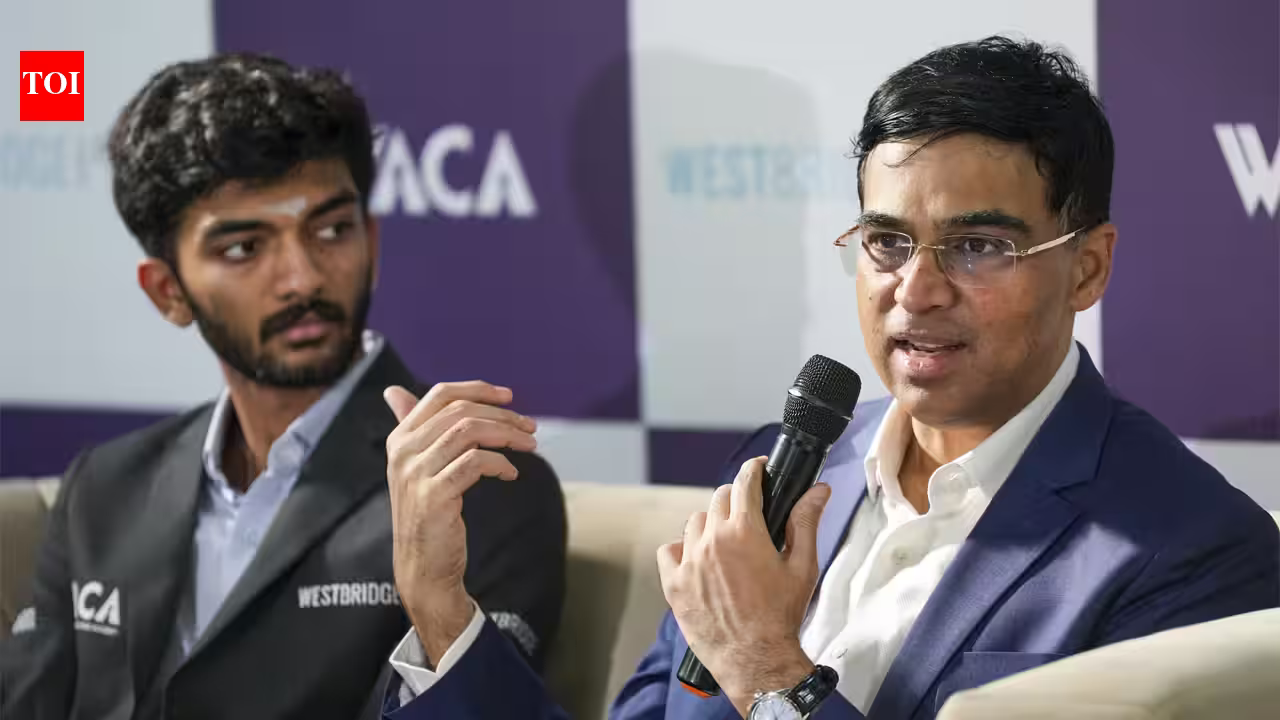
BUDAPEST — As the chess world readies itself for a seismic showdown in Geneva, the sage of Indian chess, Viswanathan Anand, has offered a piece of quintessential advice to his protégé and reigning World Champion, Gukesh Dommaraju: put down the anxiety and breathe.
With the World Chess Championship match against the formidable Uzbek challenger Javokhir Sindarov looming on the horizon, the pressure is reaching a fever pitch. Yet, amidst the intensity of preparations, the five-time world champion is urging the young phenom to prioritize mental equilibrium over relentless obsession.
“I have told him that sometimes it’s better to let go and just relax because no amount of worrying is going to fix some things,” Anand remarked on the sidelines of the Total Chess pilot event in Budapest this past Thursday. The veteran grandmaster, who has served as a mentor to Gukesh for more than half a decade, noted that this specific counsel has been a recurring theme in their mentorship.
A Mature Transition Beyond Mentorship
While the chess community is quick to point to Anand’s strategic guidance as the bedrock of Gukesh’s rapid ascent to the pinnacle of the sport, the “Tiger of Madras” remains characteristically humble. Observing Gukesh’s evolution, Anand noted that the 20-year-old displays a significantly calmer demeanor than he did two years ago when he first claimed the world title.
However, Anand is quick to deflect the praise for this newfound serenity away from his own coaching. “I’m going to give credit to his body,” Anand said with a wry smile. “He went from a teenager to 20, and that probably played a bigger part than my advice.”
It is a sentiment that underscores the rapid maturation process required for modern chess superstars. As the lines between coaching and independent development blur, Anand emphasizes that while he and Uzbek legend Rustam Kazimdzhanov—who mentors Sindarov—are often cited as the architects of the new wave, the players themselves are navigating an era defined by high-powered silicon.
“I’m more careful in taking credit for all sorts of things,” Anand admitted. “I think the youth trend is very strong, and computers play a very big part. But somebody with some wisdom or experience telling you this is how you can deal with things is useful.”
The Sindarov Factor: A Clash of Prodigies
The upcoming Geneva match is being billed as a clash of the “second generation,” with Gukesh and Sindarov both representing the fruits of elite mentorship. The narrative of “Anand’s children” versus “Rustam’s children” has taken hold, reflecting how profoundly the two grandmasters have shaped the competitive landscapes of India and Uzbekistan respectively.
Sindarov, also 20, arrives in Geneva with a pedigree of rigorous training and the tactical sharpness synonymous with the Uzbek school of chess. For Gukesh, the challenge is not merely technical but psychological. He faces a peer who possesses equal access to the same technological tools and high-level training environments that propelled Gukesh to his own championship win.
Tightening the Rules: A Call to Professionalism
Beyond the championship build-up, the elder statesman of the game found time to address a growing controversy within the competitive circuit: the trend of players forfeiting “dead rubber” matches. Recent high-profile instances, involving players such as Magnus Carlsen, have sparked intense debate over the integrity of tournament play.
Anand was unequivocal in his disapproval. “I wouldn’t even have realized that it was possible to do such a thing,” he asserted. “It’s a game day and I will go and play. I would have complained, but I wouldn’t have done this.”
Anand suspects that a loophole in the current rulebook is being exploited, creating a scenario where players might prioritize their energy reserves over their contractual obligations to complete a tournament. “Those rules are something we’ll have to tighten,” he insisted, signaling a likely push from the game’s governing bodies to ensure that future matches are played out in full, regardless of the mathematical implications for the standings.
Innovation in the Air: The Total Chess Initiative
The event in Budapest served as more than just a press engagement; it offered a glimpse into the future of the game. Discussing the “Total Chess” concept, Anand expressed genuine enthusiasm for the format’s potential to revitalize the spectator experience.
“It’s a fascinating idea,” Anand noted. “It allows us to experiment with a couple of things—one is to see how much faster you can make Classic. At the same time, combining disciplines in a single day is a very interesting idea. And this gives us the chance to test all that.”
As the clock ticks down to the Geneva match, all eyes will be on Gukesh to see if he can internalize his mentor’s advice. If he can balance the relentless analytical demands of modern computer-backed prep with the simple, human need to “let go,” he may very well solidify his reign at the top of the chess world. But in the ultra-competitive landscape of professional chess, where every move is scrutinized by algorithms, finding that space to breathe might be the most difficult opening move he has ever had to make.
Disclaimer: This content is auto-generated for informational purposes only.
Source: Read Original News