








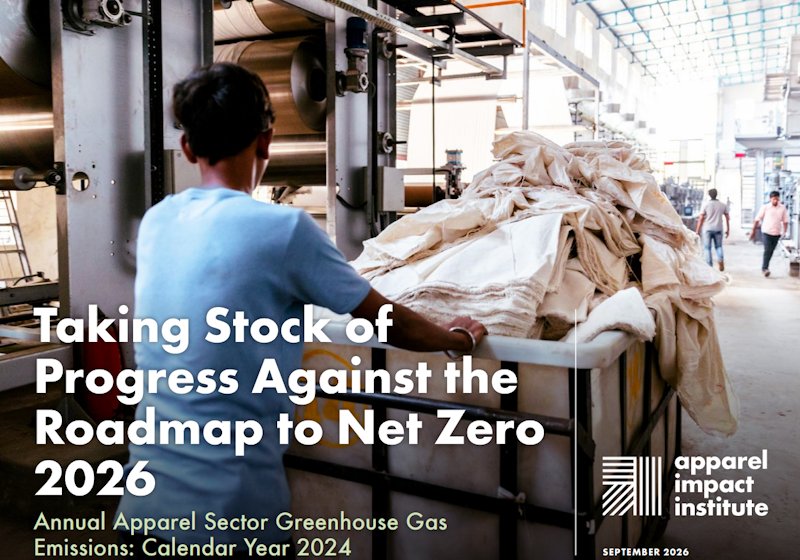
Apparel Emissions Rise as Fiber Production Surges, New Report Finds
The global fashion industry’s carbon footprint has climbed to 1.004 gigatonnes in 2024, highlighting a deepening crisis despite isolated successes in decarbonization efforts.
A sobering new report from the Apparel Impact Institute (Aii) reveals that the sector’s environmental impact remains on an upward trajectory. While individual companies and manufacturing hubs have made measurable strides in transitioning away from coal, implementing renewable energy solutions, and improving operational efficiency, these gains have been systematically outpaced by the sheer volume of global fiber production.
The findings underscore a fundamental challenge facing the industry: the “rebound effect,” where improvements in production efficiency are being neutralized by the industry’s relentless drive for higher output. As consumer demand for apparel continues to climb, the aggregate growth in fiber consumption is effectively canceling out the emission reductions achieved through greener manufacturing technologies.
A Tug-of-War Between Efficiency and Scale
The Aii report paints a complex picture of a sector caught in a tug-of-war. On one hand, the adoption of clean energy in textile processing has accelerated. Investments in solar, wind, and energy-efficient machinery are becoming more common in key manufacturing regions such as Southeast Asia and India.
However, these gains are being dwarfed by the industry’s massive reliance on synthetic fibers and the ever-shortening lifecycle of garments. With apparel emissions now officially topping one gigatonne annually, stakeholders are being urged to pivot from mere “efficiency” strategies to broader systemic changes.
The Path Forward
The report suggests that technological interventions—while necessary—are insufficient on their own. The Aii argues that the industry must confront the issue of overproduction and the reliance on fossil-fuel-derived materials if it is to have any hope of meeting global climate targets.
For many brands, the data serves as a wake-up call that current sustainability roadmaps may be misaligned with the reality of market growth. As legislative pressure mounts from regions like the European Union regarding circular economy mandates, the fashion industry faces a narrow window to decouple economic growth from carbon intensive production.
The report concludes that without a drastic reduction in total fiber volume and a radical transformation in business models—shifting away from the high-turnover “fast fashion” paradigm—the industry’s carbon footprint will continue to drift further away from the trajectory required to limit global warming to 1.5°C.