







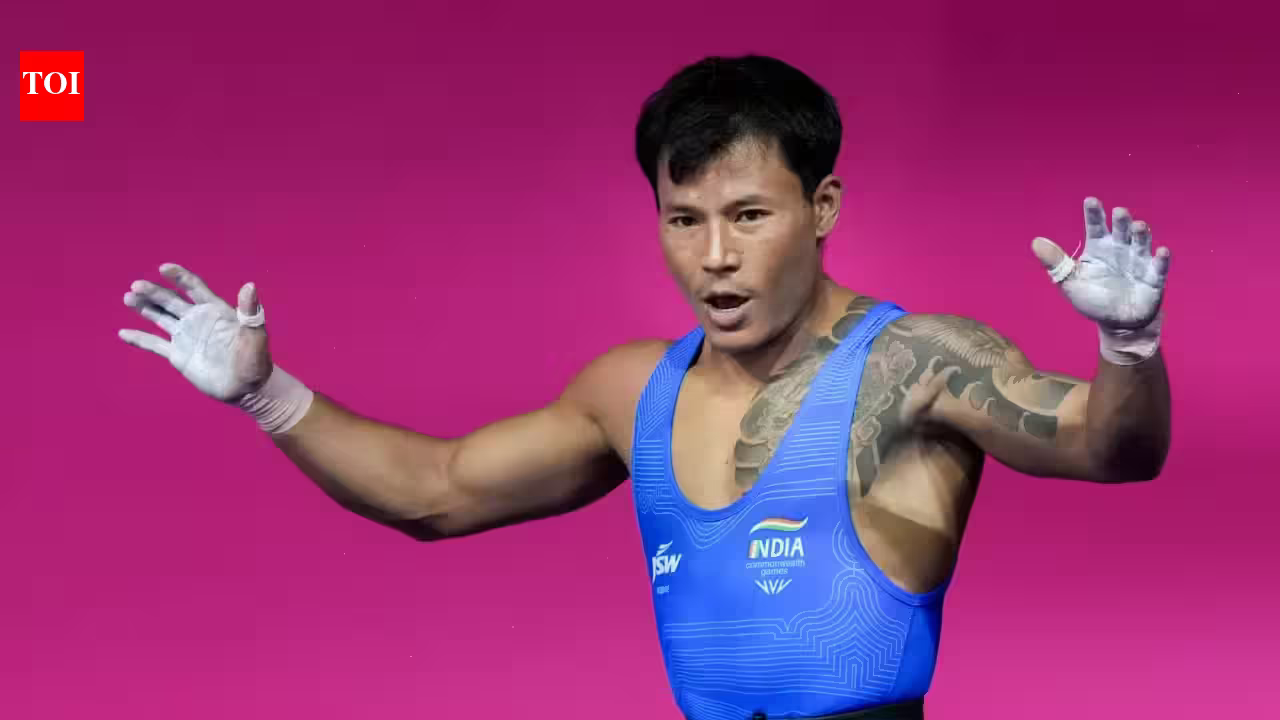
Kolkata: The landscape of India’s weightlifting contingent for the upcoming Asian Games has suffered a significant blow. Manipur’s rising star, Rishikanta Singh Chanambam, has officially been ruled out of the continental showpiece event due to a persistent and debilitating knee injury. The withdrawal comes as a crushing disappointment for the 21-year-old athlete, who had established himself as a primary medal contender following his impressive silver-medal performance at the Commonwealth Games in Glasgow.
The Asian Games, scheduled to be held in Aichi Prefecture and Nagoya, Japan, from September 19 to October 4, will now proceed without the presence of the man who was set to be the sole male representative for India in the weightlifting arena.
A Hidden Struggle Behind the Medal
Speaking candidly to the press from his home in Manipur on Wednesday, Rishikanta revealed that the physical toll of his sport had been mounting for some time, even predating his Commonwealth Games appearance.
“I had been dealing with pain on the left side of my knee even during the Commonwealth Games,” Rishikanta admitted. “I really wanted to compete in the Asiad too because it’s a big competition for me, but I couldn’t manage it. The pain became a hurdle I simply couldn’t overcome to perform at the level required for international competition.”
Following his return, a thorough medical consultation confirmed his fears. He was diagnosed with a muscle imbalance on his left side, a condition that left him with no choice but to prioritize his long-term health over immediate participation. “Right now, I’m focusing entirely on my recovery,” he added, his voice reflecting the frustration of a competitor sidelined at his peak.
Reflecting on Glasgow and What Might Have Been
Rishikanta’s exit from the Asian Games squad marks a somber turning point in a year defined by high-stakes performance. His performance in Glasgow served as a major validation of his talent, yet even in the wake of that silver-medal triumph, the weightlifter expressed a sense of “what if.”
In the men’s 60kg competition in Glasgow, the battle for the top spot was fierce. Malaysia’s Bin Kasdan Mohamad Aniq ultimately claimed the gold with a Games-record total of 273kg. Rishikanta, fighting through the discomfort, posted a respectable total of 264kg. While he showcased elite potential by equalling Bin Kasdan’s 121kg snatch, the injury manifested in the clean and jerk portion of the event. While the Malaysian athlete powered through for 152kg, Rishikanta’s output stalled at 143kg.
Reflecting on those results, Rishikanta had previously noted that he was confident he would have secured the gold medal had he been at 100% physical fitness. The missed opportunity to test his strength against the best in Asia in Japan will undoubtedly weigh heavily on him as he undergoes rehabilitation.
The Road Ahead for India’s Weightlifters
With Rishikanta’s withdrawal, India’s weightlifting squad for the Asian Games has been trimmed to four athletes, all representing the women’s categories. The team now rests on the shoulders of the seasoned Mirabai Chanu (49kg), alongside Gyaneshwari Yadav (53kg), Seram Nirupama Devi (61kg), and Harjinder Kaur (69kg).
The team enters the Japan Games with a clear mandate to improve upon the performance of the previous edition. At the last Asian Games, India fielded a two-member team featuring Mirabai Chanu and Bindyarani Devi. Despite their world-class credentials, both narrowly missed out on the podium—Mirabai finished a heartbreaking fourth in the 49kg category, while Bindyarani secured a fifth-place finish in the 55kg weight class.
The Indian contingent will be looking for redemption this time around, though the absence of Rishikanta limits the nation’s overall medal prospects in the male categories. For the Indian weightlifting federation, the focus now shifts toward ensuring that the remaining squad members are at their peak for the rigorous demands of the Aichi-Nagoya platform.
Recovery and Future Aspirations
At just 21 years old, Rishikanta Singh remains a cornerstone of the future of Indian weightlifting. While the setback of missing the Asian Games is substantial, the sporting community remains optimistic about his long-term trajectory. Muscle imbalances and knee injuries are frequent, albeit difficult, hurdles in the careers of power athletes, and a disciplined recovery period could be the difference between a fleeting career and a legendary one.
“He has the heart of a champion,” one team insider noted. “The goal now is to get him back to the gym stronger, balanced, and ready for the next cycle of international competition.”
As the rest of his teammates finalize their preparations for the trip to Japan, Rishikanta will be watching from the sidelines, committed to his rehabilitation program. For a young man who has already tasted success on the Commonwealth stage, the sting of being left out of the Asian Games is profound, but it is likely to serve as the fuel for his eventual return. The path back to the podium begins in the physiotherapy room, and if his previous performances are any indication, Rishikanta Singh is not an athlete to be counted out for long.
Disclaimer: This content is auto-generated for informational purposes only.
Source: Read Original News