







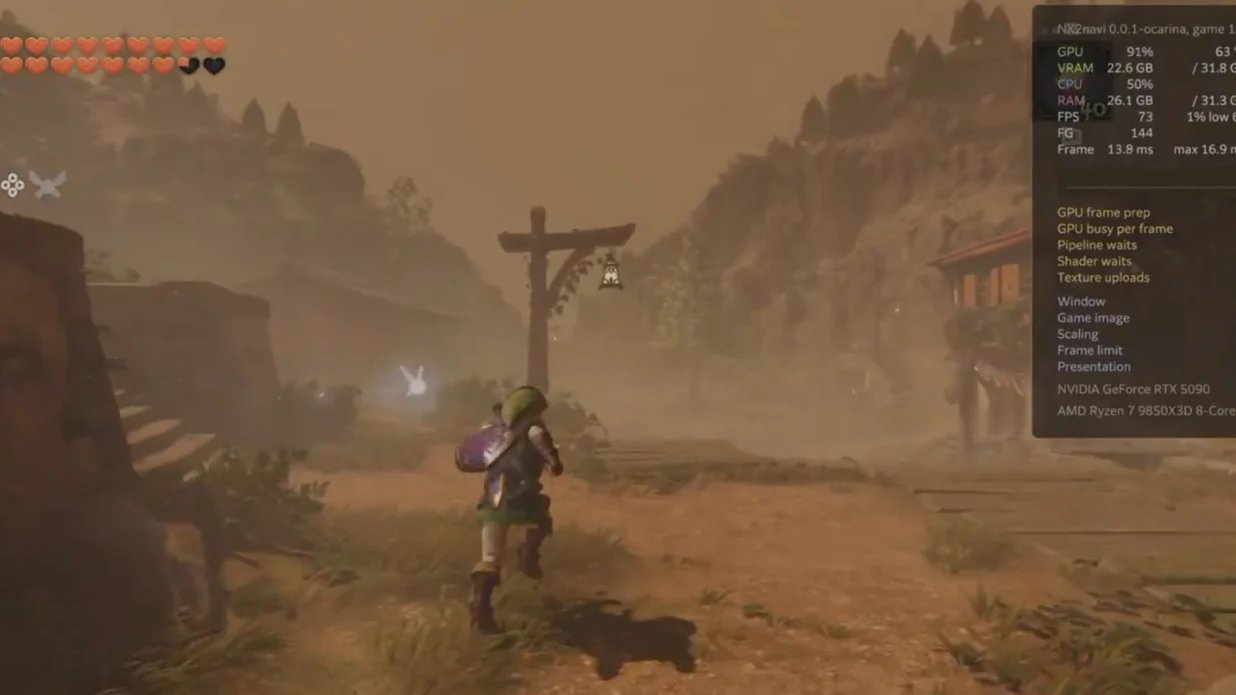
The release of The Legend of Zelda: Ocarina of Time on the Switch 2 platform has sparked significant interest among the PC gaming community. In a notable development, a fan-driven project known as NX2navi has introduced a method to run the title natively on Windows. Unlike traditional emulators, which translate console instructions during real-time gameplay, NX2navi utilizes static recompilation to transform the game’s code into a format directly executable by a PC.
Understanding Static Recompilation Versus Emulation
The primary technical distinction between NX2navi and traditional console emulators lies in how they interact with the game’s original instructions. Emulators act as an interpreter, reading console-specific code and translating it into PC-compatible language while the game is running. This overhead often leads to performance bottlenecks, stuttering, and varying degrees of input lag, as seen in early attempts to run the Ocarina of Time remake using the Lichii emulator.
Conversely, NX2navi operates as a static recompiler. It performs a one-time conversion of the game’s executable files into an x86-64 Windows application. By translating the instructions ahead of time, the game essentially runs as a native PC application rather than a guest process inside a simulated environment. This approach allows for significantly improved stability and efficiency, enabling the title to leverage PC hardware directly rather than relying on complex emulation layers.
Technical Capabilities and Visual Enhancements
Because the game runs as a native Windows executable, the NX2navi project unlocks several high-end graphical features that are typically unavailable on the native Switch 2 hardware. The project utilizes the Vulkan renderer, which provides a high-performance foundation for modern PC graphics cards.
Players can access a range of display improvements, including rendering resolutions up to 4K and 5K. The project includes support for advanced upscaling technologies: NVIDIA DLSS (Deep Learning Super Sampling) for RTX-series graphics cards and AMD FSR 3.1 (FidelityFX Super Resolution) for broad compatibility across various hardware manufacturers. Additionally, users can enable HDR (High Dynamic Range) for improved color depth and lighting, along with native support for ultrawide monitor aspect ratios.
Performance is another primary focus of the project. While the game is capped at 60 FPS by default to maintain stability, users have the capability to manually adjust this threshold. The project supports frame rates up to 240 FPS or, in some configurations, an entirely unlocked frame rate. These capabilities provide a degree of fluidity and visual clarity that far exceeds the base console experience.
System Requirements and Setup Process
To utilize NX2navi, users must possess a legitimate copy of the game, as the project does not include any game files. The process requires a legal dump of Ocarina of Time version 1.1.1 obtained from the user’s own hardware. Once the files are acquired, the NX2navi launcher initiates a compilation process that takes between 10 and 25 minutes. During this time, the software parses the data to produce the final Windows-compatible build.
The hardware requirements for running the recompiled game are reflective of modern PC standards. A system running Windows 10 or later, equipped with at least 16GB of RAM and approximately 30GB of available storage space, is necessary. From a graphics standpoint, the software demands a GPU that supports Vulkan 1.3 and active mesh shader support. These requirements ensure that the system can handle the complex geometry and rendering tasks associated with the updated version of the game.
Current Limitations and Development Status
Despite the impressive technical achievements of the NX2navi project, it remains in the early stages of development. The creators have noted that users should expect intermittent visual bugs, glitches in specific assets, and potential application crashes during gameplay. Because the project is an unaffiliated fan-led initiative, there is no formal support structure, and improvements are contingent upon the work of independent contributors.
Furthermore, the project represents a significant shift in how players interact with modern console releases on PC. By enabling native execution, projects like this challenge the traditional necessity of hardware emulation. This development has invited speculation regarding how console manufacturers, such as Nintendo, might respond to the accessibility of their software in non-console environments. As of now, the project remains a curiosity for enthusiasts interested in the technical intersection of console software and PC hardware performance, though its long-term viability and the legal implications of such recompilation projects remain subjects of ongoing discussion within the technology industry.
Disclaimer: This content is auto-generated for informational purposes only.
Source: Read Original News