





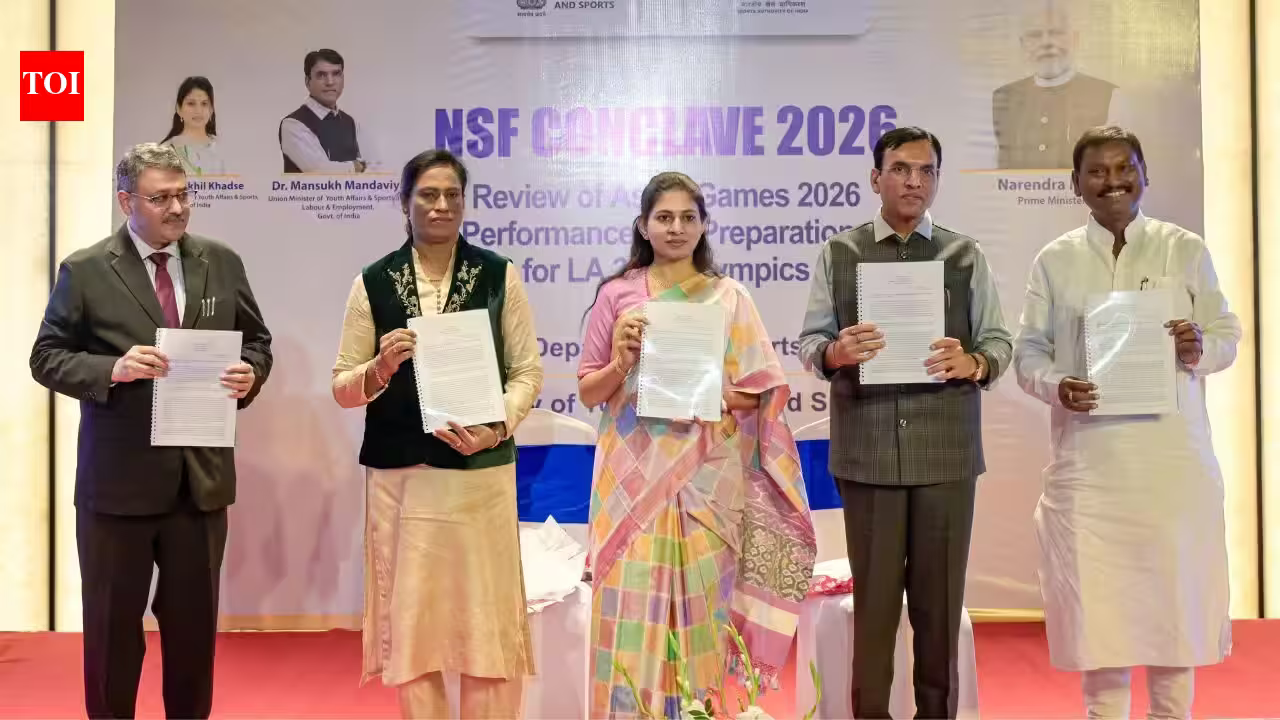
NEW DELHI: The euphoria of India’s 85-medal finish at the 2026 Aichi-Nagoya Asian Games has been quickly tempered by a sobering reality check. In a high-stakes review meeting held this Thursday, the Sports Ministry turned the spotlight on the country’s underperforming disciplines, demanding accountability from National Sports Federations (NSFs) and calling for a radical shift in how India nurtures its elite talent.
The review, spearheaded by Sports Minister Mansukh Mandaviya, was attended by Minister of State for Sports Raksha Khadse, Indian Olympic Association (IOA) President P.T. Usha, and Sports Secretary Hari Ranjan Rao. The tone was set early: while India remains a continental powerhouse, the regression from the 106-medal haul in Hangzhou to 85 in Aichi-Nagoya is a trend the government is no longer willing to ignore.
The “Mirabai Chanu” Benchmark: A Call for Depth
Perhaps the most poignant moment of the meeting came when Minister Mandaviya addressed the reliance on legendary figures to carry the weight of the nation’s expectations. Using weightlifting icon Mirabai Chanu as the standard-bearer, the Minister emphasized that a sporting superpower cannot be built on the shoulders of a few singular athletes.
“How long will Mirabai Chanu alone keep winning medals for us?” Mandaviya asked, challenging the federation heads present. “We need to produce 10 more Mirabai Chanus. Every federation must take this responsibility seriously. We have to identify talent, provide the right training, and create an environment in which athletes can progress to the highest level.”
The message was clear: India’s current sports ecosystem is overly dependent on veteran stars, and there is an urgent need to build a robust, continuous pipeline of talent that can step into the breach when champions retire or falter.
Injury Concerns and Performance Analytics
A significant portion of the meeting was dedicated to the physical integrity of India’s athletes. Recent reports regarding the fitness of high-profile track and field stars—including hurdler Jyothi Yarraji and triple jumper Praveen Chithravel—were brought to the forefront. P.T. Usha, acting on performance data presented by Athletics Federation of India (AFI) advisor Adille Sumariwalla, highlighted the recurring issue of injuries surfacing precisely when athletes arrive at the host city.
The skepticism surrounding athlete fitness extended to middle-distance runner Avinash Sable. After a lackluster showing in the 3000m steeplechase, Sable failed to start the 5000m event. Given his status as a defending champion and a previous silver medalist in the 5000m at Hangzhou, his absence raised serious questions about the depth of recovery and management protocols within the national camp.
The statistics for athletics were particularly damning: the gold medal count in the discipline plummeted from six in the previous iteration to just one in Aichi-Nagoya, with a total haul five medals lighter than the previous cycle.
Badminton and the Challenge of Scheduling
Badminton also faced harsh scrutiny, managing only a solitary bronze medal in the men’s team event. The early exit of men’s doubles stars Satwiksairaj Rankireddy and Chirag Shetty was cited as a major disappointment. While the federation pointed toward a grueling international calendar that forced players into multiple matches within 24 hours, the Ministry remained firm: the responsibility lies with the NSFs to navigate these logistical hurdles and ensure athletes are physically prepared for the demands of the modern tour.
Interestingly, the Boxing Federation of India (BFI) found itself in a unique position. Despite the sport achieving a landmark haul of three gold medals, the underlying administration—currently paralyzed by an internal power struggle between President Ajay Singh and Secretary Pramod Kumar—remains a ticking time bomb. While the Ministry avoided delving into the administrative infighting during this particular session, it is clear that such internal volatility is a hurdle that cannot be ignored for long if the boxing program is to sustain its current success.
Setting Sights on 2030 and Beyond
With the Aichi-Nagoya chapter closed, the Ministry is shifting focus toward the 2028 Los Angeles Olympics and the 2030 cycle, which includes the Doha Asian Games and the Commonwealth Games to be hosted on Indian soil.
Sports Secretary Hari Ranjan Rao laid out an ambitious roadmap for the coming years, challenging the federations to treat the 2030 Commonwealth Games as a “national challenge.” The goal is twofold: break India’s 2010 medal record and cement a top-three finish in the medal tally.
“We must treat this as a challenge and work towards it from now,” Rao stated.
To bridge the gap between potential and podium finishes, the Ministry has mandated a shift in infrastructure and support. Mandaviya urged the federations to invest heavily in sports psychology and high-performance mental training, noting that many Indian athletes succumb to the pressure of the big stage, losing focus when it matters most.
As the NSFs return to their respective headquarters, the message from the Ministry is undeniable: the days of accepting “participation” as success are over. The government is demanding institutional accountability, better injury management, and, above all, the systematic development of the next generation of champions. The road to 2030 begins now, and for India’s sports federations, there is no more room for excuses.
Disclaimer: This content is auto-generated for informational purposes only.
Source: Read Original News