







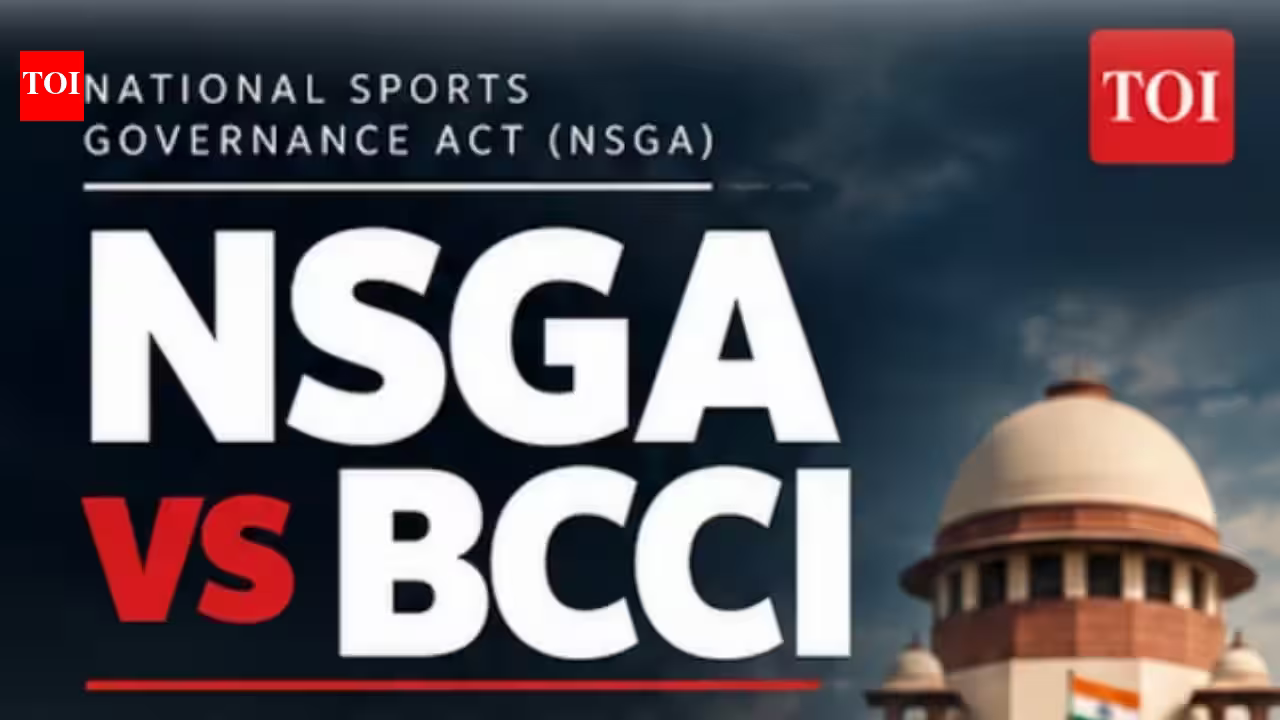
NEW DELHI – The future of Indian cricket governance stands at a pivotal crossroads as the Supreme Court of India initiates a high-stakes inquiry into the jurisdictional reach of the National Sports Governance Act (NSGA) 2025. In a move that threatens to disrupt the status quo, a bench comprising Chief Justice Surya Kant, Justice Joymalya Bagchi, and Justice V. Mohana has formally demanded that the Board of Control for Cricket in India (BCCI) and its affiliated state units justify why they should not be brought under the purview of the new federal legislation.
The judicial intervention comes amidst growing friction within state cricket associations, where internal factionalism and disputes over constitutional adherence have led to a flurry of litigation. At the heart of the current standoff is the Odisha Cricket Association (OCA), which recently deferred its internal elections, citing the need to evaluate the impact of the NSGA—a position the BCCI has vehemently countered.
The “Designated Sport” Ambiguity
The BCCI’s primary defense has been rooted in a technicality: the sport of cricket has not yet been notified by the Central Government as a “designated sport” under the NSGA. Consequently, the Board maintains that it remains outside the Act’s statutory framework.
Legal expert Aahna Mehrotra, founder of AM Sports Law & Management Co., notes that the “designated sport” status is the crucial trigger that activates the entire machinery of the National Sports Board (NSB) and the National Sports Tribunal (NST). “Under the Act, the government, through the Ministry of Youth Affairs and Sports, has the executive power to notify sports discipline-by-discipline,” Mehrotra explains. “Until cricket is formally designated, the BCCI is not a National Sports Federation (NSF) in the eyes of the new statute, leaving it outside the NSB’s oversight.”
However, this argument is now being challenged at the highest level. The Supreme Court’s order on September 9, 2026, signals that the judiciary is no longer content to wait for the glacial pace of executive notification. By questioning the BCCI directly, the Court is probing whether cricket’s entry into the statutory regime should be mandated by judicial decree rather than by the phased rollout planned by the government.
The RTI Factor: Will the BCCI Face Transparency?
One of the most persistent questions surrounding the BCCI—whether it should fall under the Right to Information (RTI) Act—remains tied to the “designated sport” debate, but with a significant caveat.
The final version of the NSGA, enacted in August 2025, ties the “public authority” status to the receipt of government grants. “Even if cricket were designated tomorrow, the BCCI would only become a public authority under the RTI Act if it accepted government funding,” Mehrotra clarifies. Since the BCCI operates on independent revenue streams, its current RTI exemption remains secure under existing legal frameworks, independent of the NSGA’s implementation.
The Clash of Frameworks: Lodha vs. NSGA
The current impasse is complicated by the fact that the BCCI is already operating under a strict, Supreme Court-mandated constitution born out of the historic Justice Lodha Committee reforms.
“The BCCI’s position—that it follows the Supreme Court-mandated constitution while the NSGA does not yet apply—is legally consistent,” says Mehrotra. “These are two separate legal triggers. However, the optics of the situation are increasingly precarious.”
As state associations like the OCA attempt to use the “wait-and-see” approach regarding the NSGA to delay elections, they face stern pushback. The BCCI has warned that such stalling tactics could lead to the withholding of funds or even derecognition. Observers note that this is a classic power struggle: incumbent officials may be using the ambiguity of the new law to entrench themselves, a tactic that failed during the initial implementation of the Lodha reforms when the Supreme Court utilized the Committee of Administrators to ensure compliance across states.
Judicial Intervention: The Only Way Out
With the Ministry’s own “notices” regarding the Act holding no statutory weight without formal notification, the legal landscape for cricket remains in a state of suspended animation. The Sports Ministry has itself signaled that elections should proceed under the existing Supreme Court-approved framework, further undermining the argument for deferral.
The path to resolution, according to legal analysts, lies entirely in the hands of the Supreme Court. While a formal government notification would be the cleanest structural solution, the judiciary is now the active arbiter. By forcing the issue, the Supreme Court is positioning itself to harmonize the new statutory regime with the existing Lodha-mandated architecture.
For the BCCI and its state units, the message is clear: the luxury of operating in a regulatory vacuum is rapidly vanishing. Whether the change comes through a government gazette or a final, binding judicial directive, the era of absolute internal autonomy for cricket’s governing bodies appears to be drawing to a close. As the Court continues its hearings, the sport finds itself at the edge of a new governance era—one where the divide between the boardroom and the law is set to be bridged once and for all.
Disclaimer: This content is auto-generated for informational purposes only.
Source: Read Original News