







For years, the popular imagination has painted the great white shark as a solitary, mindless predator lurking just beneath the surface, waiting for an opportunity to strike. However, drone footage captured by cinematographer Carlos Gauna—widely known as The Malibu Artist—is dismantling these long-held tropes, revealing a more complex, social, and often surprisingly gentle reality for these apex predators.
Gauna, who has spent years documenting the Southern California coastline from a bird’s-eye perspective, recently compiled his most significant observations into a retrospective that challenges the traditional narrative surrounding one of the ocean’s most feared creatures. Through the lens of his drone, Gauna has transitioned from mere observer to a critical contributor to marine science, documenting behaviors that were previously hidden from human view.
One of the most profound revelations in his catalog is the documentation of what is believed to be the youngest great white shark ever recorded on film. This sighting offers a rare glimpse into the early life stages of a species that remains shrouded in mystery, particularly regarding their nursery grounds. By capturing these juvenile specimens, Gauna provides researchers with invaluable data on habitat preferences and early behavioral patterns, helping to fill significant gaps in scientific understanding.
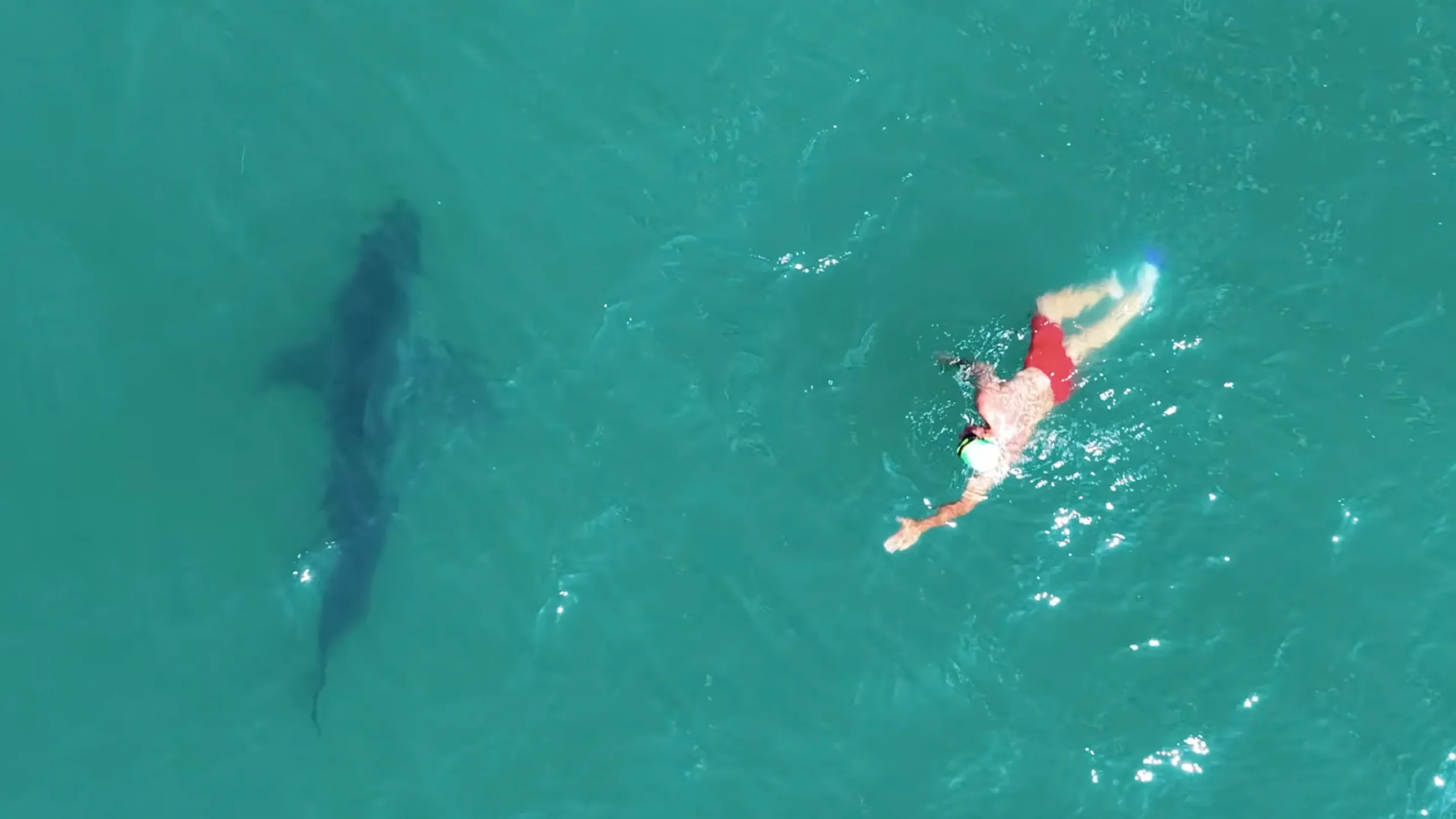
Beyond individual encounters, Gauna’s footage has highlighted the social nature of white sharks. His aerial surveys have captured large congregations of sharks, suggesting that their interactions are far more sophisticated than previously assumed. These gatherings, often occurring in relatively shallow coastal waters, underscore the frequency with which humans and sharks share the same space—frequently without the swimmers, surfers, or kayakers ever realizing they are in the company of a massive predator.
This juxtaposition of human activity and wild nature is a recurring theme in Gauna’s work. His footage serves as a stark, empirical reminder of the peaceful coexistence that defines most human-shark encounters. Far from the aggressive hunting scenes depicted in popular media, Gauna often records sharks navigating crowded beaches with remarkable indifference toward human presence. These moments have been instrumental in shifting public perception, moving away from a narrative of fear toward one of respect and conservation.
“Every once in a while, you capture something that changes everything,” Gauna noted in his recent compilation. “Something you know, even in the moment, you may never see again.”
For marine biologists, this archive is a treasure trove. The ability to monitor shark behavior without the intrusive presence of boats or divers allows for more naturalistic observations. By documenting these “secret lives,” Gauna is contributing to a broader movement in marine conservation that emphasizes the importance of protecting coastal habitats where these sharks congregate. Understanding these patterns is essential for effective coastal management and safety, as well as for the long-term protection of the species.
As technology continues to advance, the role of citizen scientists and specialized videographers like Gauna has become increasingly vital. Their work provides a bridge between rigorous academic research and public engagement, turning the abstract data of shark migration and behavior into visual stories that resonate with a global audience.
While the dorsal fin breaking the surface remains an iconic image that triggers a primal human reaction, Gauna’s work suggests that it is time for a re-evaluation. By peeling back the layers of mystery surrounding the great white shark, he is demonstrating that these animals are not the villains of the deep, but essential, intelligent, and often misunderstood components of a healthy ocean ecosystem. Through his drone’s lens, the ocean appears less like a place to fear and more like a vast, interconnected world that demands our curiosity and protection.
Disclaimer: This content is auto-generated for informational purposes only.
Source: Read Original News