






Beyond the Scoreboard: India’s Teqball Pioneers Make Their Asian Games Debut
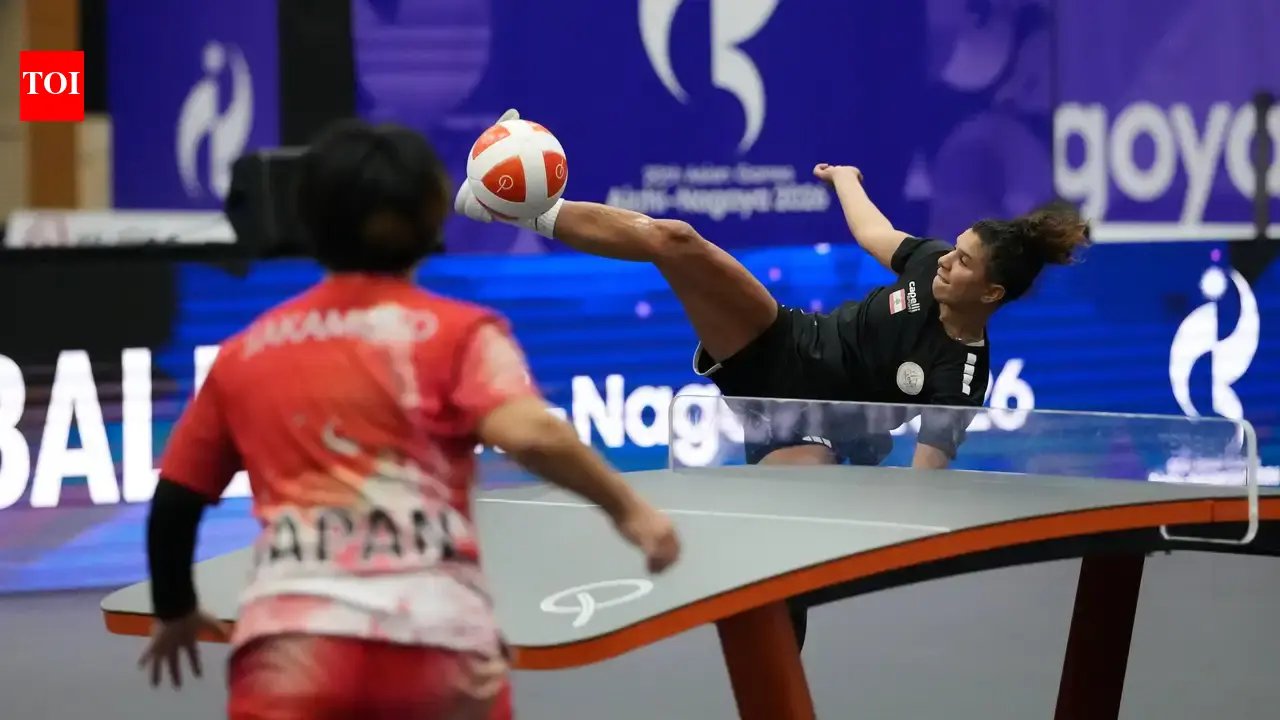
The Higashi Sports Centre in Nagoya witnessed a quiet but significant milestone for Indian sports this week. At 4:06 pm, with little fanfare and a modest audience, the Indian contingent officially stepped into the world of teqball—a high-energy fusion of football and table tennis that is making its inaugural appearance at the Asian Games. While the results on the opening day did not go in India’s favor, the atmosphere surrounding the event suggested that this was less about the final score and more about planting a flag for a burgeoning discipline.
A Steep Learning Curve on the Curved Table
Teqball, a sport birthed in Hungary just 12 years ago, presents a unique challenge: players must use their feet, knees, chest, or heads to send a ball over a curved table, mimicking the dynamics of table tennis but requiring the technical finesse of football. For the Indian men’s doubles pair of Declan Gonsalves and Mohamed Anas, the debut proved to be a trial by fire. The duo put up a valiant fight, falling 10-12, 8-12 to Vietnam and 4-12, 7-12 to South Korea.
Despite the early exit, the significance of the moment was not lost on the small, dedicated contingent of supporters in the stands. Among the spectators were Deputy Chef de Mission and former shooting icon Anjali Bhagwat, alongside Derek and Deborah Gonsalves, who traveled from Mumbai to witness their son compete on the continental stage.
From Social Media Clips to Continental Arenas
The journey for India’s small community of roughly 180 “teqers” has been defined by persistence and education. For athletes like Quimcy Dsouza, who will compete in both mixed doubles and women’s singles, the last four years have been as much about advocacy as they have been about training.
“For the entire time I have been involved in this sport, my primary job has been explaining to people what it actually is,” said Dsouza, who left her corporate life in Mumbai to relocate to Bengaluru, where she helped establish a dedicated teqball facility. Like many of her peers, Dsouza was first inspired by viral social media clips of football legend Ronaldinho demonstrating his skills on the curved table. Her transition from a curious spectator to a pioneer representing her country at the Asian Games is a journey she describes as a surreal dream come true.
Building a Future in India
While the sport is in its infancy in the country, there is a palpable sense of optimism regarding its growth. Nihar Shah, Technical Director of Teqball India, points to the Northeast as a potential hotbed for the sport’s development. The region, already rich in talent for disciplines like sepaktakraw, has shown a natural aptitude for the aerial and technical requirements of teqball.
As the tournament progresses, the focus for the Indian squad shifts toward the mixed doubles category, offering another opportunity to gain crucial international experience. For a group of self-taught athletes who have also taken on the roles of coaches and promoters, the Nagoya experience is merely the prologue. The hope, according to officials, is that this visibility will serve as the catalyst needed to transition teqball from a niche curiosity to a recognized sporting pathway for the next generation of Indian athletes.
Disclaimer: This content is auto-generated for informational purposes only.
Source: Read Original News