





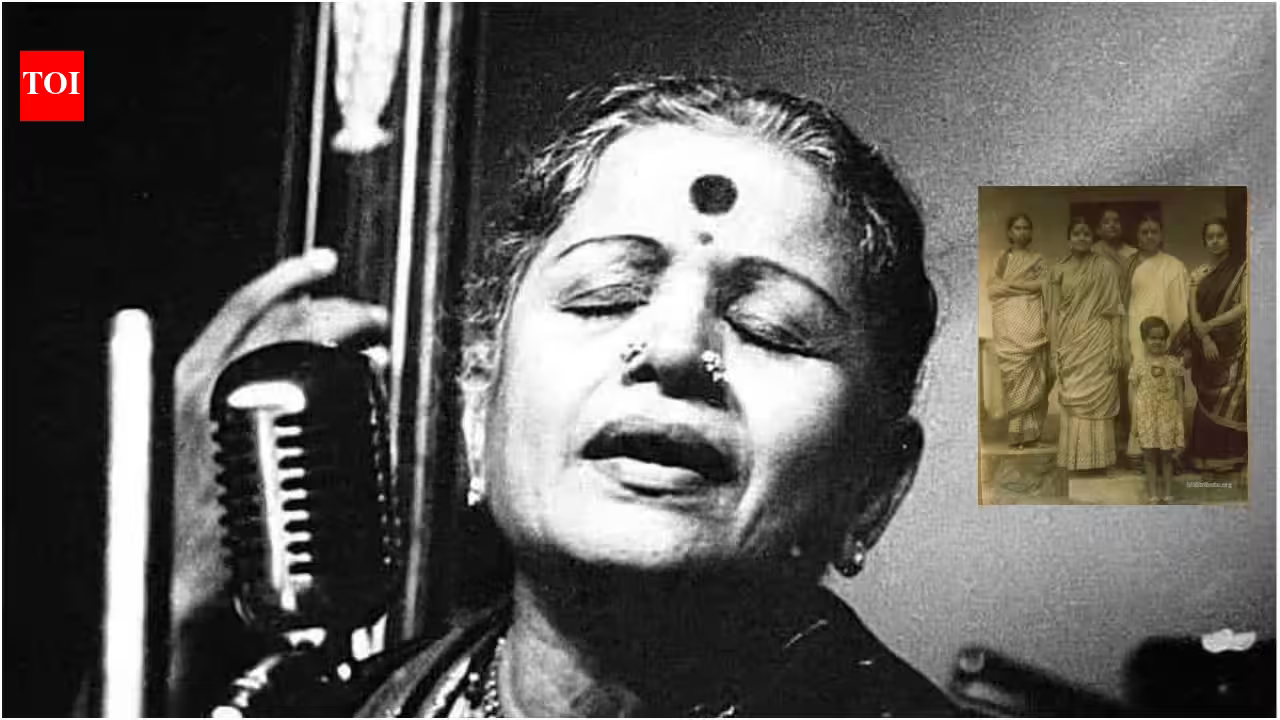
To speak of M.S. Subbulakshmi is to speak of the very soul of Indian classical music. She was not merely a vocalist; she was an institution, a bridge between the rigorous, ancient traditions of Carnatic music and the modern, global stage. Now, as the cinematic world turns its lens toward her extraordinary life with the announcement of MS – A Legacy On Screen, we are reminded that her story is not just one of melodic perfection, but of a quiet, towering resilience that transcended the boundaries of her time.
The Foundations of a Prodigy in Madurai
The narrative of M.S. Subbulakshmi began long before the concert halls and the accolades. Born into the Isai Vellalar community in Madurai on September 16, 1916, she was steeped in an environment where music was as essential as breath. Her heritage was a tapestry of sonic excellence; her mother, Madurai Shanmukhavadivu, was a master of the veena, and her grandmother, Akkammal, was a gifted violinist. It was a lineage that demanded dedication, and Subbulakshmi answered that call with startling ease.
Her initials, “M.S.,” are a permanent tribute to her mother, reflecting the deep-seated traditions of her upbringing. By the time she was 10, she was already recording; by 13, she was commanding the stage. These were not just the milestones of a child performer, but the early declarations of a voice that would eventually define the aesthetic of a generation.
Rising Above: The Madras Breakthrough
In 1936, Subbulakshmi made the pivotal move to Madras (now Chennai), the undisputed crucible of Carnatic music. Her arrival changed the landscape of the city’s music scene. It was here that she broke the gender barriers of the era, becoming the first woman to perform at the Madras Music Academy’s annual conference in 1933.
This period also signaled a transformation in her personal life. She met T. Sadasivam, a man of profound influence in the journalistic and political circles of Tamil Nadu. Their partnership, formalized in marriage in 1940, evolved into one of the most formidable professional alliances in Indian arts. Sadasivam became the architect of her public image, navigating her through the complexities of a career that required both artistic integrity and strategic management. Together, they navigated a path that saw her transition from a traditional concert performer into an icon of national stature, firmly rooted in the Indian independence movement’s spirit.
A Global Ambassador of Devotional Music
While her early training was grounded in the technical brilliance of brigas—those rapid, fluid musical phrases that challenge even the most seasoned vocalists—Subbulakshmi’s true power lay in her ability to evoke the divine. Her repertoire expanded to encompass the devotional poetry of Tulsidas, Kabir, and Annamacharya, as well as the compositions of Tyagaraja and Rabindranath Tagore.
This transition turned her voice into a vessel for something larger than entertainment. It was a meditative experience. Her reach became truly international when she graced the Edinburgh International Festival in 1963 and, perhaps most famously, the United Nations in 1966. For many across the globe, that voice—clear, unwavering, and hauntingly beautiful—became the definitive sound of India. Whether she was at Carnegie Hall or London’s Royal Albert Hall, she did not just perform; she transported her audience to a space of profound spiritual gravity.
Rashmika Mandanna’s Cinematic Challenge
Fast-forward to the 110th anniversary of her birth, and the legend of “MS” is finding a new vessel. The announcement of MS – A Legacy On Screen has sent ripples through the industry, with Rashmika Mandanna tapped to step into the role of the century.
The announcement, held fittingly at the Music Academy in Chennai, saw Mandanna wearing a traditional blue saree, looking visibly moved by the weight of the project. There is a palpable sense of pressure in portraying someone who is considered a saint of music by millions. Mandanna’s own words reflected this humility: “There is a unique divine power in your voice… Amma, you chose me to be a small part of your life—for that, I am always grateful.”
The challenge for the Pushpa and Animal star is immense. She is not just playing a singer; she is portraying a woman who remained remarkably composed in the face of immense public scrutiny and fame. It is a performance that will require not just vocal mimicry, but an internal stillness that captures the essence of Subbulakshmi’s personality.
The Guiding Hand of Kamal Haasan
The project has received a significant endorsement from the titan of Indian cinema, Kamal Haasan, who served as the chief guest at the film’s launch. Haasan, known for his own obsessive dedication to his craft, offered Mandanna a piece of advice that serves as the blueprint for the entire production: “If you bring that compassion in your eyes, you have won half the battle.”
His words pinpoint the secret to the legend’s success. Subbulakshmi was never an aggressive performer; her power came from her compassion, her humility, and her absolute service to the music. Under the direction of Gowtam Tinnanuri—who proved his ability to handle emotionally resonant stories with the National Award-winning Jersey—and with the musical genius of Anirudh Ravichander overseeing the score, the film seems poised to respect the gravity of its subject.
As production gears up, the industry waits to see how this team will navigate the life of a woman who was, in every sense, a Bharat Ratna. Can a modern film capture the quiet intensity of a life spent in the service of the divine? For those who believe in the enduring power of her music, the hope is that MS – A Legacy On Screen acts not as a mere biopic, but as an invitation for a new generation to sit in the presence of the legend once more.
Disclaimer: This content is auto-generated for informational purposes only.
Source: Read Original News