








Empowering Neurodivergent Youth Through Assistive Robotics: Lessons from the IET Scholarship
In the landscape of modern engineering education, the bridge between theoretical knowledge and real-world social impact is often crossed through rigorous competitions and research-based scholarship programs. A prime example of this pedagogical shift is the journey of Kush Garg, a student at Delhi Technological University (DTU), whose innovative work earned him the IET India Scholarship Award 2026. By prioritizing human-centric design over mere technical complexity, Garg’s project offers a blueprint for how engineering students can align their technical prowess with inclusive policy goals and social needs.
From Classroom Concepts to Field Research
Garg’s project began not in a laboratory, but in the field. Seeking to address the communication and sensory hurdles faced by neurodivergent children, he spent weeks consulting with therapists, educators, and families. This phase of his project mirrors the “Design Thinking” approach now being emphasized in top-tier technical institutions: identifying the core user problem before writing a single line of code.
Garg discovered that existing tools often focused solely on speech output, failing to address the underlying difficulties these children face in identifying their own physical or emotional states. This shift in perspective—from providing a “voice” to providing “contextual support”—highlights the importance of interdisciplinary learning, where engineering students must integrate principles of psychology and sociology into their technical problem-solving.
The Engineering Behind the Innovation
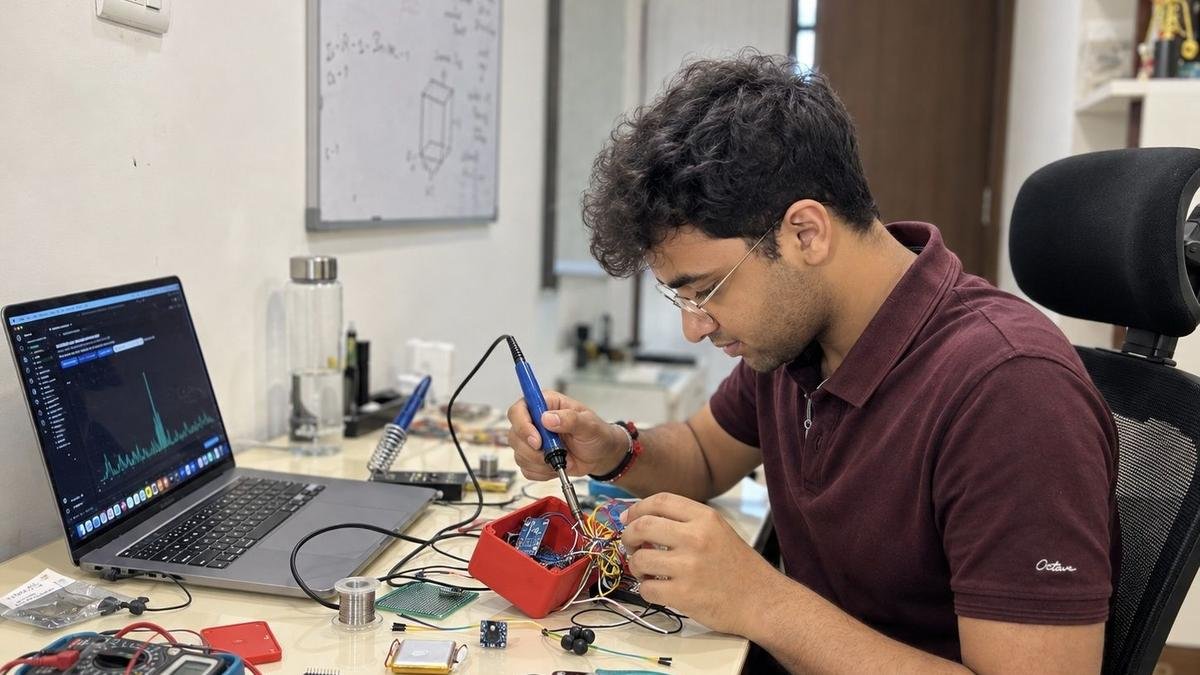
The resulting device, a compact, pocket-sized unit, serves as a masterclass in hardware-software integration. By utilizing an e-paper display and a power-efficient architecture, the prototype addresses practical barriers like battery life and portability. Technically, the device employs AI-driven contextual memory to track routines and preferences, effectively bridging the gap between a child’s internal experience and external communication.
Key technical milestones of the project include:
- Privacy-first data handling: The system prioritizes text-based transcription rather than raw audio, addressing data privacy concerns.
- Sensory Management: The integration of noise-canceling technology via wired earphones helps mitigate sensory overload in public spaces.
- Situational Awareness: By tracking routines, the device can proactively suggest prompts—such as questioning hunger during distress near lunch hours—thereby acting as a scaffold for independent living.
Bridging the Gap in Inclusive Education
For students and researchers, Garg’s success underscores a vital takeaway: the most effective innovations are those that prioritize the autonomy of the user. In the context of special education and assistive technology, the goal is to shift from a model where parents and teachers serve as constant “interpreters” to one where the technology facilitates the child’s own agency.
Winning the IET India Scholarship, which saw a competitive field of over 48,000 applicants, demonstrates the high premium currently placed on projects that address United Nations Sustainable Development Goals, particularly regarding reduced inequalities and quality education.
The Road Ahead: Rigorous Testing and Scaling
Garg’s next phase involves refining the device to include fall detection and haptic (vibration) alerts, alongside moving toward a slimmer form factor. This transition from “prototype” to “product” is a critical hurdle in the engineering curriculum. It requires moving beyond successful lab demonstrations to rigorous, longitudinal testing in real-world environments.
As engineering departments continue to evolve, the narrative of this project serves as a compelling lesson: the future of education lies in the ability of students to step outside the classroom, listen to the complexities of the human condition, and apply engineering principles not just to build better machines, but to foster more inclusive, connected communities.
Disclaimer: This content is auto-generated for informational purposes only.
Source: Read Original News