







India-US Trade Negotiations Hit a ‘Plateau’ as Finance Minister Signals Limited Room for Compromise
Munich: Union Finance Minister Nirmala Sitharaman has provided a candid assessment of the ongoing trade negotiations between New Delhi and Washington, suggesting that the dialogue has reached a critical juncture where further concessions may prove difficult for both sides.
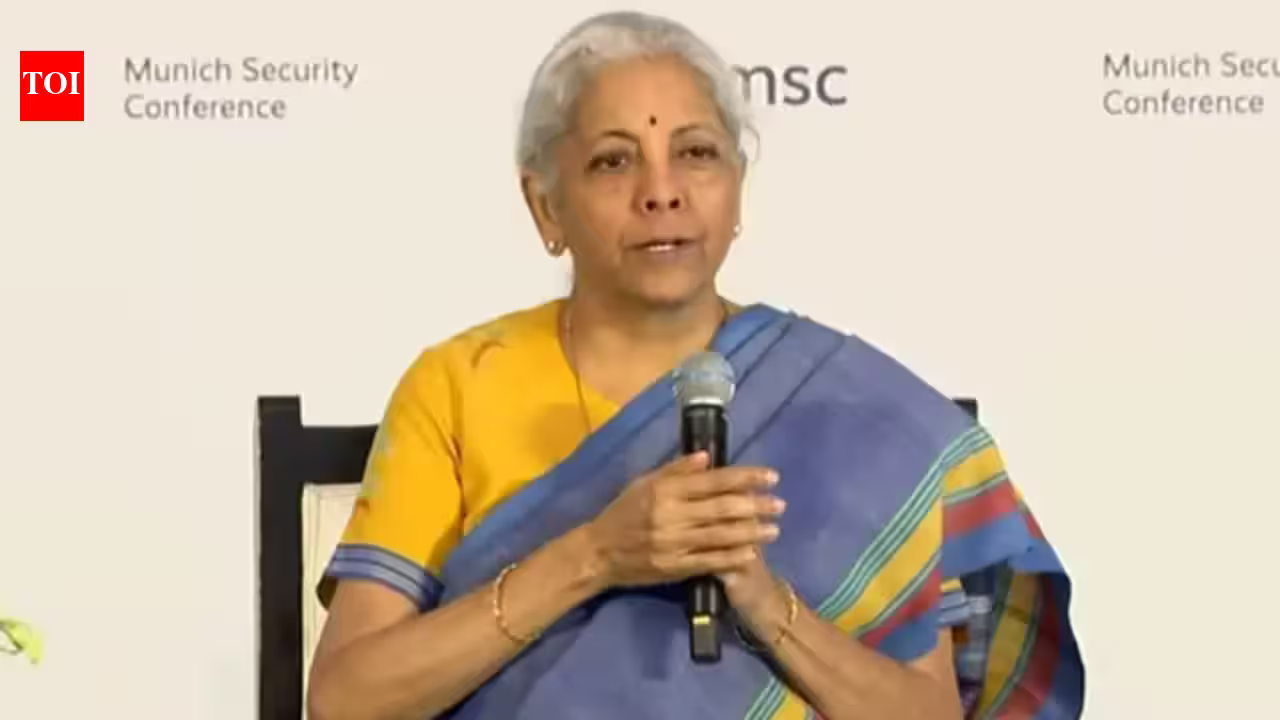
Speaking at the Munich Leaders Meeting, the Finance Minister emphasized that while talks remain active, the process has entered a phase of diminishing returns. “The agreement negotiations are still ongoing, although we’d like to believe that both sides have reached a plateau beyond which giving or taking might be very, very difficult,” Sitharaman stated, while leaving a slim opening for potential adjustments should new avenues for cooperation emerge.
Balancing Trade Dynamics
At the core of the friction, according to Sitharaman, is the structural trade imbalance that currently favors India. She acknowledged that Washington is keen to address what it perceives as cumulative trade losses, seeking to normalize the balance sheet through a more favorable deal. “The trade balance is very much in our favor,” she noted, pointing out the inherent challenge of satisfying American domestic demands to reduce that gap while simultaneously protecting Indian economic interests.
The negotiations, which have been described as “very rigorous,” come on the heels of high-level diplomatic efforts. Prime Minister Narendra Modi recently held a productive discussion with US President Donald Trump, where the two leaders reviewed the status of the Comprehensive Global Strategic Partnership, covering trade, energy, and defense. Despite this high-level engagement, an interim bilateral trade agreement remains elusive, particularly following a US Supreme Court ruling that previously invalidated the legal foundation for certain preferential tariff mechanisms.
Distinct Approaches to Europe and the US
During her address, the Finance Minister was also questioned on whether India’s strategic autonomy—specifically regarding the procurement of Russian oil—had become a hurdle in trade discussions with European partners. Addressing concerns that India might face legislative hurdles similar to those seen in the United States, Sitharaman was dismissive of such fears.
“In Europe, as much as I understand till today, there is no Lindsey Graham bill,” she remarked, highlighting the different geopolitical landscape in the European Union compared to the US, where specific legislative threats have previously clouded trade dialogues.
Path Toward an Interim Agreement
The diplomatic push to finalize an interim deal continues at the ministerial level. Commerce and Industry Minister Piyush Goyal recently met with US Trade Representative Jamieson Greer on the sidelines of the G20 Trade Ministers’ Meeting in Milwaukee. Following the session, Goyal described the conversation as “productive,” signaling a shared intent to reach a mutually beneficial conclusion despite the current deadlock.
While both nations remain committed to enhancing their bilateral relationship—spanning critical technology, energy, and global security—the road to a finalized trade pact requires navigating complex domestic legal constraints in the US and the challenging reality of a plateaued negotiation process. As it stands, both New Delhi and Washington are weighing the cost of further concessions against the long-term benefits of a comprehensive trade framework.
Disclaimer: This content is auto-generated for informational purposes only.
Source: Read Original News