








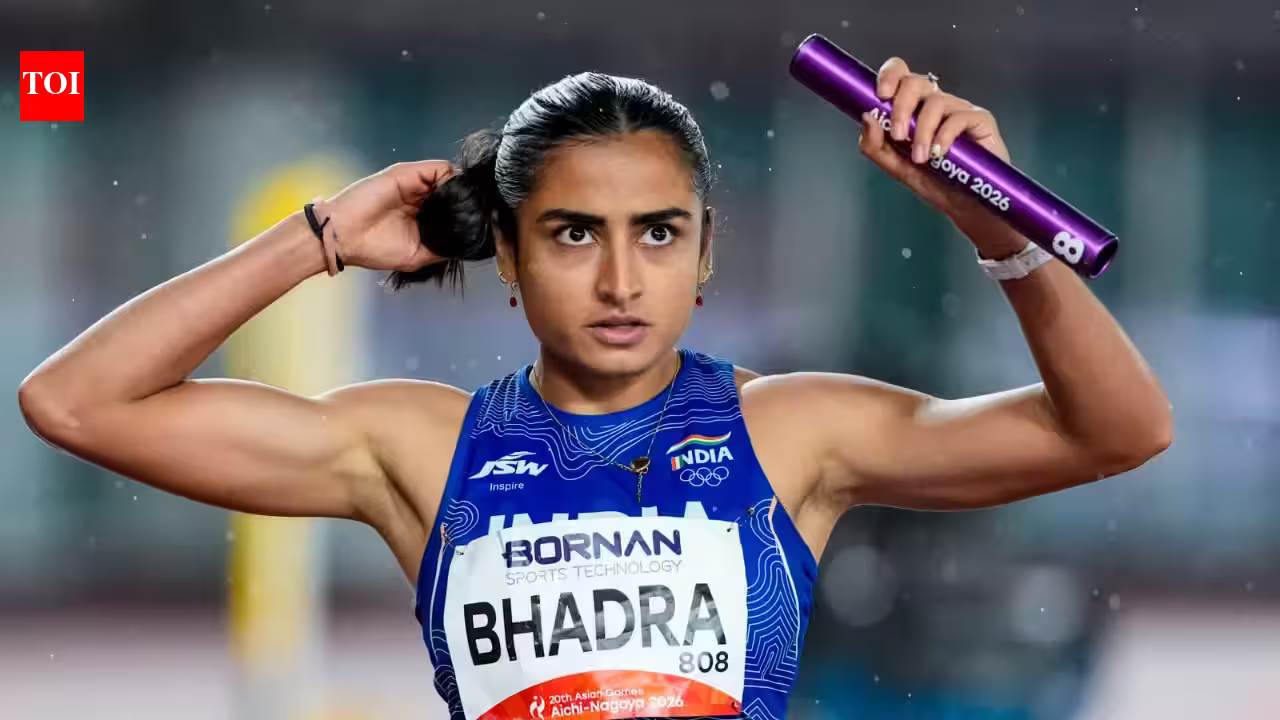
Aichi-Nagoya will long be remembered as the proving ground for Harita Bhadra. Arriving in Japan with a modest ambition—to chase a podium finish and secure a new personal best—the Indian sprinter leaves the 2026 Asian Games with a hardware haul that signals her arrival on the senior international stage: two bronze medals and a national record.
Bhadra’s performance in the women’s 200m and the mixed 4x100m relay cemented her status as one of India’s most promising track talents. Her journey, capped by a breathtaking 41.06-second national record in the relay, has transformed her perspective on what is achievable at the world level.
“Getting on the podium is one of the best feelings, especially when you’re representing India,” Bhadra told Timesofindia.com shortly after her success. “It was a surreal experience. Even though I didn’t hit a new personal best, considering the environment and the pressure, I feel like I gave my absolute best.”
A Baptism by Fire on the Global Stage
For Bhadra, this was her first senior international competition. Without the buffer of a junior international track record, the Reliance Foundation-backed athlete was thrust into the deep end. The scale of the stadium and the intensity of the competition environment provided lessons that no training block could replicate.
“I discovered how strong I can be mentally,” Bhadra reflected. “Such scenarios can be experienced only in competition. The level of pressure and the level of execution will only increase as you go higher, but I realized that if I tell my mind to do something, it can do it.”
This mental fortitude was on display in the 200m final, where the margins for error were razor-thin. In a race won by Singapore’s Shanti Pereira, Bhadra clinched the bronze with a time of 23.20 seconds, edging out Japan’s Abigeirufuka Ido by a heartbreakingly narrow 0.01 seconds. The result was not confirmed until Bhadra spotted the result on a distant screen, a moment of realization that solidified her place among the continent’s elite.
The Relay and the Power of Partnership
If the 200m was a test of individual grit, the mixed 4x100m relay was a masterclass in collective trust. Alongside teammates Gurindervir Singh, Sneha Shanuvali, and Animesh Kujjur, Bhadra thrived under the pressure of the anchor leg.
The journey to the podium was far from smooth. In the semifinal, a baton exchange mishap saw Kujjur take a tumble, yet Bhadra’s composure in the final 100 meters was nothing short of clinical.
“My only thought was that I had the baton,” she said. “My job was to make the team qualify. You have to trust your partners, and that’s what our coaches kept reminding us—the work was already done.”
By the time the final rolled around, the nervousness had shifted into a focused, calm rhythm. The result—a national record of 41.06 seconds—stands as a testament to the effectiveness of the team’s acclimatization camps in Bhubaneswar and Tsukuba.
Setting Sights on the 22.45 Barrier
With her breakthrough at the Asian Games, Bhadra has shifted her focus from local competition to the world stage. Having made the bold decision earlier this year to put her studies on hold and commit entirely to her craft, the 23-year-old is now laser-focused on the 2027 World Championships.
The objective is clear: shave her current personal best of 23.14 seconds down to the 22.45-second qualifying mark for the Worlds. While the number seems daunting, Bhadra views it as the natural progression of her current trajectory, particularly after witnessing her own success in the final 30 meters of her races in Japan—an area she had specifically targeted with coach Rohit Mane.
“It is doable,” she said, balancing confidence with a grounded outlook. “I know I have more left in me. I trust the process, and I trust that when the time is right, I will execute the race I have in my mind.”
Beyond the Track: A Return to Roots
Despite the newfound fame, Bhadra remains committed to her “one day at a time” philosophy. She refuses to be swayed by external expectations, insisting that her primary competition remains her previous self.
As she prepares to head home, her plans are refreshingly humble: celebrating with family, debriefing with her coaching team, and returning to her creative outlet, “Dagina.” The handmade jewelry brand, which she launched in late 2025 as a mental escape from the rigors of sprinting, is set for a fresh collection.
“I might do a collection inspired by Japan,” she teased.
For now, however, the track remains the priority. With the mental resilience she discovered in Aichi-Nagoya and the technical improvements solidified under the Reliance Foundation program, Harita Bhadra is no longer just chasing the podium—she is setting the pace for the next generation of Indian sprinting. The goal is no longer just to participate; it is to arrive on the world stage, and if her performance in Japan is any indication, she is well on her way.
Disclaimer: This content is auto-generated for informational purposes only.
Source: Read Original News