








The automotive landscape of the mid-1960s was defined by a shift in consumer demand. As the post-war generation matured, they sought vehicles that combined affordability with a performance-oriented aesthetic. The Ford Mustang’s 1964 debut served as the catalyst for this transformation, proving that a compact platform could support high-output engines. This development sparked an intensive competitive era, where every major American manufacturer raced to capture the “pony car” segment. What followed was a decade of engineering evolution characterized by the pursuit of displacement and power.
1967 to 1973 Mercury Cougar
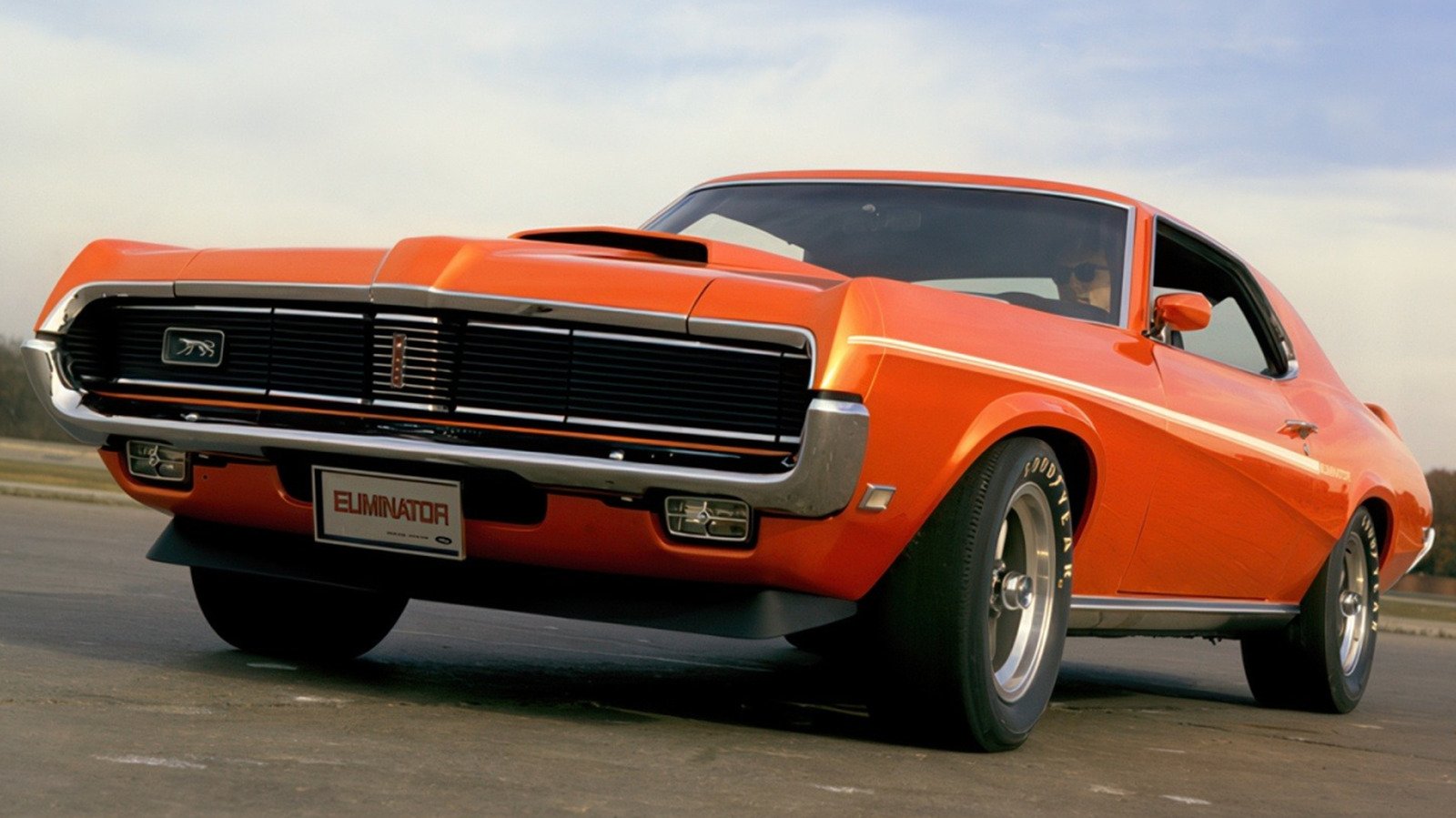
Positioned as the premium extension of the Ford pony car platform, the Mercury Cougar offered a distinct contrast to the Mustang’s raw approach. While built on the same architecture, the Cougar featured a three-inch longer wheelbase and prioritized ride quality through enhanced sound insulation and softer suspension geometry. The vehicle’s aesthetic identity was established by its full-width grille and hidden headlamps, which signaled a more sophisticated intent.
Despite its luxury-leaning profile, the Cougar did not compromise on performance. It utilized the 289-cubic-inch small-block V8 and the 390-cubic-inch big-block engine. Mercury further distinguished the model by offering the legendary 427-cubic-inch V8 in the GT-E variant, a power plant not found in the standard Mustang lineup. By 1969, the arrival of the 351-cubic-inch Windsor and Cleveland engines, alongside the massive 429 CJ, ensured the Cougar remained competitive. The XR-7G package solidified its place as a performance-tourer, providing specific suspension upgrades and interior refinements for those seeking both power and comfort.
1964 to 1974 Plymouth Barracuda and Cuda
Plymouth narrowly beat the Mustang to market by sixteen days with the original Barracuda. However, the first iteration, derived from the economy-focused Valiant, struggled to gain long-term traction. It was not until the second generation, introduced in 1967, that the model found its footing with an expanded engine lineup including the 383-cubic-inch Super Commando V8.
The definitive transformation occurred in 1970 with the introduction of the third-generation E-body platform. This shift allowed Plymouth to install its most potent engines, including the 440-cubic-inch Magnum and the 426-cubic-inch Hemi. These high-performance variants were badged as the “Cuda.” To manage the output of these engines, the Cuda featured heavy-duty suspension, wider track widths, and the distinct “Slap-Stick” floor-shifted transmission. These models remain some of the most sought-after examples of the era due to their limited production numbers and the sheer capability of their big-block configurations.
1970 to 1974 Dodge Challenger
The Dodge Challenger emerged as a sibling to the Plymouth Barracuda, utilizing the same E-body platform but adopting a larger footprint. With a two-inch longer wheelbase and a wider body, the Challenger projected a modern and imposing stance. Inside, the mechanical hardware largely mirrored the Cuda, featuring an array of power plants from the base 225-cubic-inch slant-six to the high-performance 340-cubic-inch V8.
The R/T trim served as the performance anchor for the Challenger, typically equipped with the 383-cubic-inch V8. For enthusiasts, the 440-cubic-inch Six Pack and the 426-cubic-inch Hemi were available, creating a significant performance ceiling. To support this power, the R/T included a “Rallye” suspension system with heavy-duty sway bars, a necessary addition given the platform’s focus on straight-line speed rather than cornering agility. By 1974, stricter emissions regulations brought an end to these large-displacement options, leading to the adoption of the 360-cubic-inch engine before the model was eventually phased out.
1967 to 1969 Chevrolet Camaro
Responding to the market pressure created by the Mustang, General Motors developed the Chevrolet Camaro with a focus on modular performance. Based on the F-body platform, the Camaro was designed to accommodate a wide variety of configurations, launching with eight different powertrain combinations. This versatility ranged from fuel-efficient inline-six engines to the 396-cubic-inch big-block V8.
The Z/28 variant stands as a technical highlight of this period. Engineered for SCCA Trans-Am homologation, it featured a high-revving 302-cubic-inch V8, performance-tuned suspension, and upgraded disc brakes. On the more extreme side, the Central Office Production Order (COPO) system allowed dealerships to outfit cars with race-bred 427-cubic-inch big-block engines. The ZL1, featuring an all-aluminum 427 block, achieved legendary status by delivering approximately 500 horsepower, illustrating the absolute peak of factory-backed pony car development.
1967 to 1969 Pontiac Firebird and Trans Am
The Pontiac Firebird shared the F-body architecture with the Camaro but utilized a distinct engineering philosophy. Guided by John Z. DeLorean, the design focused on handling and unique powertrain configurations. The Firebird featured overhead-camshaft inline-six engines that provided significantly higher power output than the standard Chevrolet counterparts.
The introduction of the Trans Am package, while not strictly tied to race homologation eligibility for its large-displacement engines, created a new tier of performance. It featured comprehensive upgrades, including stiffened suspension, variable-ratio power steering, and aerodynamic improvements such as rear spoilers and ram-air induction. These additions sought to balance the brute force of the 400-cubic-inch V8 with improved road-holding capabilities, cementing the Firebird’s reputation as one of the more refined yet powerful entries in the segment.
1968 to 1974 AMC Javelin
The AMC Javelin represented a unique approach to the pony car formula, emphasizing agility and a lighter chassis. Despite AMC’s conservative reputation, the Javelin was a competitive force. The base models focused on weight reduction, while the high-performance Go Package provided essential upgrades such as a limited-slip differential, front disc brakes, and upgraded cooling systems.
For the second generation, the Javelin’s performance was bolstered by the introduction of the 401-cubic-inch V8. This engine allowed the Javelin to remain relevant even as its competitors pivoted toward new regulations. Beyond its street performance, the Javelin earned professional accolades, securing manufacturer championships in the Trans-Am series in 1971 and 1972. This track success highlighted the effectiveness of the Javelin’s engineering, even as the broader pony car market began to contract in the mid-1970s due to the combined pressures of emissions mandates and insurance costs.
Disclaimer: This content is auto-generated for informational purposes only.
Source: Read Original News