








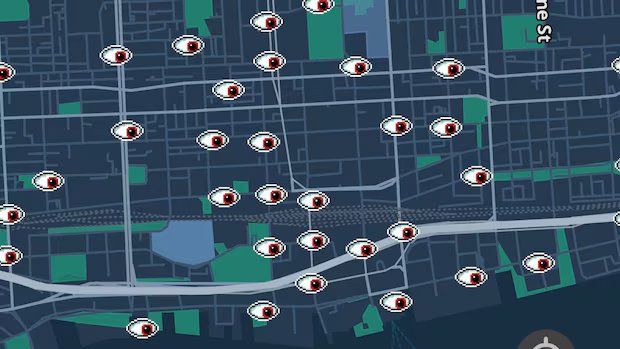
MapQuest users across Canada and the United States can now peel back the curtain on the surveillance state right from their mobile devices. The long-standing mapping service has introduced a new “surveillance layer” that utilizes animated, shifting eyes to mark the precise locations of automated licence plate readers (ALPRs) in local communities.
The update comes as MapQuest experiences a sudden, viral resurgence, three decades after its initial launch. The company recently gained significant public attention and a surge of three million new users after it stood its ground against a U.S. executive order demanding that the name of Lake Ontario be changed to “Lake America”—a directive that rivals like Google and Apple had complied with.
MapQuest general manager Doug Berger noted that the decision to display surveillance cameras was a direct response to user feedback. “We knew that there were a ton of cameras in use and documented in the U.S. and Canada,” Berger said. “You would never know unless they were pointed out to you.”
The new feature, which draws on crowd-sourced data from OpenStreetMap, allows users to toggle the surveillance layer on or off. Once activated, “spooky” animated eyes appear on the map, representing locations where ALPRs—operated by both police and private entities like Flock, Genetec, and PlateSmart—have been installed.
While law enforcement agencies maintain that ALPR technology is a vital, secure tool for tracking stolen vehicles and identifying missing persons, the proliferation of the technology has sparked intense privacy concerns. Critics, including the Canadian Civil Liberties Association, have warned that such tools are ripe for misuse, citing documented instances in the U.S. where officers have weaponized the technology to stalk ex-partners or monitor individuals without cause.
Berger emphasized that the map’s new feature is intended to foster transparency rather than take a political stance. “We’re not taking a political stance against the efficacy of them or anything, but we are bringing forth the visibility of them for people using the MapQuest app in an effort to be transparent,” he said.
The choice of using animated eyes was initially tied to the company’s Halloween-themed release, but the “strong visual” proved so popular that the company plans to keep it for the foreseeable future.
This move is part of a broader shift in MapQuest’s strategy, as the company leans into user-requested features. Following the success of the surveillance layer, the Los Angeles-based firm is now looking toward the upcoming U.S. midterm elections, with plans to mark polling locations on its maps. Berger indicated that the company hopes to implement a similar transparency-focused election feature for Canadian users in the future, maintaining the firm’s new commitment to putting practical, community-sourced information directly into the hands of the public.
Disclaimer: This content is auto-generated for informational purposes only.
Source: Read Original News