





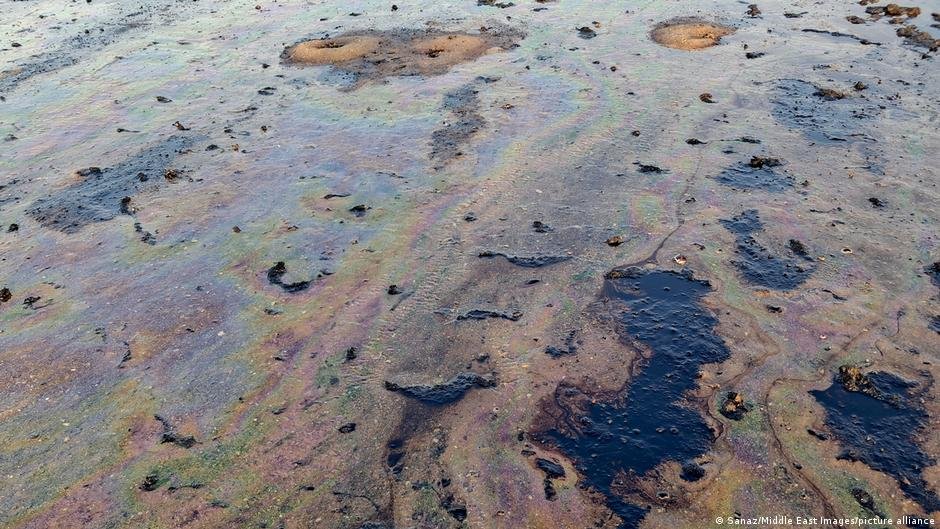
A dark, muddied patch of blue, a shimmering metallic sheen, or a winding thread of silver against the water—these visual anomalies, captured by orbiting satellites, have become the grim signature of an unfolding environmental catastrophe in the Strait of Hormuz. As the US-Iran conflict intensifies, the world’s most critical maritime oil corridor is being transformed into a graveyard for tankers, with leaked crude threatening some of the region’s most fragile ecosystems.
Experts tracking the waterway report that since the outbreak of hostilities, more than 100 oil spills have been identified through remote sensing. While the number of large oil-laden tankers stranded in the Strait has fluctuated, each vessel represents a potential ecological time bomb. Greenpeace, which recently released an investigative report on the region, warns that the cumulative damage has reached a dangerous new scale, with oil slicks now drifting into protected habitats.
The geographic scope of the contamination is significant. Earlier this week, observers identified five major oil slicks spanning a visible area of approximately 240 square kilometers—an expanse roughly four times the size of Manhattan. While weather conditions and natural dispersion have reduced the surface area of these slicks to about 80 square kilometers, scientists caution that the reduction is deceptive.
“Oil can also sink into the sediment and impact the ecosystems for years and years,” said Nina Noelle, an expert on environmental disaster relief at Greenpeace.
Of particular concern are the locations currently affected. Satellite data confirms that oil has encroached upon the waters near Oman’s Musandam National Park, a critical sanctuary for coral reefs and migratory seabirds. Similarly, slicks have been identified near the Minab River Delta in Iran, where protected mudflats and mangrove forests act as vital nurseries for marine life.
The biological toll is immediate and severe. Mangroves, which rely on specialized aerial roots to exchange gases, are being suffocated by films of oil, a process that typically leads to mass tree die-offs. For seabirds, the impact is equally lethal; oil coating their feathers destroys buoyancy and waterproofing, while toxic exposure can ruin eggs and lead to developmental deformities in hatchlings.
The human cost of this crisis is also mounting. Many Gulf states rely heavily on desalination to provide drinking water—up to 90% in Kuwait and 86% in Oman. With oil slicks threatening the very water used for these processes, the potential for a public health emergency is rising. Additionally, local coastal communities, whose livelihoods depend on small-scale fishing, face the threat of poisoned stocks and decimated biodiversity.
Compounding the crisis is the near-impossibility of an effective cleanup. According to Wim Zwijnenburg, an environmental researcher at the Dutch peace organization Pax, military instability, mine risks, and restrictive government policies in the region make conventional disaster response efforts nearly impossible to organize. Furthermore, widespread GPS spoofing—used by vessels to mask their locations during the conflict—has made it difficult to pinpoint the exact origin and scale of every spill, leaving researchers to rely on conservative estimates.
As the environmental damage continues to accumulate, advocates are pointing to the disaster as a sobering reminder of the hazards inherent in a global energy system reliant on fossil fuels.
“The most sustainable long-term damage prevention would be to reduce and ultimately end our dependency on oil and gas,” Noelle said. “As long as our energy systems and transport routes are centered around fossil fuels, there will be a continued environmental risk.”
For now, the Strait of Hormuz remains a flashpoint where geopolitical warfare and ecological collapse have become dangerously intertwined, leaving behind a legacy of pollution that may persist long after the fighting stops.
Disclaimer: This content is auto-generated for informational purposes only.
Source: Read Original News