








The Technical Significance of NTFS Integration
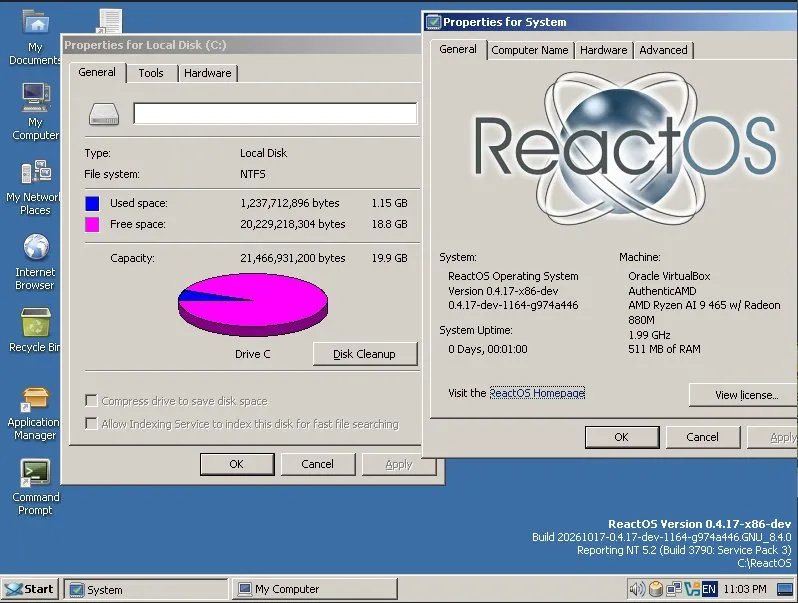
ReactOS, the long-standing open-source project dedicated to creating a Windows-compatible operating system, has achieved a critical technical milestone. The development team has successfully implemented a driver that allows the operating system to be installed directly onto a drive partition formatted with the NT File System (NTFS). For years, ReactOS was restricted to utilizing the File Allocation Table (FAT32) system for its primary installations. While FAT32 served as a functional bridge during the project’s early stages, its architectural limitations—specifically regarding file size restrictions and the lack of advanced metadata handling—made it a poor substitute for the robust file management expected in a Windows environment.
The transition to NTFS is not merely a feature addition; it is a foundational shift. NTFS, introduced by Microsoft in 1993 with Windows NT 3.1, provides the structural backbone for modern Windows releases, including Windows XP and its successors. By enabling NTFS support, the ReactOS project aligns its storage management closer to the standards of the Windows Server 2003 era, which remains the primary target for binary compatibility. This change allows ReactOS to handle larger files and more complex security descriptors natively, which are prerequisites for a system designed to replicate the Windows user experience.
Understanding the Limitations of the Current Driver
Despite the excitement surrounding this development, the ReactOS team has urged caution for prospective users. The newly implemented NTFS driver is currently in an early state and lacks several key features considered essential for a production-grade file system. Most notably, the driver does not yet support caching. In standard file system operations, caching serves as a temporary storage layer that significantly accelerates read and write tasks by reducing the frequency of direct hardware access. Without this, the current implementation of NTFS in ReactOS will exhibit performance metrics that are noticeably inferior to traditional drivers.
Furthermore, the driver currently lacks support for journaling and security descriptors. Journaling is a mechanism that keeps track of changes not yet committed to the main file system, ensuring data integrity in the event of an unexpected power loss or system crash. The absence of this feature means that ReactOS installations on NTFS are currently more susceptible to corruption than those on more mature file systems. Additionally, while the team has successfully enabled basic read and write capabilities, they have explicitly noted that there are likely undiscovered bugs within the codebase. Consequently, the driver is intended for experimental testing by developers and enthusiasts rather than for everyday operation on primary hardware.
The Goal of Binary Compatibility
The primary mission of ReactOS is to provide an open-source alternative that runs Windows applications and drivers seamlessly. Achieving this requires more than just a similar graphical interface; it demands a kernel-level architecture that replicates the behavior of the Windows NT family. Since Windows NT 3.1, the operating system has relied on NTFS to manage system files, registry hives, and security protocols. For an operating system to be truly compatible, it must be able to parse and navigate the file system structures that Windows software expects to find.
By overcoming the FAT32 limitation, ReactOS moves significantly closer to the goal of binary compatibility. Many modern Windows applications and system tools are designed to interact specifically with the nuances of NTFS. These tools often rely on features like alternate data streams or specific access control lists (ACLs) that FAT32 does not support. By implementing a native NTFS driver, the ReactOS developers are effectively removing a barrier that prevented the execution of various complex Windows programs that previously failed due to filesystem incompatibility. This update represents a major step toward making the OS a viable environment for legacy Windows software.
Impact on Future Development and Beta Milestones
The integration of an NTFS driver serves as a key indicator of progress as the project looks toward reaching a beta stage. In the lifecycle of software development, moving from a rigid, legacy-compatible system like FAT32 to a sophisticated standard like NTFS signals that the core architecture is maturing. It demonstrates the team’s ability to reverse-engineer and implement complex components of the Windows NT stack. This progress provides the necessary infrastructure for other high-level features that have been bottlenecked by storage limitations.
As the team refines the driver to include caching, journaling, and full security support, the community will likely see improvements in overall system stability and performance. These future iterations are essential for the OS to progress toward a broader release. While the current driver is a “proof of concept” in many respects, it provides the framework necessary for testing more sophisticated features such as full partition support and integration with Windows-style file permissions. For the developers working on the ReactOS kernel, this milestone serves as a practical testing ground for complex driver development, which will ultimately benefit the long-term sustainability of the project.
Operational Guidance for Early Adopters
For users interested in testing the latest ReactOS builds, the advice remains clear: maintain a cautious, sandbox-oriented approach. Because the NTFS implementation is still considered experimental, it is strongly recommended that testing be conducted within a virtual machine environment rather than on physical hardware. Virtualization allows users to snapshot the state of their system, providing a safety net if a file system error occurs during testing.
The ReactOS project has provided a platform for users to report bugs, and community feedback is critical during this phase of the rollout. Those who choose to test the new driver should focus on file read/write operations and verify if specific Windows applications that previously failed on FAT32 now exhibit improved behavior. By documenting these interactions, the community plays a direct role in the refinement process. While the project is not yet ready to replace a primary Windows machine, the NTFS update confirms that the development roadmap is advancing, bringing the project one step closer to its ultimate goal of providing a stable, open-source alternative to the proprietary Windows environment.
Disclaimer: This content is auto-generated for informational purposes only.
Source: Read Original News