








Delhi Police Stifle Youth-Led Protest as City Remains Choked by Toxic Smog
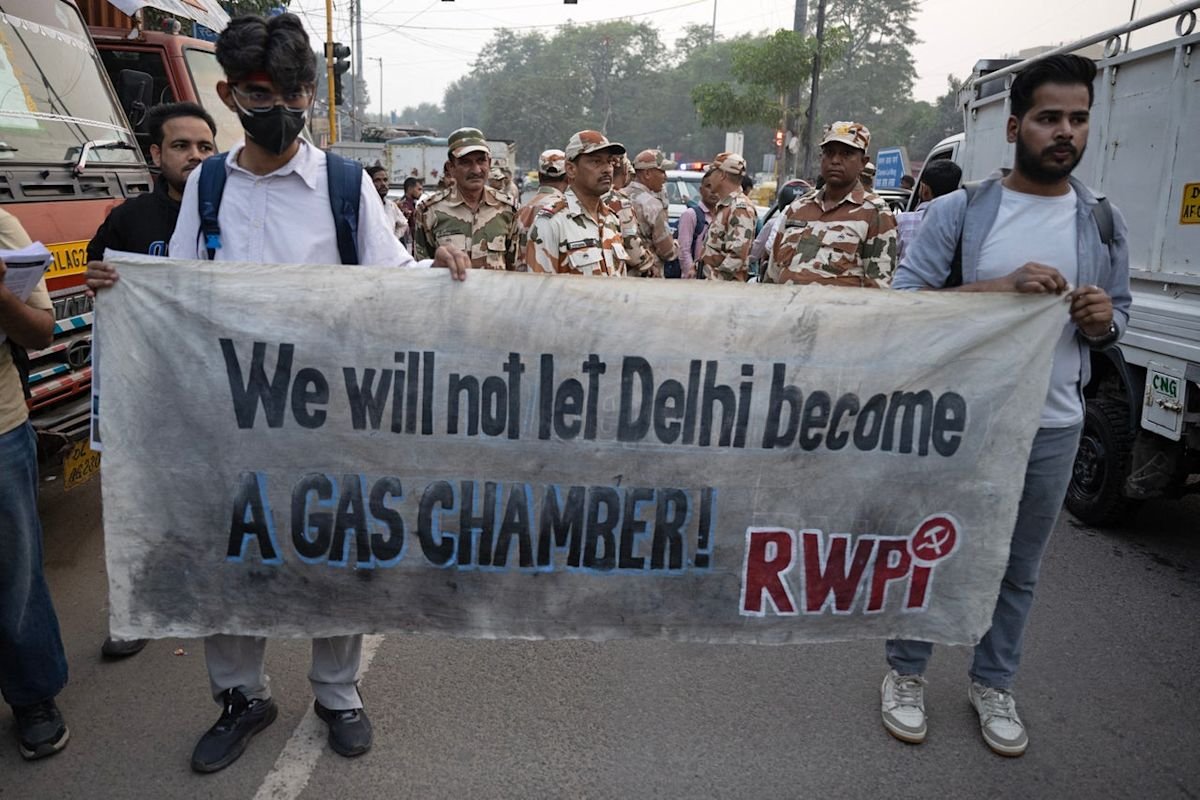
As a thick, toxic haze continues to blanket the Indian capital, authorities moved to suppress a youth-led demonstration aimed at highlighting the city’s escalating air quality crisis. On Wednesday evening, protesters attempting to march from Old Delhi’s Turkman Gate toward Jantar Mantar were intercepted and halted by police just meters into their journey.
The mobilization was orchestrated by a coalition of civil society groups, including the Revolutionary Workers’ Party of India, the Disha Students’ Organisation, the Naujawan Bharat Sabha, Scientists for Society, and the Stree Mukti League. The participants intended to demand more aggressive state intervention and stricter enforcement of anti-pollution protocols, particularly in the wake of a smog-heavy Diwali festival.
Escalating Tensions and Police Action
The crackdown on Wednesday is part of a broader pattern of state resistance against environmental activism in the capital. According to representatives from the Revolutionary Workers’ Party, officers went as far as confining members inside a children’s library in Karawal Nagar to prevent them from participating in the march, allegedly trapping both activists and minors inside the premises.
This intervention follows a series of confrontations between protesters and law enforcement. Earlier this month, on November 1, a similar march from Ramlila Maidan to Jantar Mantar was blocked, resulting in the detention of at least 22 activists. While those individuals were released after several hours, police subsequently filed formal criminal complaints, citing charges of obstruction, disobedience of official orders, and conspiracy.
These actions mirror the state’s hardline approach during previous years, including a 2023 demonstration where authorities arrested 23 individuals, claiming the gathering had extremist links—a charge vehemently denied by the organizing groups.
A Public Health Emergency
The suppression of dissent comes as Delhi’s residents grapple with some of the worst air quality levels globally. By Thursday morning, the Central Pollution Control Board reported an Air Quality Index (AQI) of 321, firmly in the “very poor” category. Monitoring stations at locations like IIT Delhi recorded even higher, more hazardous levels, with the vast majority of the city’s sensors reflecting severe degradation.
Data from the Diwali period underscores the severity of the crisis. On the night of the festival, average PM2.5 concentrations reached a staggering 493.17 micrograms per cubic meter. For context, World Health Organization (WHO) safety guidelines recommend a 24-hour average of just 15 micrograms.
The health implications of these statistics are dire. Research published in The Lancet Planetary Health linked over 33,000 annual deaths across ten major Indian cities—including Delhi—to short-term exposure to PM2.5 levels exceeding safe limits. The study estimates a 1.42 percent increase in daily mortality for every 10-microgram rise in pollutant concentrations.
Persistent Challenges
Delhi’s struggle with air quality is a seasonal inevitability, exacerbated by stagnant winter air and low wind speeds that trap emissions. Official data suggests that 23 percent of the city’s winter pollution originates from vehicular exhaust, while 20 percent is attributed to the burning of biomass and agricultural crop stubble in neighboring states.
Despite Supreme Court directives limiting firework use to “green” alternatives during specific time slots, the post-Diwali spike has pushed pollution levels to their highest point since 2021, leaving activists and residents alike demanding more than just seasonal mitigation efforts.
Disclaimer: This content is auto-generated for informational purposes only.
Source: Read Original News