








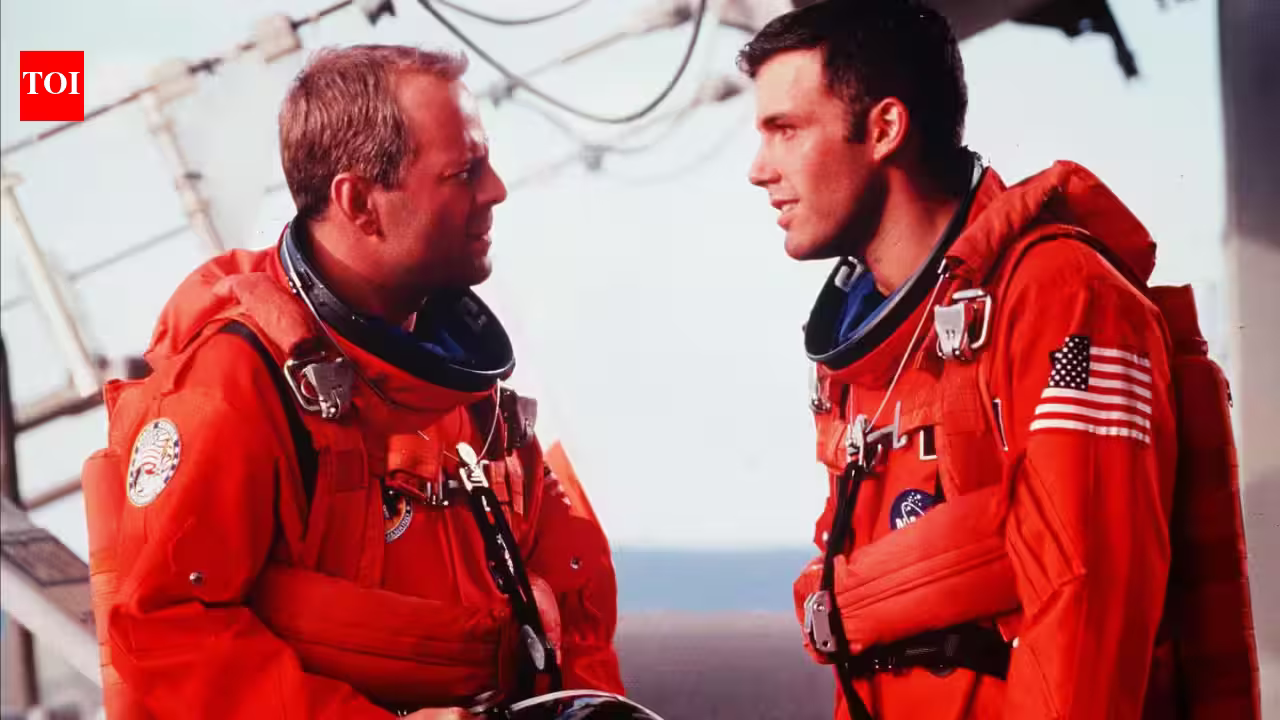
In the high-stakes, hyper-critical ecosystem of 1990s Hollywood, the transition from “young gun” to “leading man” was rarely a smooth climb. It was a gauntlet of unsolicited advice, ego-driven critiques, and the kind of locker-room banter that could either sink a newcomer or build a thick skin. For Ben Affleck, then an up-and-coming talent fresh off the success of Good Will Hunting, the set of Michael Bay’s disaster epic Armageddon served as a masterclass in this peculiar brand of industry mentorship. It was here that he found himself in the crosshairs of the ultimate action icon, Bruce Willis, who had no qualms about dissecting Affleck’s career choices—and his vocal range—in real-time.
Decades later, the anecdote remains a fascinating glimpse into a bygone era of moviemaking, where the stars of Die Hard and Batman collided, resulting in a dynamic that was part professional rivalry, part bizarre, big-brother-style coaching.
The ‘Armageddon’ Mentorship
To understand the context of this interaction, one must look back at 1998. Armageddon was the quintessential summer blockbuster: loud, expensive, and packed with the kind of testosterone that defined the late-90s cinema landscape. Bruce Willis was firmly established as the king of the action genre, a man whose word carried the weight of a franchise. Ben Affleck, on the other hand, was the rising star looking to cement his place in the A-list hierarchy.
On the set of a movie that required them to save the world from an asteroid, the two actors formed an unlikely bond. But as Affleck recently recounted on the Happy Sad Confused podcast, that bond came with a side of blunt, unvarnished opinion. It wasn’t just about the stunt work or the delivery of dialogue; it was about the macro-strategy of building a career—a task Willis took upon himself to critique, even when he hadn’t fully done his homework.
The ‘Shakespeare in Love’ Miscalculation
The most glaring example of Willis’s misplaced professional counsel involved one of the most decorated films of the decade: Shakespeare in Love. At the time, Affleck was eyeing the role of the haughty actor Ned Alleyn. Willis, however, was dead set against it.
“He also was like, ‘Man, don’t go do that Shakespeare movie, man. You don’t want to do that movie,’” Affleck shared, recalling the conversation.
It is a moment that feels almost comical with the benefit of 20/20 hindsight. Shakespeare in Love didn’t just succeed; it became a cultural phenomenon, sweeping the 1999 Academy Awards, including the coveted Best Picture trophy. The film proved to be a pivotal point in Affleck’s filmography, allowing him to flex his range beyond the roles he was initially typecast into. As Affleck generously noted, Willis’s advice wasn’t born out of malice—it was simply based on a hunch, or perhaps a misunderstanding of the script, which Willis hadn’t even bothered to read. It serves as a potent reminder that in Hollywood, even the biggest stars are often just shooting in the dark.
A Critique of the Vocal Cords
Beyond the strategic career advice, Willis seemingly decided that Affleck’s very essence—specifically his speaking voice—needed an overhaul. In a confession that highlights the often absurd standards of 90s leading men, Affleck revealed that Willis had a bone to pick with his natural register.
“Your voice is too high,” Willis reportedly told him. “Don’t have that high voice.”
For any actor, hearing that their literal voice is a hindrance to their success could be crushing, but Affleck’s recollection is marked by a sense of amusement rather than bitterness. When Affleck pointed out the obvious—”Bruce, that’s just my voice. Can I change that?”—the Moonlighting legend doubled down, insisting that he was doing the younger man a favor. “You don’t want to sound like that, man! I’m helping you out!”
It is a classic “Bruce Willis” moment: direct, slightly abrasive, and delivered with the absolute confidence of a man who has lived life on his own terms. It captures the tension of the era, where performers were often molded into specific archetypes, and suggests that Willis, for all his charms, was firmly rooted in an old-school aesthetic of what a “star” was supposed to sound and act like.
The Enduring Bond of Hollywood
Despite the unsolicited vocal coaching and the questionable career advice, Affleck holds no grudges. In fact, his reflection on the matter is surprisingly tender. He describes Willis as “the sweetest guy in the world,” emphasizing that despite the blunt delivery, the intention was never to demean.
In the fast-paced, often cold environment of filmmaking, these types of interactions—however strange—are often how bonds are forged. Affleck’s narrative isn’t one of bullying, but of a unique, albeit slightly eccentric, dynamic between two generations of actors. It portrays Willis not as a villain, but as a seasoned veteran who truly believed he was handing down the secrets of the trade, even if those secrets were hilariously outdated.
The Legacy of the Work
Looking back at the trajectory of both men, it is clear that Affleck’s decision to ignore Willis’s advice paid dividends. His performance in Shakespeare in Love showcased a theatricality that helped broaden his appeal, and his voice, high-pitched or not, went on to anchor some of the most iconic films of the 21st century.
Shakespeare in Love, directed by John Madden, remains a cornerstone of 90s cinema, a fictionalized, romanticized romp through Elizabethan England that captured the imagination of the public and the critics alike. Affleck’s portrayal of Ned Alleyn was a highlight, bringing a dash of arrogance and charm that sat perfectly alongside Joseph Fiennes’ Shakespeare and Gwyneth Paltrow’s Viola de Lesseps.
In the end, the story serves as a fascinating piece of industry lore. It reminds us that behind the polished posters and the red carpet appearances, there is the human element: the actors, the insecurities, the bad advice, and the inevitable moments of clarity that come with time. Bruce Willis may have been wrong about the script and wrong about the voice, but he certainly succeeded in leaving an impression that, twenty-five years later, is still being retold with a smile.
Disclaimer: This content is auto-generated for informational purposes only.
Source: Read Original News