








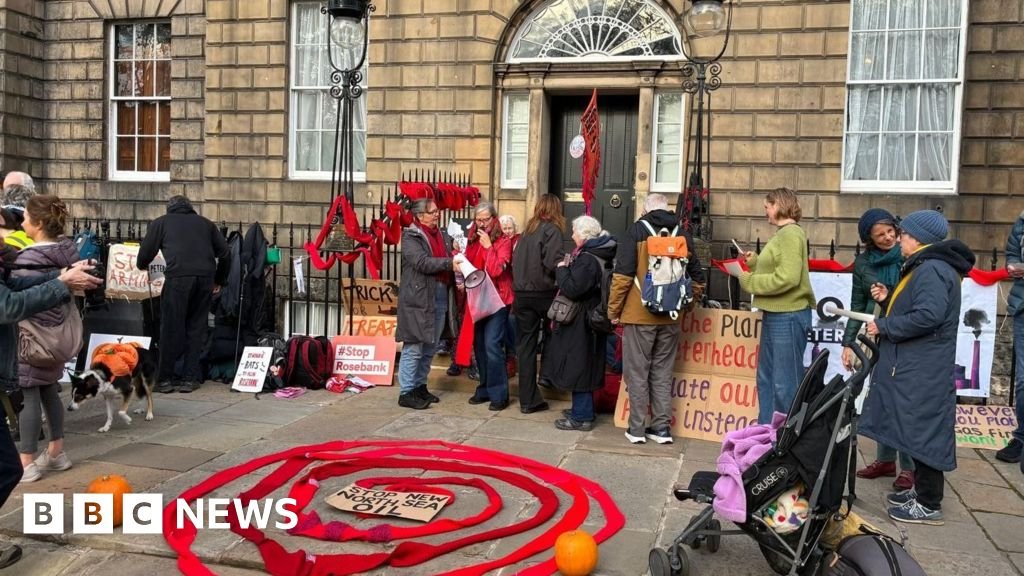
Protesters gathered outside Bute House, the official residence of the First Minister of Scotland in Edinburgh, on Thursday morning for a Halloween-themed demonstration aimed at highlighting the government’s ongoing stance on fossil fuel exploration. Organized by environmental campaign groups, the event sought to equate the continued reliance on oil and gas with a “climate horror story,” urging the Scottish Government to take more aggressive action toward a rapid energy transition.
The demonstration saw participants donning costumes and carrying themed placards, transforming the perimeter of the historic Charlotte Square residence into a visual commentary on the climate crisis. Protesters argued that the Scottish Government’s rhetoric regarding environmental stewardship is undermined by the continued development of domestic oil and gas fields in the North Sea.
A spokesperson for the protest groups stated that the timing of the demonstration was intended to emphasize the “frightening” reality of current global warming trends. The group specifically criticized the continued licensing of fossil fuel projects, which they claim are incompatible with Scotland’s stated goal of achieving net-zero emissions by 2045. “We are here to show that the government’s current trajectory is a nightmare for future generations,” the spokesperson remarked. “We need a just transition that moves workers and the economy away from fossil fuels, not more infrastructure that locks us into carbon-heavy energy production for decades to come.”
The protest highlights the ongoing tension between environmental activists and the Scottish administration. While the Scottish Government has frequently emphasized its ambition to become a global leader in renewable energy—pointing to the significant growth of its offshore wind sector—it often faces criticism regarding the pace of policy implementation. The Scottish Government does not have direct control over the licensing of oil and gas exploration in the North Sea, as this remains a reserved power of the UK government in Westminster. However, environmental campaigners argue that the Scottish Government maintains enough political influence to obstruct or push back against these projects more forcefully than it has in the past.
Police Scotland confirmed they were in attendance at Bute House throughout the morning. The protest remained largely peaceful, with participants engaging in chants and speeches directed toward the residence. Traffic in the surrounding area experienced minor disruptions, though access to the square remained open for the duration of the demonstration.
In response to the protest, a Scottish Government spokesperson reiterated their commitment to achieving a “fair and managed” transition. “The Scottish Government is fully committed to a just transition that protects the rights and livelihoods of workers in the energy sector,” the statement read. “We have been clear that we do not support the status quo of unlimited oil and gas extraction. Our focus remains on accelerating the move toward renewable energy sources, such as wind and hydrogen, which hold the key to our long-term economic security and environmental sustainability.”
Despite these assurances, the protest underscores a growing impatience among climate activists who feel that the urgency of the climate emergency is not being reflected in political decision-making. As the UK and Scottish governments continue to navigate the complexities of energy security in the wake of global volatility, the pressure from environmental groups shows no signs of abating.
The demonstration at Bute House serves as a reminder that as the climate crisis becomes increasingly central to public discourse, symbols of political authority are likely to face more frequent interventions from groups seeking to bridge the gap between ambitious climate targets and the reality of current infrastructure development.
Disclaimer: This content is auto-generated for informational purposes only.
Source: Read Original News