








BENGALURU: In the high-stakes, high-octane arena of professional chess, the line between strategic mastery and pure panic is often measured in milliseconds. On Day 3 of the Global Chess League (GCL) in Bengaluru, that thin line was crossed in the most dramatic fashion imaginable, serving up a reminder that in the modern era of rapid-fire chess, the clock is just as dangerous as the opponent sitting across the board.
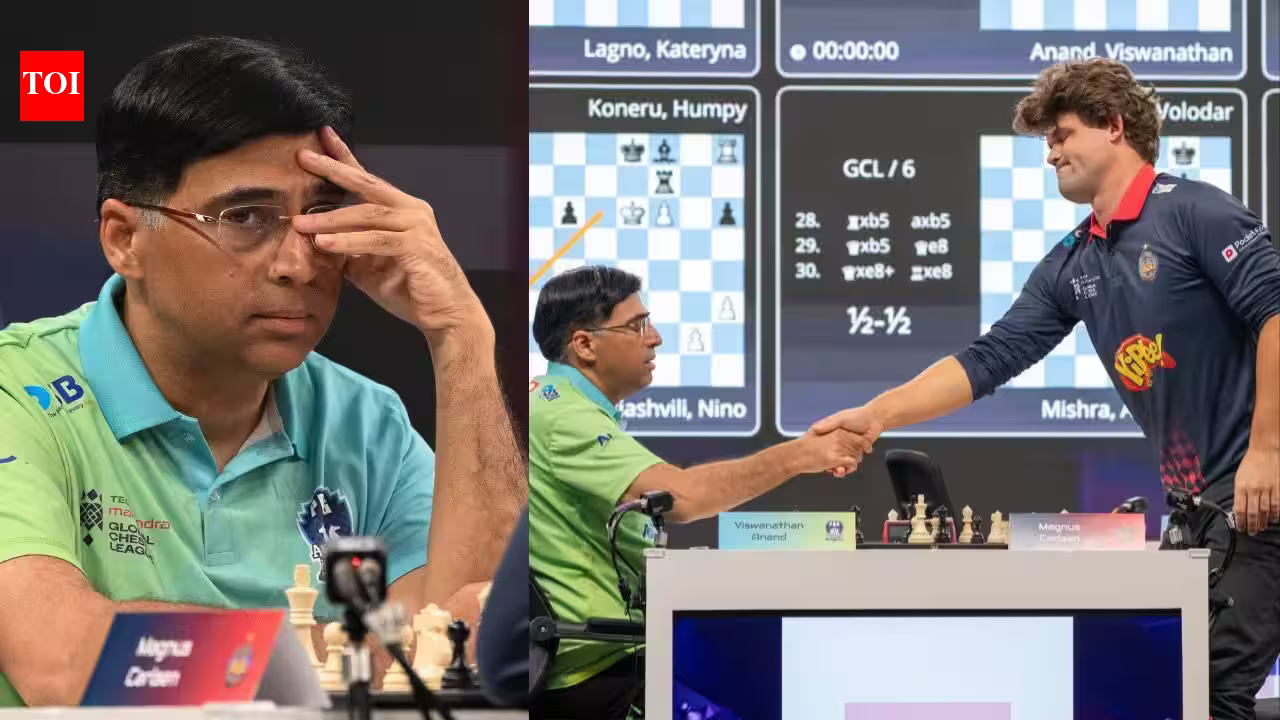
The marquee clash between two titans of the game—Alpine APL Pipers’ Magnus Carlsen and Alaskan Knights’ Viswanathan Anand—delivered a moment that left spectators breathless. As the middle-game tension reached a boiling point, the chess world held its collective breath. With the board evaluation teetering on a knife’s edge and the clock rapidly winding down, the unthinkable happened: Anand, a five-time world champion renowned for his speed and composure, failed to strike his clock before time expired, handing an unlikely victory to his longtime rival, Carlsen.
The “Flagging” Phenomenon
In the lexicon of professional chess, “flagging” is the ultimate heartbreaker. It is a win secured not through checkmate or a favorable material exchange, but through the mechanical attrition of seconds.
“A few moves ago, I had a few seconds more than him, so somehow my brain stopped looking at the clock, and I didn’t keep one second left,” a candid Anand told reporters following the match. “Once I make a move, I will get some time, but apparently I let my clock run out. That was a pity, but I’m happy the team won.”
While the loss stung on an individual level, Anand’s frustration was mitigated by the overall performance of the Alaskan Knights, who managed to edge out the Pipers 9–7 in the match. It was a testament to the team-centric format of the GCL, where an individual lapse does not necessarily equate to a team collapse.
Carlsen, ever the pragmatic competitor, acknowledged the unconventional nature of his victory. “I felt like I was playing him a little bit in the middle game. I was pretty happy with the position from the opening, and then again I was a little bit shaky with little time,” the World No. 1 admitted. “For a period there, he was defending very, very well… and then I just obviously resigned myself to a draw. Then I randomly glanced at his clock and saw that it was out. That’s how it goes sometimes at times like this.”
Carlsen’s Creative Spark
Beyond the dramatic flag-fall, Carlsen continued to push the boundaries of opening theory. During the Pipers’ subsequent encounter with the American Gambits, the Norwegian superstar raised eyebrows by deploying the provocative 3…f6 against World Championship challenger Javokhir Sindarov.
The move, which initially stemmed from a lighthearted “misclick” by his coach, has evolved into a calculated, albeit bizarre, weapon in Carlsen’s arsenal. “I kind of like the general idea of taking a random move in the opening, and then with computer analysis, you can make pretty much anything work,” Carlsen explained after holding the game to a draw. His willingness to experiment, even at the highest level of team competition, underscores his relentless pursuit of dynamic, unpredictable play.
The Competitive Landscape
Day 3 was defined by its volatility. While the Pipers stumbled against the Knights in the morning, they roared back with a clinical 15–3 demolition of the American Gambits later in the day, signaling that their early-tournament momentum remains largely intact.
Elsewhere, the Mumba Masters asserted their dominance by overwhelming the Ganges Grandmasters with a 12–3 scoreline. Meanwhile, the Triveni Continental Kings finally broke their winless streak, clinching an 11–6 victory over the Alaskan Knights to put their first points on the board.
As the dust settled on the third day, the APL Pipers solidified their position atop the leaderboard with 9 match points. The race for the remainder of the podium, however, is a logjam; Mumba Masters, the American Gambits, and the Alaskan Knights are currently deadlocked with 6 points apiece. At the bottom of the table, the Ganges Grandmasters and Triveni Continental Kings are fighting to salvage their campaigns, each sitting on 3 points.
A Love Affair with Indian Chess
Amidst the competitive fire, Carlsen took a moment to reflect on the atmosphere in Bengaluru. The fervor surrounding the GCL has been palpable, with the venue buzzing with energy throughout the day.
“It’s very nice to play here. Chess in India is massive,” Carlsen noted, clearly energized by the reception. “That’s great to see, and I definitely want to come here and experience the love people have for chess.”
As the tournament shifts into Day 4, the narrative is clear: with the pack tightening and the pressure of the clock looming over every move, the GCL is proving to be a true test of nerve. Whether it is a brilliant tactical sacrifice or a frantic dash to beat the clock, the action in Bengaluru is showing no signs of slowing down. Fans can look forward to a full slate of action on Tuesday, headlined by the crucial Ganges Grandmasters versus Alaskan Knights showdown.
Disclaimer: This content is auto-generated for informational purposes only.
Source: Read Original News