








Vibrating Catalyst Turns Carbon Dioxide into Useful Fuel, Researchers Find
In a breakthrough for sustainable chemistry, researchers at Osaka University have developed a novel catalyst that utilizes mechanical vibration to transform carbon dioxide (CO2) into carbon monoxide—a critical step toward efficient, low-energy carbon recycling.
Carbon dioxide is often viewed as a burden, but for researchers, it is a potential treasure trove of chemical feedstock. A team at Osaka University has unveiled a sophisticated new catalyst that captures CO2 and converts it into carbon monoxide (CO) using only mechanical vibration. The findings, published in the journal ACS Catalysis, demonstrate a significant leap forward in the field of piezocatalysis.
The Challenge of CO2 Conversion
Piezocatalysis is a process that relies on piezoelectric materials to convert mechanical energy—such as sound or vibration—into electrical charges capable of driving chemical reactions at room temperature. While promising, the technology has historically faced two major hurdles: CO2’s poor solubility in water prevents it from reaching the catalyst surface, and many conventional catalysts lack sufficient active sites to handle the chemical transformation efficiently.
A Precision-Engineered Solution
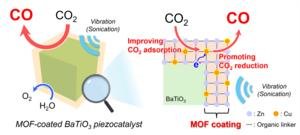
To overcome these limitations, the Osaka University team engineered a core-shell nanostructure. They began with barium titanate (BaTiO3) nanocubes, which serve as the “piezoelectric engine.” These were coated in ZIF-8, a hydrophobic metal–organic framework (MOF) known for its exceptional ability to capture and concentrate CO2.
The researchers then embedded isolated copper (Cu) atoms into this shell to act as high-efficiency reaction sites. This design effectively creates a “local reaction environment” where CO2 is concentrated near the copper atoms, and piezo-induced electrons are funneled directly to the site of the reaction.
“Precisely controlling the local reaction environment around the catalyst surface can significantly improve catalytic activity,” explained Assistant Professor Yoshifumi Kondo.
Fivefold Increase in Efficiency
The results were striking. Under ultrasonic vibration at room temperature, the new catalyst—dubbed Cu-ZIF-8/BT—produced CO at a rate of 114 μmol g⁻¹ h⁻¹. By comparison, pristine BaTiO3 managed only 24 μmol g⁻¹ h⁻¹ under identical conditions. This represents an approximately fivefold increase in production capacity.
The researchers also found that the structural integrity of the catalyst is vital. When the components were merely mixed together rather than integrated into a core-shell structure, performance plummeted. Furthermore, the catalyst proved to be highly stable, maintaining its activity through five consecutive reaction cycles without degradation.
A New Era for Carbon Recycling
This study marks an important milestone in developing energy-saving technologies for CO2 utilization. By demonstrating that mechanical energy can be harnessed to drive complex chemical transformations, the team has opened new doors for potential applications in both photocatalytic and electrocatalytic systems.
As society seeks more sustainable methods to manage atmospheric carbon, this “vibration-powered” approach offers a promising, scalable pathway toward converting greenhouse gases into the building blocks of modern industry.
Source Details:
- Study: “Unlocking Enhanced Piezocatalytic CO2 Reduction on BaTiO3 via Cu Single Atoms within a Hydrophobic Metal−Organic Framework Shell”
- Journal: ACS Catalysis
- DOI: 10.1021/acscatal.6c02044