






The Paradigm Shift: From Global Integration to Strategic Fragmentation
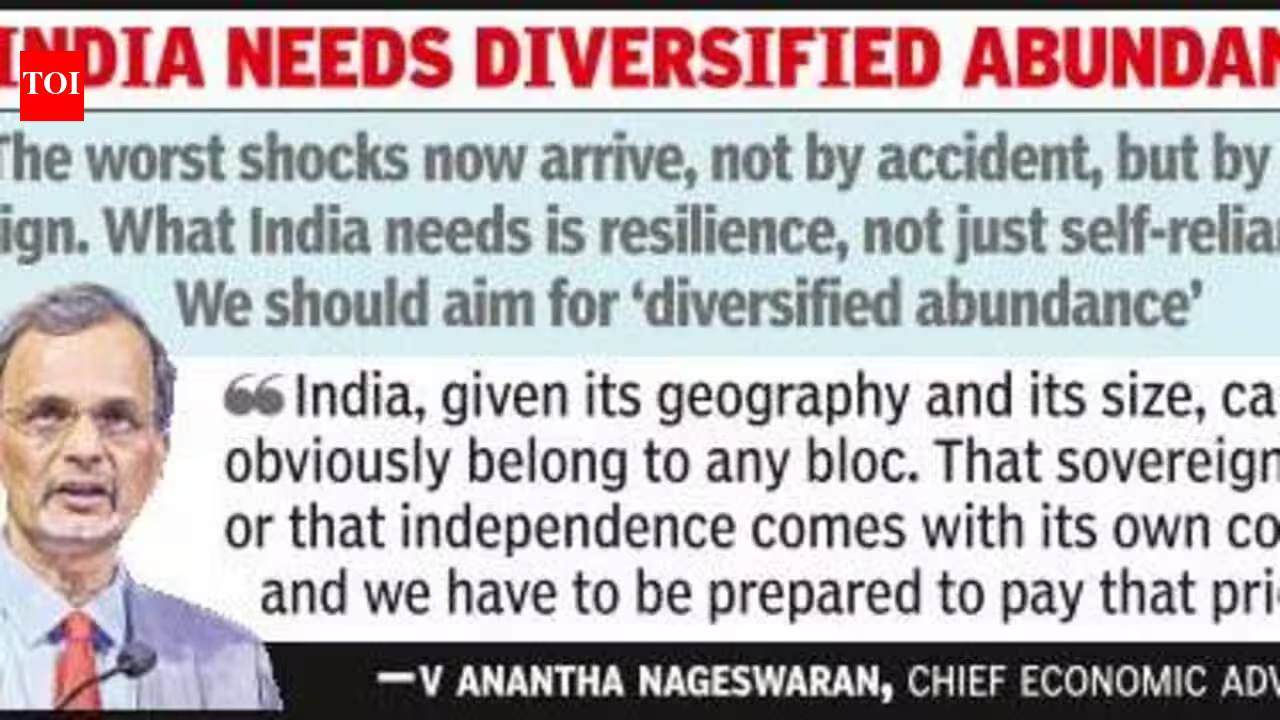
For nearly three decades, the global economy thrived under a regime characterized by hyper-globalization, seamless supply chains, and a disinflationary environment. From the early 1990s through 2020, capital flowed toward efficiency, and goods moved across borders with minimal friction. However, the current economic landscape suggests that this era has concluded. As identified by Chief Economic Adviser V Anantha Nageswaran, the global economy is transitioning into a phase where geography, energy security, and technological dominance are being weaponized, forcing nations to reconsider their reliance on fragile, long-distance supply networks.
In the Indian context, this shift is particularly significant. As a major net importer of crude oil, India’s economic stability is inextricably linked to global commodity cycles. When crude oil prices surge—as evidenced by the rise from $85 to $114 per barrel—the cascading effects permeate the entire macroeconomic framework. The fiscal deficit, the current account deficit, and domestic inflation are all sensitive to these fluctuations. The recent 30 percent spike in the Indian crude basket within a single month serves as a stark reminder that the country remains highly exposed to external price volatility, compounded by the fact that shocks are no longer accidental, but often structural and intentional outcomes of geopolitical friction.
The Weaponization of Trade, Technology, and Energy
One of the most profound insights regarding the current global order is the intentional nature of modern economic shocks. Historically, supply chain disruptions were often viewed as transient events caused by natural disasters or cyclical demand mismatches. Today, however, trade, technology, and energy are increasingly being used as strategic instruments of statecraft. When nations employ trade restrictions or energy levers to exert pressure, the resulting economic instability becomes a deliberate feature of international relations rather than a bug.
For India, this necessitates a departure from the conventional pursuit of self-reliance. While the rhetoric of self-reliance has dominated domestic industrial policy, experts argue that “diversified abundance” is a more robust goal. Building a economy that is resilient requires more than just domestic manufacturing; it requires a strategy that avoids over-dependence on any single geopolitical bloc. By maintaining strategic autonomy, India refuses to align formally with competing spheres of influence. While this independence serves the long-term objective of sovereignty, it imposes a short-to-medium-term cost, manifesting in higher energy premiums and increased logistical complexity as supply chains are reconfigured to bypass hostile regions.
The AI Boom and the Permanent Floor on Energy Prices
A unique challenge to modern price stability is the intersection of emerging technologies and physical infrastructure. The artificial intelligence (AI) investment boom is often analyzed through the lens of software progress or semiconductor supply, but its impact on energy demand is equally critical. Massive data centers and the underlying infrastructure required to train large-scale AI models are energy-intensive. Unlike previous waves of technological innovation that often optimized energy usage, the current wave necessitates a significant increase in base-load electricity demand.
This structural demand for energy, combined with the instability in the Persian Gulf and ongoing geopolitical conflicts, suggests that we may be entering a period where energy prices remain permanently elevated. Even if current military conflicts reach a resolution, the foundational demand for energy to sustain digital and AI infrastructure will likely place a structural floor on oil and natural gas prices. For an emerging economy like India, which is simultaneously investing heavily in digital infrastructure and manufacturing expansion, this creates a double-bind: the economy requires cheap energy to grow, yet the global market is trending toward a higher-cost equilibrium.
Strategic Autonomy and the Cost of Non-Alignment
India’s commitment to strategic autonomy is frequently tested by the current realities of international trade and finance. As major global powers move toward entrenched blocs, middle powers are forced to navigate a world where neutrality is expensive. If India chooses not to fully integrate into a specific Western or Eastern economic alliance, it may face higher transaction costs in technology transfers, capital procurement, and trade negotiations.
However, the alternative—becoming a captive economy within a bloc—could prove even more costly in the long run. The resilience that India seeks is predicated on the ability to source resources from multiple markets simultaneously. This requires significant investment in energy hedging, deeper diplomatic ties with resource-rich nations, and the development of internal buffers to absorb price shocks. The cost of this independence is essentially an insurance premium paid against the risk of being cut off from critical supplies during times of high geopolitical tension. Business leaders and policymakers in India must integrate this “geopolitical risk premium” into their long-term financial forecasting and operational planning.
Navigating a Post-Disinflationary World
The era of predictable, low-inflation economic cycles, which was heavily supported by global trade integration, has given way to a period where physical resources dictate fiscal health. Commodities are no longer merely inputs; they are assets of strategic importance. Businesses operating within India must shift their focus from purely efficiency-based models—which prioritize lean inventory and just-in-time delivery—to resilience-based models that prioritize buffer stocks and diversified sourcing.
The government’s role in this transition involves strengthening domestic logistics and incentivizing energy efficiency, not just to curb carbon emissions, but to reduce the vulnerability caused by energy imports. As the global economy becomes more segmented, the competitive advantage will likely shift to nations that can manage their fiscal deficits while simultaneously securing the energy required for sustained industrial growth. The warnings issued by the Chief Economic Adviser are not just about the current price of oil; they are a call for a fundamental reassessment of how the Indian economy protects itself against a volatile, high-stakes global environment. To navigate this, the Indian private sector must collaborate with policymakers to build a national framework that values resilience and long-term security over the short-term gains of global hyper-efficiency.
Disclaimer: This content is auto-generated for informational purposes only.
Source: Read Original News