







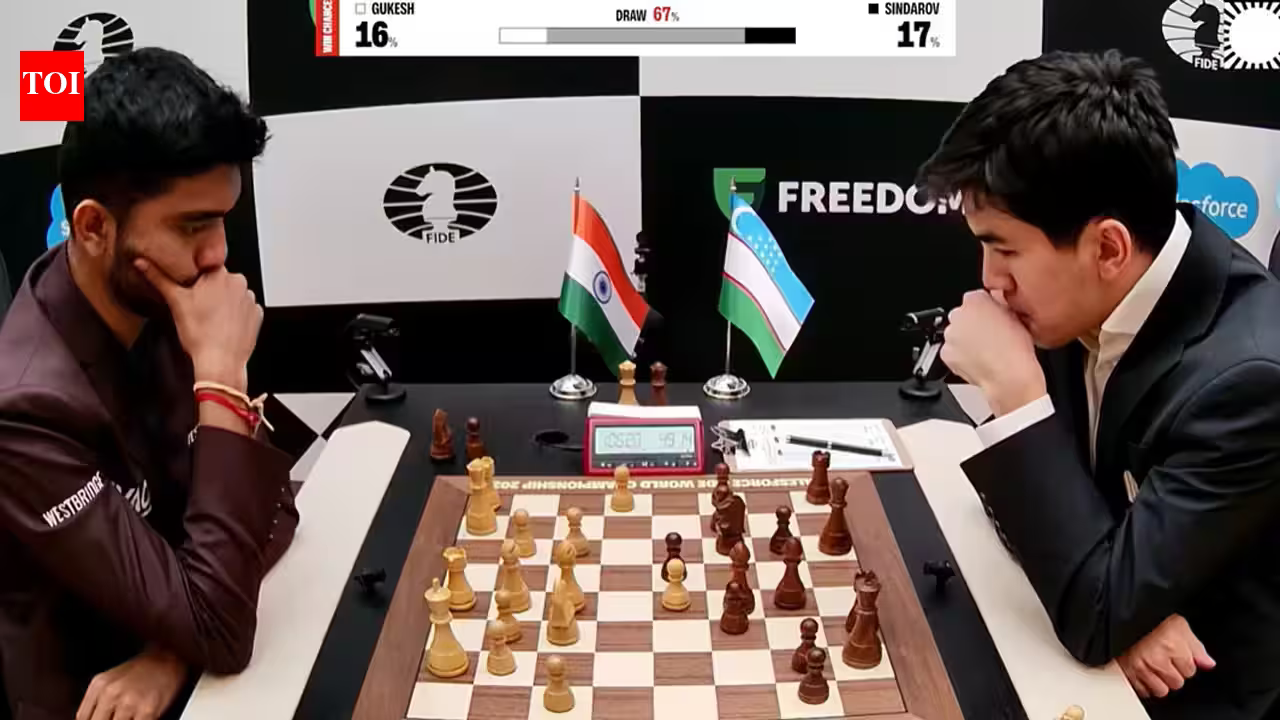
GENEVA — The intellectual warfare currently gripping the Swiss city of Geneva reached another stalemate on Saturday as D Gukesh and Javokhir Sindarov played to their fourth consecutive draw. In a match defined by precision, tactical restraint, and a profound respect for the Petroff opening, the two grandmasters once again found themselves locked in a cycle of balance, leaving the 14-game contest deadlocked at 2-2.
While the spectators in Geneva and the global online audience may be hungry for a decisive result, the two protagonists seem perfectly content to probe each other’s defenses with clinical, almost surgical, accuracy. Saturday’s encounter, which lasted just under four hours, was less a battle of blunders and more a testament to the modern standard of high-level defensive chess.
The Petroff Puzzle
The fourth game saw Gukesh—who opted to switch from the London System used in previous white-piece outings to a king-pawn opening—attempt to steer the game into uncharted territory. By deploying the rarely-seen 5.Be2, Gukesh aimed to narrow the position and force his challenger into unfamiliar lines. It was a tactical gamble that forced a 17-minute think from Sindarov, who eventually responded with the sturdy Ne6.
The maneuvering was sophisticated, with Gukesh attempting to utilize his preparation of 9.Qb1 to apply pressure. For a brief window, the Indian prodigy held a significant advantage on the clock, boasting a 25-minute buffer as he searched for a breakthrough. However, the 20-year-old challenger from Uzbekistan remained unflappable. Sindarov’s responses—specifically the precise sequence of Nxc3 followed by Qc8—effectively neutralized the threats before they could materialize into a tangible advantage for the champion.
Tactical Liquidation
As the game progressed toward the 20-move mark, the mounting pressure of the time control forced both players to sharpen their focus. Despite Gukesh’s attempts to exploit the board, the position underwent a series of inevitable simplifications. The exchange of rooks and dark-squared bishops stripped the board of its most volatile pieces, leading to an endgame consisting of queens and four pawns each.
Gukesh, needing to force the issue, sought a route to victory, but Sindarov’s defense held firm. Even a dangerous-looking passed pawn on the b-file, created by the Uzbek grandmaster, served more as a psychological hurdle than a genuine winning threat. Recognizing the parity of the position, Gukesh eventually opted for a series of perpetual checks, resulting in a three-fold repetition after 34 moves.
Post-Game Analysis and Mindset
Addressing the press after the draw, Sindarov echoed the sentiments of many elite chess theorists, noting that the nature of high-level preparation makes equality almost inevitable. “Chess is equal if both sides play well, always a draw,” Sindarov remarked. “It was a tricky game, but the draw is a normal result. Gukesh got the position that was easier to play with white.”
Gukesh, for his part, remained undeterred by the lack of a win in the opening four rounds. While he admitted to a moment of caution as his initial time advantage began to evaporate, he remains optimistic about the path ahead. “A lot of more games to come,” he said, reflecting a long-term strategy rather than a desperate scramble for an immediate point.
The tension of the match has not escaped the notice of the wider chess world. Legendary five-time world champion Viswanathan Anand recently weighed in on the psychological demands of such a high-stakes series, noting the importance of maintaining one’s own internal rhythm. “Playing fast in the opening is a show of confidence,” Anand told Chess.com. “But even if your opponent does that, you must play at your pace. The way to do it is to ignore the opponent’s speed and do it as if they don’t exist.”
Looking Ahead to Sunday
With four games now in the books and 10 remaining, the psychological warfare is only expected to intensify. The nature of the match will shift on Sunday as Sindarov takes the white pieces. Having demonstrated a high level of comfort in the Steinitz Attack variation—a line that served him well in his qualification run for the Candidates—Sindarov will likely attempt to turn the tables and force Gukesh into the defensive.
For Gukesh, the challenge will be to maintain his composure as the match enters its second week. The parity seen thus far reflects two players who are exceptionally well-prepared and wary of each other’s tactical reach. However, as the games tick down, the threshold for risk-taking will inevitably rise. Whether one of these grandmasters chooses to deviate from the established opening books or continues to rely on perfect technical play, Sunday’s fifth game promises to be a pivotal chapter in what is becoming a fascinating chess odyssey in the heart of Switzerland.
As it stands, the match is perfectly poised. While the scoreboards show 2-2, the real battle is happening within the clock management and the preparation rooms, where every half-move counts and no mistake goes unpunished. The fans in Geneva, and those tuning in from across the globe, will be waiting to see if tomorrow is the day the stalemate finally breaks.
Disclaimer: This content is auto-generated for informational purposes only.
Source: Read Original News