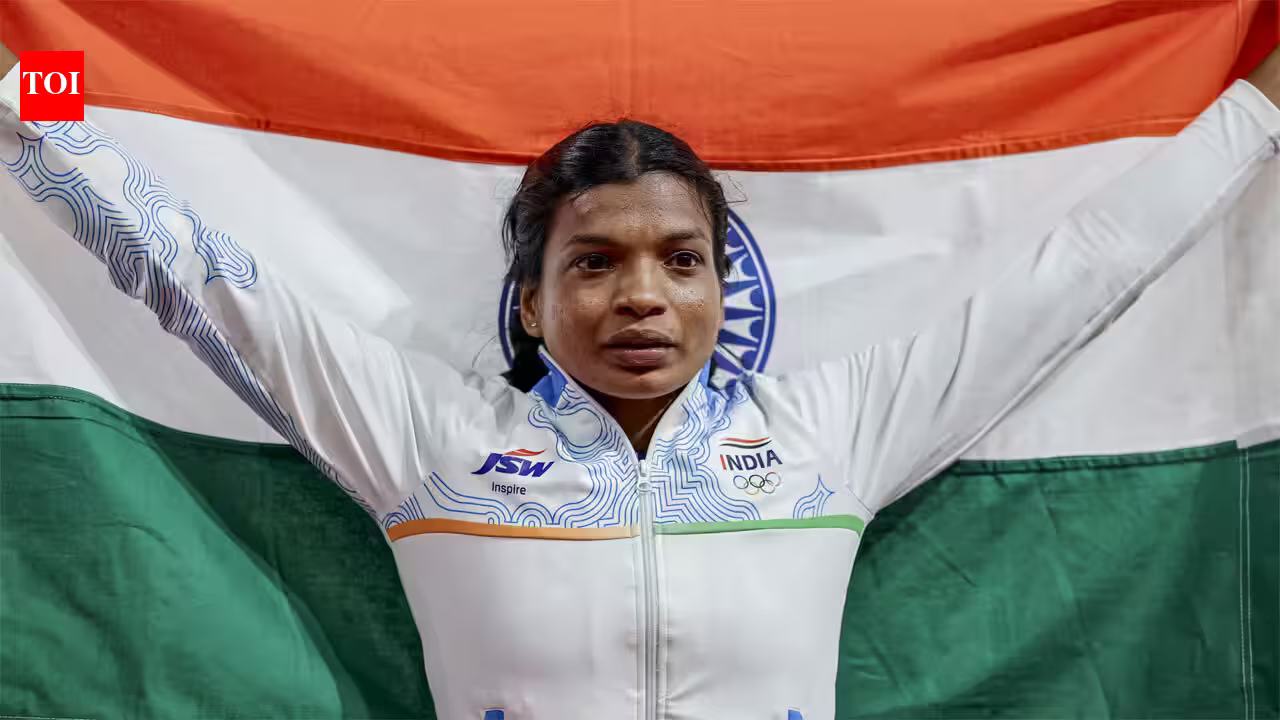






NAGOYA — For 24-year-old Baranica Elangovan, the glint of bronze around her neck at the Asian Games in Nagoya represents far more than a sporting achievement. It is a profound act of defiance, a physical manifestation of perseverance, and a resounding answer to the small-minded critics who once suggested that a girl from her village had no business scaling heights on a fiberglass pole.
When Elangovan cleared 4.15 meters in Nagoya to become the first Indian to ever secure a pole vault medal at the Asian Games, she wasn’t just etching her name into the record books. She was closing the chapter on years of injury, skepticism, and the stifling societal pressures that deemed her chosen discipline “too risky” for a young woman.
Breaking Barriers and Defying Taboos
The path to the podium was never paved with ease. Hailing from Mayiladuthurai, Elangovan’s foray into athletics was met with friction from those in her community who could not fathom a woman engaging in such a demanding, high-risk sport. When she suffered a grueling ACL injury in 2019, the whispers became audible.
“I come from a village. When I started, I underwent ACL surgery after an injury while vaulting in 2019,” Elangovan recalled in an interview following her historic finish. “At that time, everyone was telling my parents, ‘Why let a girl take part in pole vault? This event is quite risky. If something happens to her, no one will marry her.’ They were talking behind our backs.”
While the pressure to conform could have easily sidelined a lesser athlete, Elangovan’s parents proved to be her strongest pillars. Choosing to value their daughter’s potential over antiquated village norms, they entrusted her training to coach Milber Bertrand Russell.
“My mum and dad believed in me. They spoke clearly with the coach, and he told them, ‘She’ll be able to do more than you think. She’ll definitely shine in sport.’ They didn’t listen to others; they believed in me,” she said, her gratitude palpable.
An Unlikely Path to the Podium
Elangovan’s entry into pole vaulting was, ironically, a serendipitous accident. Upon moving to Chennai for college, her initial ambition was to excel in triple jump. However, while searching for a coach to hone her triple jump skills, fate intervened.
“I got a coach for the pole vault because of the event. After seeing it, I got really excited, and I just wanted to give it a try,” she explained. That impulsive curiosity sparked a journey that would eventually lead her to international prominence.
In Nagoya, the final was a test of nerves as much as agility. Both Elangovan and Kazakhstan’s Polina Ivanova found themselves locked in a battle for third place after both failed to clear 4.25 meters. The bronze was awarded based on a countback, but in the heat of the competition, the gravity of the moment hadn’t fully registered for the Indian athlete.
“I didn’t believe I’d won the medal,” Elangovan admitted. “My colleague came up and said, ‘You were at the bronze, you won it.’ I was aiming for a personal best, but I actually got the medal.”
Her approach to the competition had been strictly process-oriented. By focusing on her run-up and aggressive technique rather than the scoreboard, she managed to maintain the mental clarity required to perform under intense pressure.
Support Systems and Future Aspirations
The historic victory also highlighted the logistical hurdles Indian athletes often face on the world stage. Elangovan was quick to credit the Athletics Federation of India (AFI) for their pivotal role in her success, particularly regarding the transportation of her specialized equipment—a perennial headache for pole vaulters traveling internationally.
“This time, our Athletics Federation of India tried every possible way with every airline to take our poles, and they made it really possible,” she noted. “There was also a preparatory camp at Sugupa University one week before the Asian Games, which helped me adapt to the environment, food, and recovery. They sorted everything out.”
With the medal finally secured, Elangovan turned her thoughts to her mentor, Milber Bertrand Russell. “This is for you, Anna,” she said, dedicating the achievement to him.
Looking ahead, Elangovan is optimistic about the trajectory of the sport in India. Where there were once only a handful of practitioners, the landscape is shifting. She points to a burgeoning interest in the U-20 categories, suggesting that her own success might serve as a catalyst for a new generation of Indian pole vaulters.
“Definitely! When I started, there were only five to six competitors. Now, you can see around 15 competitors, and many more young athletes are doing it,” she observed.
Baranica Elangovan’s bronze medal is more than just a piece of hardware; it is a signal of changing times. By refusing to let the fear of injury or social stigma dictate her path, she has cleared the bar for future athletes to chase their own ambitions, regardless of the doubts whispered behind their backs. For now, she stands at the peak of a historic journey, looking toward a future where “risky” is simply another word for “opportunity.”
Disclaimer: This content is auto-generated for informational purposes only.
Source: Read Original News