







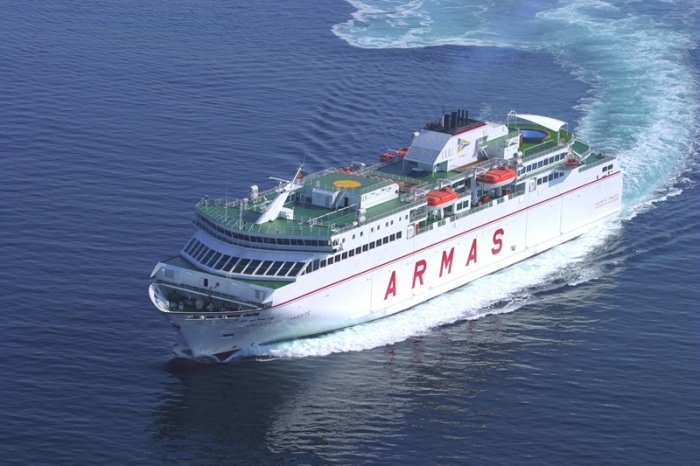
DFDS has announced a significant expansion of its operational capacity in the Strait of Gibraltar, marking a strategic move to solidify its foothold in the vital trade corridor between Europe and North Africa. Following formal regulatory approval from both Spanish and Moroccan competition authorities, the ferry giant has finalized an agreement with Naviera Armas to acquire the combined freight and passenger ferry, Volcán de Tamasite.
The addition of the vessel to the DFDS fleet is a direct response to the sustained growth in demand for both commercial freight and passenger travel on the Algeciras-Tanger Med route. The acquisition includes not only the ship itself but also the transfer of existing operational permits, allowing for a seamless integration into the company’s current network of two ferries already serving the region.
“The Strait of Gibraltar is an important link for trade and travel, and we are looking forward to continuing to serve the region with additional capacity,” said Michael Hansen, CEO of DFDS. “This will provide greater flexibility and enhanced connectivity for both freight and passenger customers.”
The Volcán de Tamasite is a familiar sight in these waters, having operated on this specific route for several years. The vessel is well-equipped to manage the high-volume traffic characteristic of the region, boasting a capacity for up to 1,469 passengers and 1,414 lane meters of freight. DFDS expects the ferry to officially enter service under its banner by mid-November.
For Ronny Moriana Glindemann, Managing Director for the Strait of Gibraltar at DFDS, the investment is about long-term stability and service excellence. “Adding a third vessel to our fleet strengthens our position in the Strait of Gibraltar and gives us greater flexibility to meet our customers’ transport needs,” Glindemann noted. “It also enables us to further develop our operations and support growing demand in the years ahead.”
This expansion is part of a broader strategy for DFDS, which oversees more than 10,000 sailings annually across its network. The Strait of Gibraltar routes are critical for the movement of essential goods, facilitating the transport of fresh produce, automotive components, textiles, and specialized industrial materials.
As supply chains between the European Union and North Africa continue to tighten, the deployment of the Volcán de Tamasite provides DFDS with a competitive edge. By increasing the frequency and reliability of its sailings, the company aims to streamline the movement of goods and people across one of the world’s most active maritime crossroads. With the integration process currently underway, stakeholders in the shipping and tourism sectors are keeping a close watch on how this added capacity will reshape regional logistics and travel connectivity in the coming months.
Disclaimer: This content is auto-generated for informational purposes only.
Source: Read Original News