









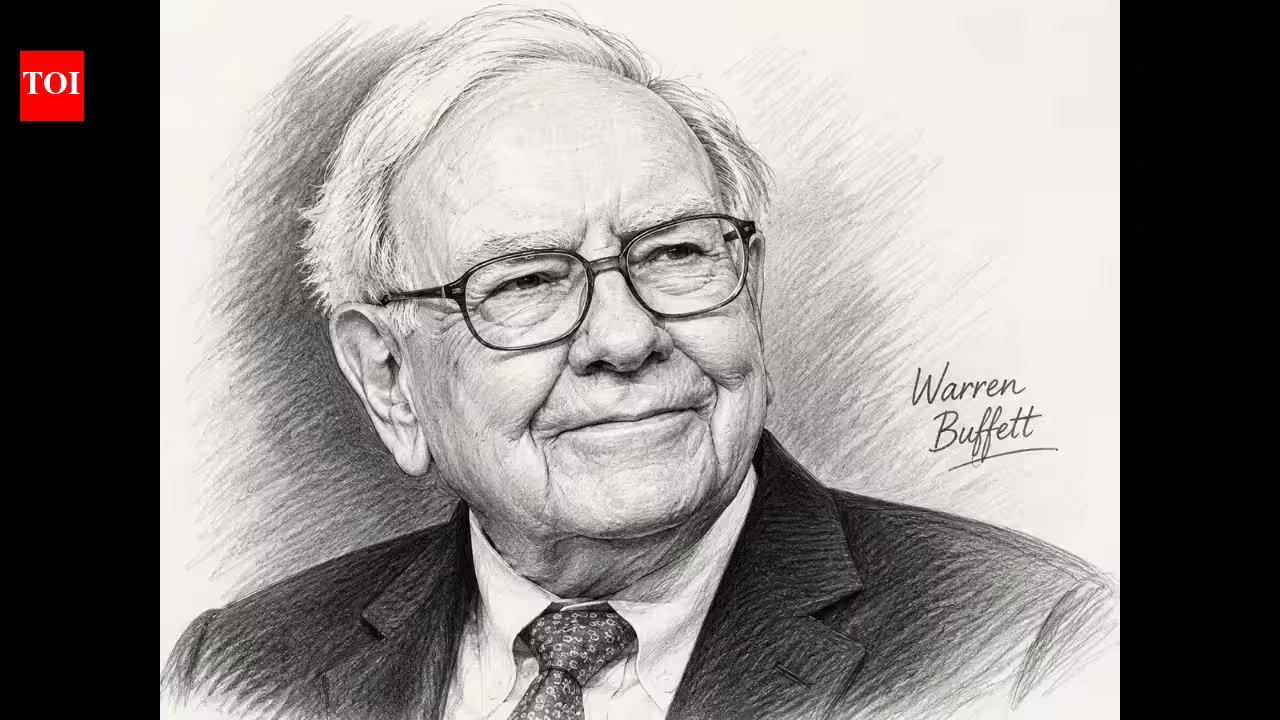
From Terrified to Titan: How Warren Buffett Conquered His Deepest Fear and What It Teaches Us
New Delhi, India – It’s a statement that would surprise many, coming from one of the world’s most successful and influential figures: "I had been terrified of public speaking. I couldn’t do it." These are the words of none other than Warren Buffett, the legendary American investor and former CEO of Berkshire Hathaway, as revealed in the HBO documentary "Becoming Warren Buffett." This candid admission challenges the popular misconception that highly successful individuals are inherently confident, offering a profound lesson on overcoming fear and building resilience.
For most people, the idea of confidently addressing a crowd is a daunting prospect, often leading to trembling hands, a blank mind, and a constricted throat. We often envision successful figures like movie stars effortlessly captivating audiences, overlooking the personal struggles they might have faced to reach that point. Buffett’s journey, however, demonstrates that even the "Oracle of Omaha" once grappled with a fear as common and paralyzing as glossophobia.
The Billionaire Who Feared the Stage
Long before he became the revered investor whose insights are dissected by business professionals globally, Buffett harbored a significant personal challenge: an intense fear of public speaking. As he confessed in the HBO documentary, this fear was so severe that he found it impossible to speak comfortably in front of an audience. Yet, Buffett possessed a critical insight that many only gain much later in life: the inability to communicate effectively could be a far greater impediment to success than a lack of financial acumen.
Driven by this realization, Buffett decided to confront his fear head-on. He enrolled in a Dale Carnegie public-speaking course. This wasn’t a grand amphitheater filled with thousands, but a simple classroom where he practiced week after week, slowly chipping away at his apprehension. Through consistent effort and repeated exposure, the very act he once dreaded began to lose its intimidating power.
Years later, the certificate from this public speaking course held a place of honor in Buffett’s office, alongside his prestigious degrees from the University of Nebraska and Columbia University. This seemingly small detail speaks volumes, highlighting the profound significance of overcoming a deeply ingrained fear. It represented a personal victory, a testament to his determination to conquer a weakness that could have otherwise limited his potential.
Nervousness Is Not a Precursor to Failure
A common mistake among students and professionals alike is to misinterpret nervousness as an indication of inadequacy. A shaky voice, a forgotten line, or even a momentary stammer can be misconstrued as evidence of incompetence. However, as the article emphasizes, nervousness doesn’t predict failure; it often signifies that what you are doing truly matters to you.
The fear associated with public speaking isn’t merely about vocal delivery; it’s intrinsically linked to being seen. Concerns about accents, grammar, appearance, or the possibility of making a mistake in front of others often fuel this anxiety. The underlying fear isn’t, "What if I can’t speak?" but rather, "What if people see me make a mistake?" The path forward, then, lies in embracing these imperfections, making mistakes, and discovering that the world doesn’t crumble as a result.
Action Before Confidence: The Buffett Way
Perhaps the most impactful lesson from Buffett’s experience is that he didn’t wait for confidence to magically appear before taking action. Instead, he started speaking, and confidence gradually followed. This challenges the common trap of delaying participation or presentations until one feels "more confident" or "less nervous."
Confidence, the article asserts, is not a prerequisite but a byproduct of action. The initial attempts might be awkward, and subsequent ones might still induce discomfort. However, through persistent effort and small victories, the fear begins to recede. The goal isn’t to eliminate fear entirely, but to teach the brain that speaking is safe, even with the presence of nervousness.
Start Small, Conquer Big
Buffett’s journey teaches us that monumental goals are achieved through incremental steps. Instead of envisioning a stadium packed with thousands, begin with smaller, manageable actions. Ask a question in class, volunteer to answer, explain a concept to a few friends, participate in a group discussion, or present to a small audience.
If your voice trembles, let it. If you forget a line, pause, breathe, and continue. The objective is not instantaneous fearlessness but a gradual re-education of your brain. Each time you stand up, speak, and survive the experience, you are actively rewriting the narrative of fear.
The True Value of Buffett’s Certificate
The enduring inspiration from Buffett’s story isn’t just his transformation into a brilliant orator, but his deliberate effort to address a recognized weakness. He understood that an unaddressed fear could limit his future, a lesson that extends far beyond public speaking. Whether it’s a fear of mathematics, asking "silly" questions, or shying away from opportunities due to self-doubt, fear can dictate decisions if left unchecked.
Buffett, despite having the option to avoid public speaking throughout his life, chose to confront it. This decision, the article concludes, proved to be one of the most valuable investments he ever made.
So, the next time a teacher asks for volunteers, don’t immediately avert your gaze or pretend to be preoccupied. Take a breath, raise your hand. Your voice might tremble, but let it. Your first sentence might not be perfect, but utter it anyway. Because in those uncomfortable classroom moments, a stronger, more confident version of you is emerging – one that understands that confidence is not the absence of fear, but the ability to move forward despite it. Your journey, much like Buffett’s, can begin with one raised hand, one trembling voice, and one decision to reclaim your voice from the clutches of fear.