









Strategic Reshoring: India’s Targeted Approach to Industrial Self-Reliance
The Indian government’s latest initiative to identify approximately 120 key products for intensive domestic manufacturing marks a calculated evolution in its industrial policy. By moving beyond broad-based incentives, the Department for Promotion of Industry and Internal Trade (DPIIT) is shifting toward a granular, product-specific strategy. This movement is designed to mitigate systemic risks associated with import dependence, particularly for critical intermediates and capital goods that form the backbone of the nation’s burgeoning industrial ecosystem.
Historically, India has relied on global supply chains to fuel its manufacturing growth. However, disruptions caused by geopolitical tensions in West Asia and the lessons learned from the pandemic have highlighted the fragility of this model. When global logistics falter or foreign suppliers impose export restrictions—as seen with recent limitations on tunnel boring machines—the Indian economy faces immediate, localized inflation and production delays. The current strategy seeks to insulate the domestic market from these external shocks by fostering a robust local production base for essential components.
The Mechanism of Intervention: Protection, Incentives, and R&D
The government’s strategy is not a monolithic directive; rather, it utilizes a three-pronged intervention model designed to address the specific economic hurdles facing manufacturers. The first pillar is short-term trade protection. By leveling the playing field against aggressive pricing from foreign competitors, particularly from jurisdictions like China, the state provides a temporary shield that allows domestic firms to scale operations. This approach mirrors the successful rollout of the mobile phone manufacturing sector, where phased protection facilitated the growth of a domestic assembly and component ecosystem.
The second pillar focuses on correcting structural cost disadvantages. Indian manufacturers often face higher logistics and power costs compared to their global counterparts. To bridge this, the government is considering capital incentives and turnover-linked subsidies. These financial levers are intended to lower the cost of entry and operation, making locally manufactured goods price-competitive.
The third and perhaps most vital pillar is the commitment to Research and Development (R&D). The government has recognized that simple assembly, or “screwdriver manufacturing,” is insufficient for long-term security. Previous experiences in battery assembly and solar panel production, where manufacturers merely imported cells and sold finished packs, revealed that true sovereignty resides in the ownership of the technology. By providing R&D support, the government aims to catalyze the development of proprietary technology within India, ensuring that the entire value chain—not just the final assembly—is rooted in domestic capability.
Targeting High-Impact Sectors
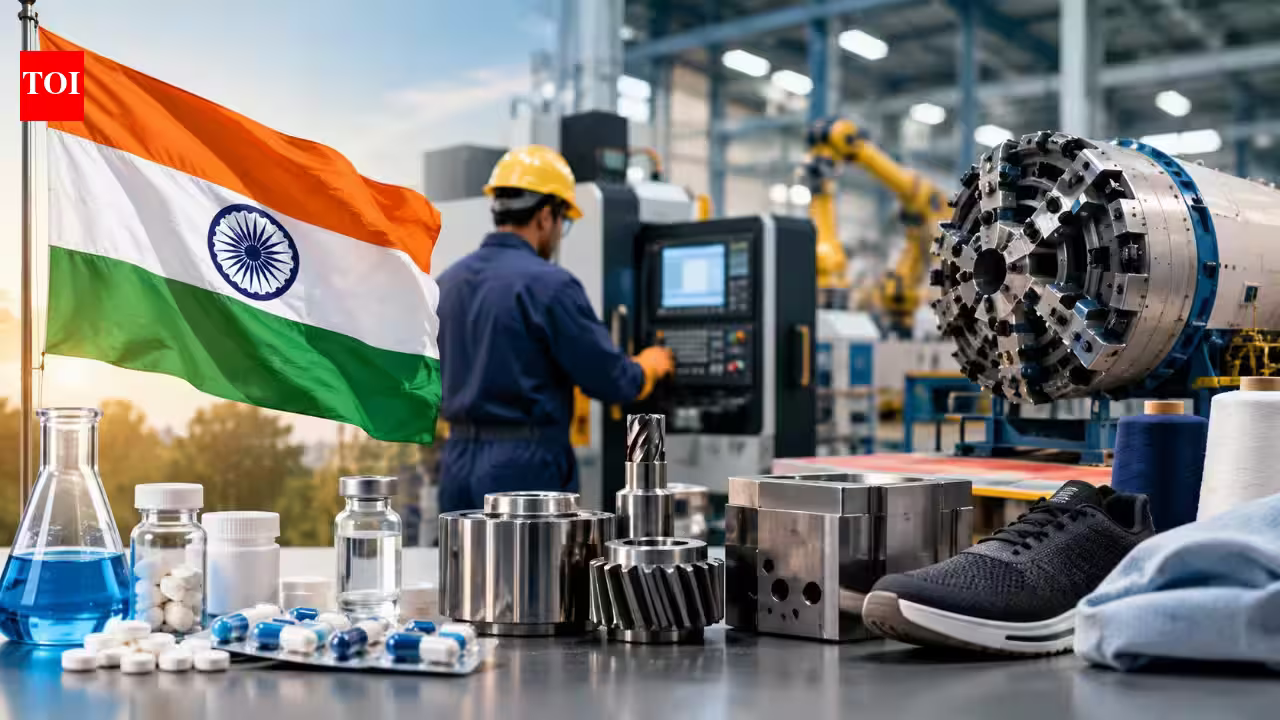
The selection of the 120 products is a strategic exercise in industrial mapping. The list includes specialized chemicals like acetic acid, pharmaceutical ingredients, medical technology, machine tools, textile looms, and aerospace maintenance, repair, and overhaul (MRO) equipment.
The focus on pharmaceutical inputs is a direct response to the national imperative for health security. Similarly, prioritizing machine tools and construction equipment addresses the “hardware” of industrialization. As India continues to ramp up infrastructure projects, the demand for high-end construction machinery—including the aforementioned tunnel boring machines—has surged. Reducing reliance on foreign machinery not only stabilizes project timelines but also fosters a secondary industry of maintenance and spare parts, further deepening the domestic industrial footprint.
The Legacy of PLI and the Evolution of Policy
Over the past decade, the Production Linked Incentive (PLI) schemes have been the cornerstone of India’s manufacturing ambitions. These schemes have successfully attracted major international players to set up shop in India, effectively integrating the country into the global value chain for electronics, white goods, and semiconductors. However, the current initiative represents an evolution from “attracting investment” to “building depth.”
The government is now addressing the gaps that the PLI schemes identified. For instance, while PLI schemes successfully increased the assembly of electronic devices, the next logical step is the indigenization of electronic components. The reliance on imported components meant that while domestic manufacturing output rose, so did the import bill for critical inputs. The current push seeks to close this loop by incentivizing the production of the very components that the PLI-backed assembly units consume. This ensures that the multiplier effect of government spending remains within the national economy.
Economic Implications for the Indian Business Context
For the Indian corporate sector, this policy pivot offers both challenges and significant growth opportunities. Companies that have historically thrived on trading imported goods will need to reassess their business models. The regulatory environment is signaling that value addition must happen within India. Firms that pivot toward manufacturing these 120 critical items will likely find themselves in a favorable position to access government subsidies, preferential procurement, and protection from predatory pricing.
However, the success of this plan hinges on execution and the ability of the private sector to absorb the technology required for high-end manufacturing. The emphasis on R&D is a signal to Indian firms to invest in engineering talent and technical collaboration. If domestic companies can successfully transition from being importers to innovators, the resulting industrial base will be significantly more resilient and scalable.
Navigating Global Realities and Future Stability
India’s industrial strategy is inextricably linked to the broader goal of Atmanirbhar Bharat, or self-reliant India. In an era where “friend-shoring” and “de-risking” have become buzzwords in global boardrooms, India is positioning itself as a reliable, self-sufficient node in the global economy. By securing its supply chains for critical intermediates and capital goods, India is not necessarily opting for autarky, but rather seeking the autonomy required to navigate a volatile geopolitical landscape.
The integration of medical technology, aerospace MRO, and advanced machinery into the manufacturing priority list reflects a sophisticated understanding of future demand. As India’s economy grows, the complexity of its industrial needs will only increase. By front-loading the development of these industries, the government is attempting to prevent future supply bottlenecks before they occur. The ultimate measure of this policy will be the extent to which it reduces the trade deficit in these categories and replaces imported content with high-quality, locally engineered alternatives. As India moves forward, the synergy between government support and private sector enterprise will determine the durability of this new manufacturing wave.
Disclaimer: This content is auto-generated for informational purposes only.
Source: Read Original News