







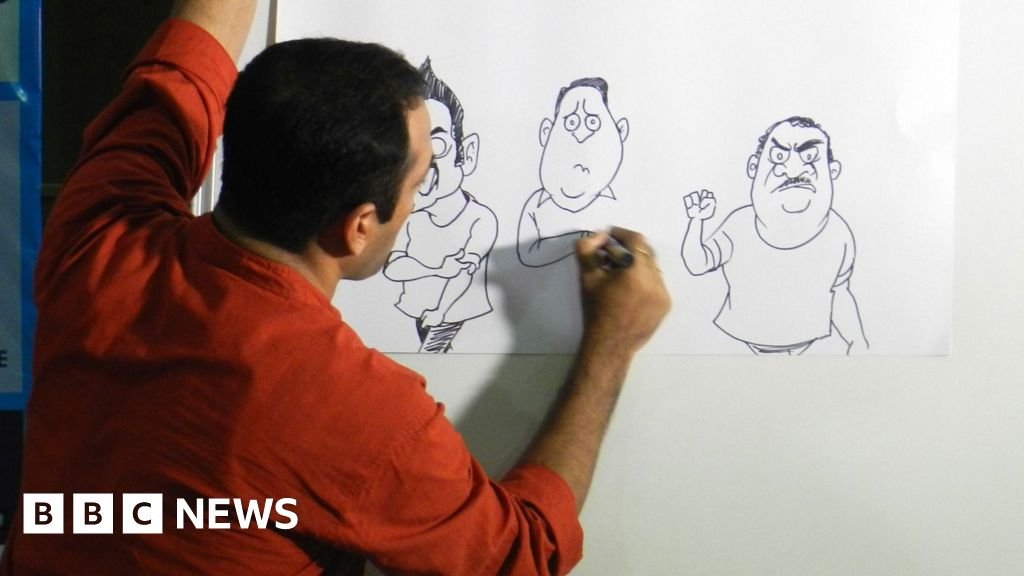
The Shrinking Margin for Mirth: Indian Cartoonists Navigate a New Era of Censorship
For decades, the political cartoon was a staple of the Indian breakfast table—a punchy, ink-stained critique that held power to account with wit and irony. From the legendary works of R.K. Laxman’s “The Common Man” to the sharp, biting social commentary of modern digital artists, satire has long served as a vital safety valve in the world’s largest democracy. However, as the digital landscape shifts, many of the country’s leading cartoonists are reporting an increasingly hostile environment, where online restrictions and a hyper-sensitive public discourse are making the art of political ridicule harder than ever.
The Digital Minefield
The transition from print to the digital sphere has been a double-edged sword for creative expression. While social media platforms like X (formerly Twitter) and Instagram provide a global stage for artists to showcase their work, they also expose them to unprecedented levels of scrutiny. Cartoonists today describe a landscape fraught with “digital lynch mobs,” where a single satirical drawing can trigger a deluge of harassment, coordinated reporting to platform moderators, and in more extreme cases, legal intimidation.
“The space for dissent is being squeezed from both ends,” says a veteran political cartoonist based in New Delhi, who requested anonymity for fear of professional reprisal. “You have the institutional pressure—laws that are increasingly invoked to criminalize speech—and then you have the grassroots pressure from ideological armies online. It’s no longer just about the editor killing your cartoon; it’s about the entire internet trying to kill your career.”
Self-Censorship as a Survival Strategy
The psychological toll of this climate has led to a pervasive culture of self-censorship. Many artists acknowledge that they now “edit” their own work before it ever leaves their desks, performing a mental calculus to determine if a caricature will invite an Information Technology Act notice or a visit from local authorities. This preemptive pruning of ideas, they argue, is more dangerous to democracy than any formal ban, as it slowly leaches the teeth out of satire.
When satire loses its edge, it ceases to be satire. It becomes decorative. Many cartoonists fear that if they stop poking the bear, the bear will eventually stop fearing the gaze of the public entirely. The nuance of a well-crafted visual metaphor is often lost on algorithms and polarized audiences, both of whom prefer to view political commentary through the binary lens of “with us or against us.”
The Spirit of Defiance
Despite these mounting hurdles, the creative community remains remarkably resilient. Rather than abandoning the craft, many cartoonists are adapting their tactics. Some have moved behind paywalls on subscription-based newsletters, cultivating niche communities where they feel safe to express their views without fear of mass-reported takedowns. Others are turning to more abstract, allegorical forms of art that rely on coded messages to bypass the simplistic sensitivities of the digital crowd.
The consensus among the fraternity is clear: satire is an essential diagnostic tool for a healthy society. If the cartoons stop, it suggests that the society has lost its ability to laugh at itself—a precursor to deeper authoritarian trends. By continuing to hold up the mirror, however cracked it may be, Indian cartoonists are insisting that the right to dissent remains a cornerstone of the nation’s identity. The ink may be drying on the page, but the resolve to keep drawing, they assert, is far from exhausted.
Disclaimer: This content is auto-generated for informational purposes only.
Source: Read Original News