









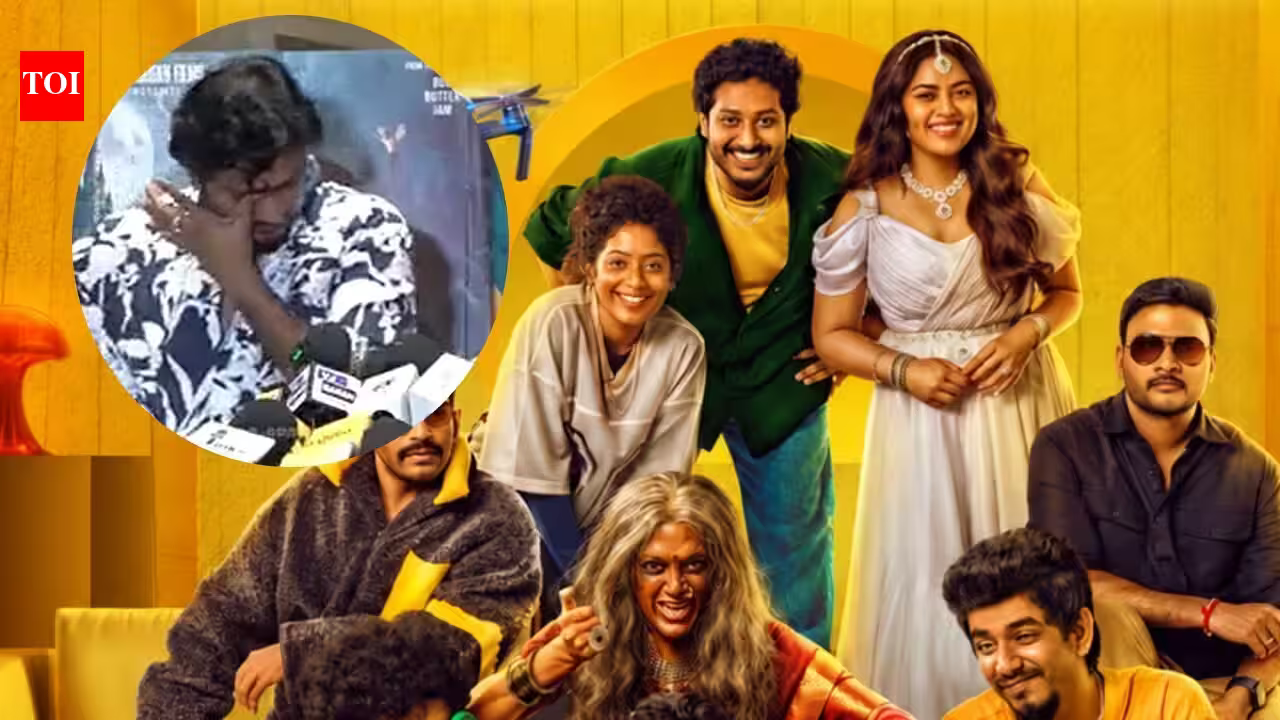
The landscape of Tamil cinema has long been a battlefield of titans, where the sheer gravity of a superstar’s project can often pull the oxygen out of the room for smaller, independent ventures. This week, that reality has hit home with a gut-wrenching force for the team behind the horror-fantasy comedy Drones.
Directed by Raghav Mirdath and featuring a cast that balances established talent with rising stars—including Parithabangal fame’s Dravid, the luminous Siddhi Idnani, Anjali Nair, Devadarshini, and Qureshi—the film arrived on October 16 with high hopes and a unique premise. Yet, as it fights for its life in an unforgiving exhibition market, the film’s creative producer, Satheesh, has stepped into the spotlight, not to celebrate a box-office victory, but to issue a desperate, tearful plea for the one thing every filmmaker needs: a platform to be seen.
The Struggle for Visibility in a Superstar-Dominated Market
The release timing of Drones was, in industry parlance, a “calculated risk” that unfortunately tipped into a nightmare scenario. Hitting screens just one day after the juggernaut Jailer 2 meant that the lion’s share of theater owners’ attention—and their screen allocations—was immediately locked up by the Rajinikanth-led sequel.
For a mid-budget, genre-bending film like Drones, the math is brutal. When multiplexes and single screens are forced to prioritize the biggest commercial draws to ensure their own survival, “smaller” films often get relegated to the fringes: odd hours, minimal show counts, or worse, being yanked from the marquee entirely before the word-of-mouth cycle can even begin. Satheesh’s recent press meeting served as a sobering reminder of this lopsided ecosystem. He didn’t mince words, describing a grueling week of professional begging. “We have made a good film with young talents, and everyone who has watched it has appreciated it,” he said, his voice thick with emotion. “But there has not been a single day in the past week when we have not pleaded with theatre owners. We are not getting a platform. How can we show our talent if we do not get one?”
The Paradox of Positive Reviews and Empty Seats
There is a specific, modern tragedy in the story of Drones: it is being liked by those who actually manage to find it. In the digital age, a film’s success is often predicated on the “first weekend” rush. When audiences are denied the convenience of multiple showtimes, that momentum dies on the vine.
Reports from the ground indicate that in several locations, Drones has been restricted to a solitary screening per day. For a film that relies on the “horror-fantasy comedy” hook, the atmosphere is key. Watching such a film at 10:00 AM in a mostly empty hall is a far cry from the intended theatrical experience, which in turn hampers the film’s ability to generate the kind of viral buzz that can save a struggling release. The irony, as Satheesh noted, is that the very people the film was designed to entertain—the younger, tech-savvy audience—are ready and willing, but the logistics of the current distribution model are keeping the seats empty.
The Second-Week Hurdle and the Battle for Survival
Entering its second week, Drones finds itself at a precarious crossroads. While the film has managed to survive the initial onslaught, the hurdle is only getting higher. New releases are queuing up to claim the already scarce screen space, and the pressure on exhibitors to maintain high occupancy rates is unrelenting.
The team is currently engaged in a desperate outreach campaign, trying to convince theater owners that Drones is a viable product that can provide steady, if modest, returns. However, the industry’s reliance on “tentpole” movies creates a self-fulfilling prophecy: if a film isn’t allowed the breathing room to grow, it is labeled a failure, even if the creative output was superior to the competition. The Drones team isn’t asking for special treatment; they are asking for the opportunity to let the audience be the judge.
A Broader Conversation on Theatrical Fairness
The plight of Drones highlights a systemic issue within the Tamil film industry that has been simmering for years. While the glory of blockbusters sustains the industry’s economy, the health of the broader ecosystem depends on the survival of independent and mid-tier films. When directors like Raghav Mirdath and producers like Satheesh are forced to use their press time to plead for basic access, it indicates that the “gatekeepers” of the cinema experience—the exhibitors—are increasingly risk-averse.
The question remains: does the audience truly have a choice, or is the choice being made for them by distribution monopolies? As Drones continues its uphill climb, it serves as a litmus test for the industry. If a film with decent reviews and a talented cast cannot find a home, what hope is there for the next generation of filmmakers who aren’t backed by massive studio budgets?
For now, the team behind Drones continues to soldier on, hoping that the voices of the few who have seen and loved the film will grow loud enough to force a change in strategy. It is a David versus Goliath battle in the truest sense, and as history has shown, Goliath usually holds the keys to the cinema hall. But for the sake of artistic diversity, one can only hope that the audience, through their own support, forces a crack in that wall. If you are looking for something different at the cinema this week, you might just find that this “drone” is worth the price of admission.
Disclaimer: This content is auto-generated for informational purposes only.
Source: Read Original News