







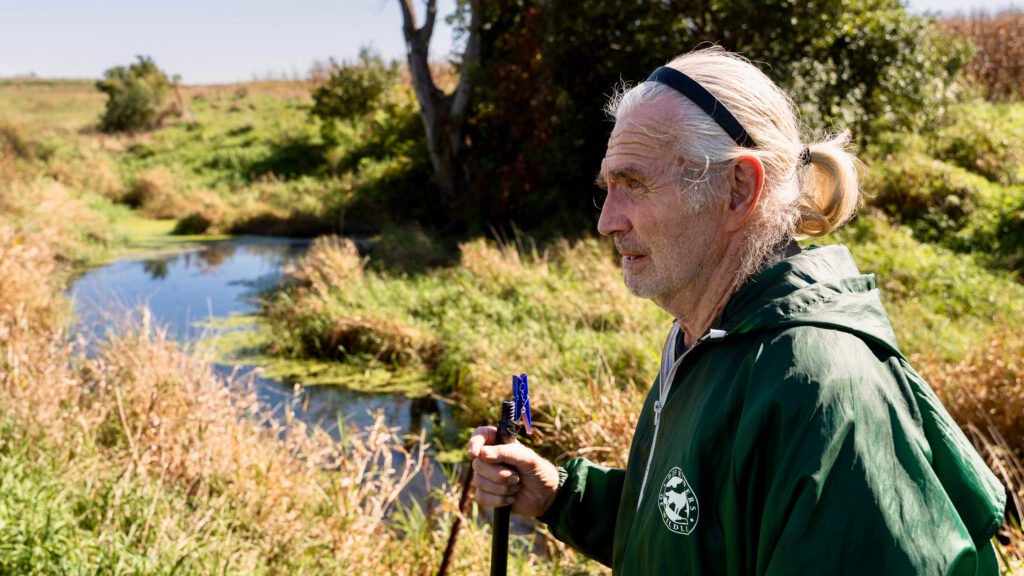
When rainwater rolls down the hillside near Gordon Garrison’s property in Estherville, Iowa, it frequently arrives at the local stream carrying a foul, murky red hue. For Garrison, the source is clear: a 4,400-head hog confinement facility, built half a mile from his home in 2015, which regularly spreads liquid manure across the surrounding, sloping fields.
Garrison’s experience is a microcosm of a systemic regulatory failure in Iowa. While the federal Clean Water Act of 1972 was designed to protect the nation’s waterways from pollution—specifically from concentrated animal feeding operations (CAFOs)—Iowa has largely sidestepped its enforcement duties. As factory farms have proliferated across the state, the Iowa Department of Natural Resources (DNR) has embraced a philosophy of “coaching for compliance,” prioritizing technical assistance over the rigorous permitting and penalization required by federal law.
The scale of the issue is immense. Iowa is home to nearly 4,000 federally recognized CAFOs, yet only 4 percent of them hold the National Pollutant Discharge Elimination System (NPDES) permits mandated by the Clean Water Act. Thousands more operations are categorized as “automatically exempt” by state law, which claims they have no potential to discharge waste. However, the environmental reality contradicts this; manure spills, stormwater runoff, and leaching nutrients have turned Iowa’s network of waterways into a landscape of degradation, forcing municipal water utilities to spend millions on treatment systems.
The impact is not merely ecological; it is a public health crisis. Elevated nitrate levels in drinking water have forced communities to invest in costly removal infrastructure, while private wells—which serve 300,000 Iowans—remain largely unmonitored. Research continues to link long-term exposure to nitrates with thyroid disease, reproductive risks, and certain cancers. With Iowa experiencing high and rising rates of new cancer cases, public frustration has boiled over, fueling movements like the “Protect Water, Prevent Cancer” campaign.
The state’s reluctance to enforce the law has not gone unnoticed by federal authorities. In 2011, the EPA investigated the Iowa DNR and found it was failing to meet its Clean Water Act obligations. A subsequent five-year remedial work plan was established to correct the path, but the results were negligible. Between 2013 and 2018, the number of CAFOs with NPDES permits in Iowa actually declined, despite the industry’s massive growth.
“They’re just doing what the state lets them get away with,” Garrison says. After reporting manure runoff from the neighboring facility in 2018, he watched as the DNR fined the operator $4,800—a minor administrative penalty—without requiring an NPDES permit. When Garrison attempted to sue the facility in federal and state courts, his cases were ultimately dismissed, hindered by a legal landscape that prioritizes the state’s agricultural economic engine over environmental accountability.
The state’s approach hinges on a “permanent remedy” loophole. Instead of requiring permits, which bring stricter monitoring and higher financial liability, state inspectors often clear facilities of violations once a corrective action—such as building a dirt berm or cleaning a spill—is completed. This policy treats systemic pollution as a series of isolated incidents, ignoring the ongoing risks of operating thousands of large-scale animal facilities.
Even as the political debate over water quality intensifies ahead of midterm elections, change remains elusive. For residents like Garrison, the burden of monitoring has shifted to the citizens themselves. He now volunteers with Nitrate Watch, a project that has confirmed that more than 50 percent of surface water samples in the state show nitrate levels at or above federal drinking water limits.
For Garrison, the lack of enforcement is a calculated choice rather than a lack of resources. “We don’t fund the regulator,” he notes. “That’s the best way not to have regulations enforced.” As the state continues to act as a sacrifice zone for the industrial meat industry, the health of its water and its people remains in a precarious state, left to the mercy of a system that has long since abandoned its mandate to protect.
Disclaimer: This content is auto-generated for informational purposes only.
Source: Read Original News