






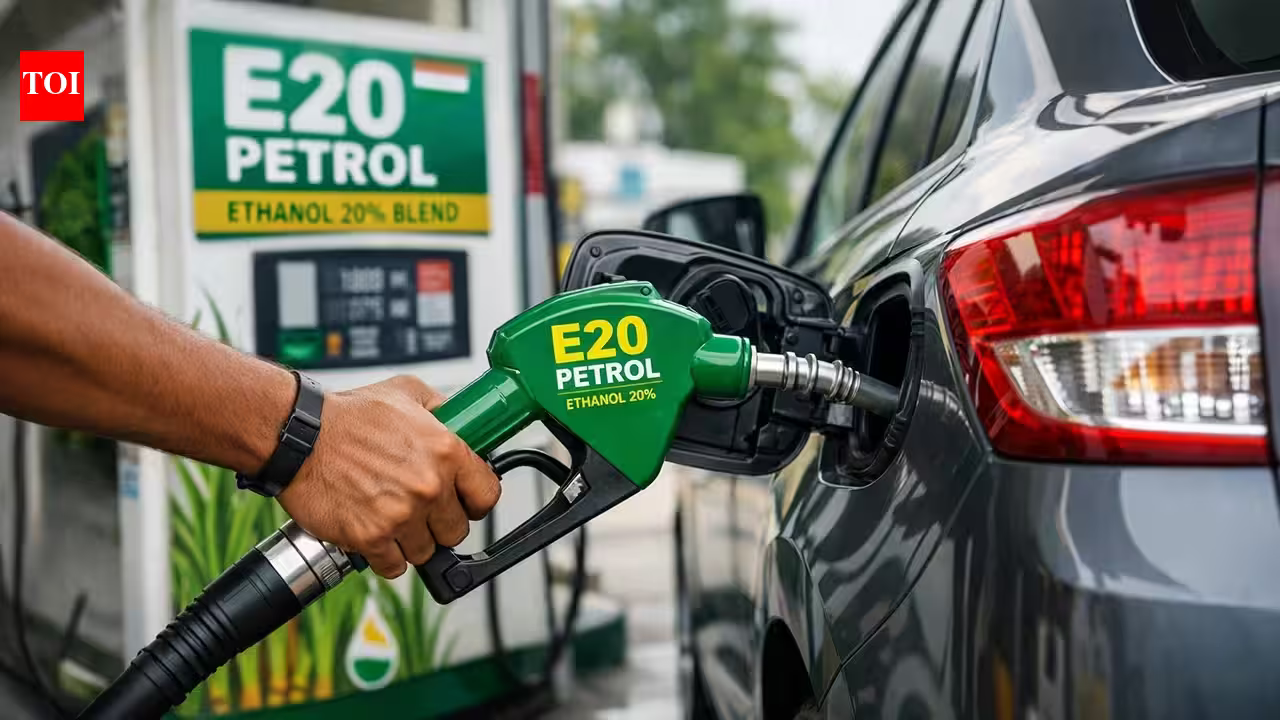
Chief Economic Adviser V. Anantha Nageswaran has put forth a significant recommendation for the Indian government: to reintroduce petrol with a lower ethanol content at fuel stations. This call comes amidst growing apprehension among consumers regarding the potential impact of E20 petrol, which contains a 20% ethanol blend, on their vehicles. Since its nationwide rollout last year, and particularly since April 1st when it became the sole petrol variant available, E20 has been a cornerstone of India’s strategy to curtail reliance on imported oil and mitigate environmental pollution.
Nageswaran, in an opinion piece co-authored with Akash Poojari, a consultant in India’s Department of Economic Affairs, suggested that “Restoring a lower blend at the pumps, say, E10, alongside the option to buy E20, would calm most public concern.” This marks a notable public appeal from a senior official for greater flexibility in fuel choices, especially as consumer dissatisfaction with the current policy continues to mount. While both authors emphasized that their views were personal, such a public divergence from an established government stance is considered unusual among high-ranking Indian officials, a point highlighted by Reuters.
The government had previously stated in the preceding month that it had no intentions of reintroducing lower-ethanol petrol variants, such as E0 or E10. However, the mandatory transition to E20 has generated widespread concerns regarding vehicle performance and the potential for damage to various automotive components. Numerous vehicle owners have taken to social media platforms to express their discontent, demanding the reinstatement of petrol with a reduced ethanol content.
A recent report by Reuters shed light on the fact that senior executives within major Indian automakers have privately voiced their apprehension regarding potential contamination issues in E20. Although the opinion article by Nageswaran and Poojari stated that current evidence does not definitively support claims of E20 damaging engines, it did acknowledge the potential for problems, particularly with older vehicles. The article specifically pointed out that “India has roughly 75 to 80 million older two-wheelers… older rubber seals that are not rated for ethanol are a separate problem… retrofitting those seals… that way will take years.” Consequently, the authors urged the government to “protect the existing fleet while the retrofit programme catches up.”
The Central government’s decision to mandate E20 petrol has also ignited a significant political debate. Opposition leaders have referenced a 2021 NITI Aayog report, questioning whether the nationwide implementation of E20 adhered to the prescribed safeguards and phased approach outlined in the report. This debate further intensified during a Supreme Court hearing concerning petitions challenging the E20 policy. During this hearing, Attorney General R. Venkataramani characterized E20 as an “experiment,” with its outcome anticipated to become clear in the coming year. The Centre subsequently clarified that it was not referring to E20 itself as an experiment.
Among consumers, the most prominent concern revolves around fuel efficiency. Despite these apprehensions, the Centre has steadfastly defended the ethanol blending program. They argue that increased blending has been instrumental in reducing India’s reliance on imported crude oil, conserving foreign exchange reserves, and bolstering energy security. Furthermore, the government has emphasized that India achieved its 20% blending target five years ahead of the original 2030 deadline. The government has also refuted claims that India’s ethanol policy is an anomaly on the international stage, asserting that the country is part of a broader global movement towards higher ethanol blends. As an illustrative example, they cite the United States, where E10 is the standard petrol blend, E15 is being expanded, and millions of flex-fuel vehicles are designed to operate on blends containing up to E85.