




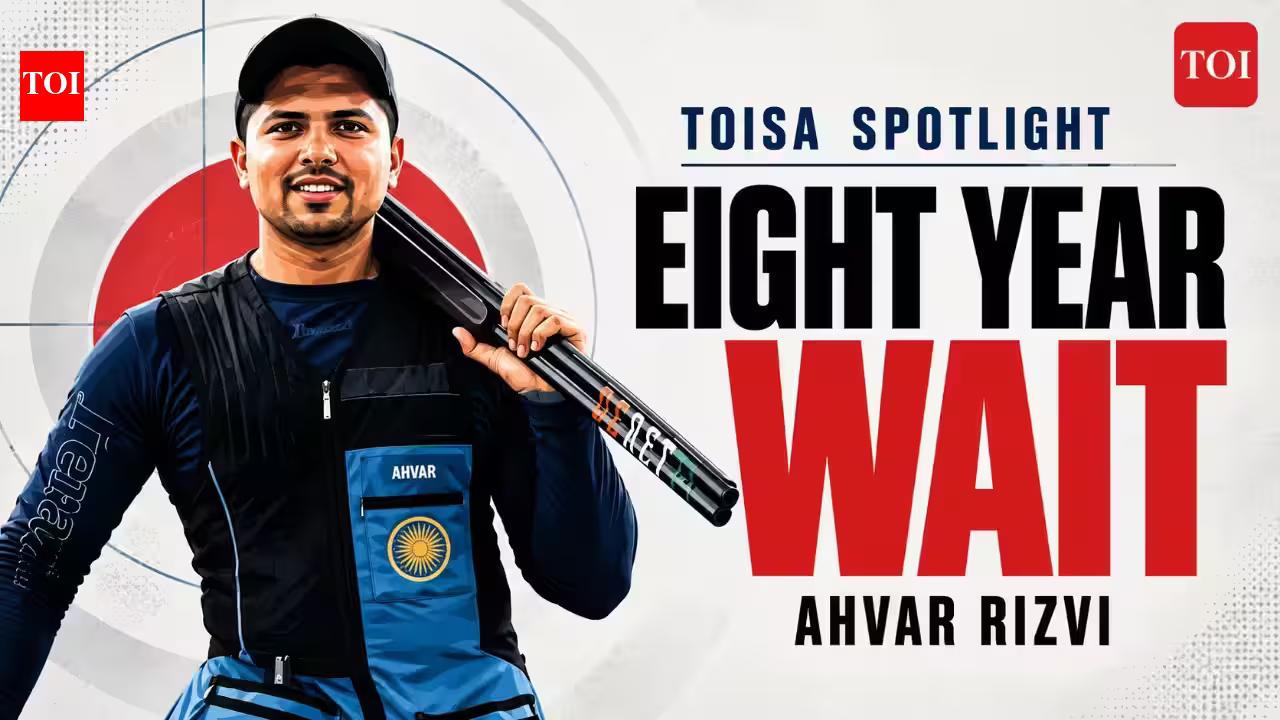
Persistence is a virtue often tested in the unforgiving arena of competitive shooting, and for 26-year-old Ahvar Rizvi, the path to the Asian Games has been defined by exactly that. Seven years after a crushing heartbreak nearly derailed his career, the shooter from Mahalgaon, Meerut, is finally set to represent India on the continental stage.
The journey to the 2026 Asian Games squad—where he joins Kynan Chenai and Shapath Bharadwaj—has been anything but linear. It is a story of adaptation, the kindness of peers, and a refusal to let the vanishing of his preferred discipline signal the end of his Olympic dreams.
The Heartbreak of 2018 and a Forced Evolution
In 2018, Rizvi was a rising star in Double Trap, fresh off a triumphant gold-medal performance at the Junior World Championships in Changwon. Everything seemed to be falling into place for the Asian Games selection. But in the razor-thin margins of elite shooting, a single point can be the difference between glory and obscurity.
“I missed the Asian Games by one point,” Rizvi recalled. “I was very sad because there is a competition once every four years, and it is a big competition. You miss that, so then I didn’t understand what to do.”
The blow was compounded by international regulation changes that effectively erased Double Trap from the competitive circuit. Suddenly, the discipline in which Rizvi had established himself for nearly seven years was gone, leaving him to navigate the steep learning curve of Trap shooting. “I struggled a lot when Double Trap was closed,” he admitted. “I had been in the team continuously for seven years, and then suddenly I was out of the team.”
For a young athlete, the transition was not just technical; it was an identity crisis. He faced years of missing selection by narrow margins, at times even stepping away from the range entirely, questioning if his future lay in the sport at all. But through the guidance of his coach, Vikram Singh Chopra, and a persistent internal drive, Rizvi eventually found his rhythm.
From Borrowed Steel to Competition-Ready
The road to recovery required more than just hours on the range; it required the right equipment. Transitioning from a specialized Double Trap setup meant Rizvi needed a new firearm, a costly and complex process. In a testament to the camaraderie of the Indian shooting circuit, fellow shooter and Asian Games silver medallist Lakshya Sheoran stepped up, providing Rizvi with a Trap gun that he utilized for a year across nationals and trials.
“Although I have a trap gun, this gun is not mine. This is my friend Lakshya’s gun,” Rizvi shared. While the firearm came from a friend, Rizvi took ownership of his performance by sourcing a custom stock from Italy, meticulously adjusting it to fit his ergonomics. The results of that fine-tuning, overseen by coach Vikram Singh Chopra, have provided the stability he lacked during his early, frustrated years in the sport.
“I am seeing a lot of improvement since I changed my stock,” Rizvi noted. “I was a little worried about my equipment, but now I just have to focus 100 per cent on what I have to do.”
Life Outside the Crosshairs
While his focus is currently anchored on the clay targets of Nagoya, Rizvi maintains a grounded existence far from the tension of international matches. Hailing from a farming background, he views his time in the fields with his father and brother as an essential counterbalance to the high-pressure environment of the shooting circuit.
“Ahvar Rizvi is a normal person. He is a son of a farmer, and if there is no shooting, he is in the fields with his father and elder brother,” he said. This humility seems to serve as a psychological anchor, keeping him focused on the task at hand rather than the grandeur of the stage he is about to enter.
However, the transition to the Asian Games is not lost on him. He acknowledges the natural nerves that come with international competition but has developed a systematic approach to managing them. “There is excitement and nervousness when we play a match. But the main thing is to control it,” he explained. “When I talk to my coach whenever I get nervous, I get a lot of relief and I stay focused.”
Eyes on the Future
Rizvi’s 2026 campaign has been a period of steady growth. While his results at the Almaty and Lonato World Cups indicate he is still fine-tuning his consistency, his selection for the Asian Games proves that he has arrived at a place of maturity.
Looking back at the one-point deficit of 2018, Rizvi no longer dwells on what might have been. “I went back and never looked back,” he says with conviction. With the 2028 Olympics already appearing on the horizon, he views the Asian Games not as a final destination, but as a crucible for his future aspirations.
As he prepares to hold the Indian flag high in Nagoya, his mantra remains simple and resilient: “If the target is going to be left, let it come. But we have to break. We have to hit the target. Never give up.”
For Ahvar Rizvi, after years of silence and transition, the target is clearly in sight.
Disclaimer: This content is auto-generated for informational purposes only.
Source: Read Original News