






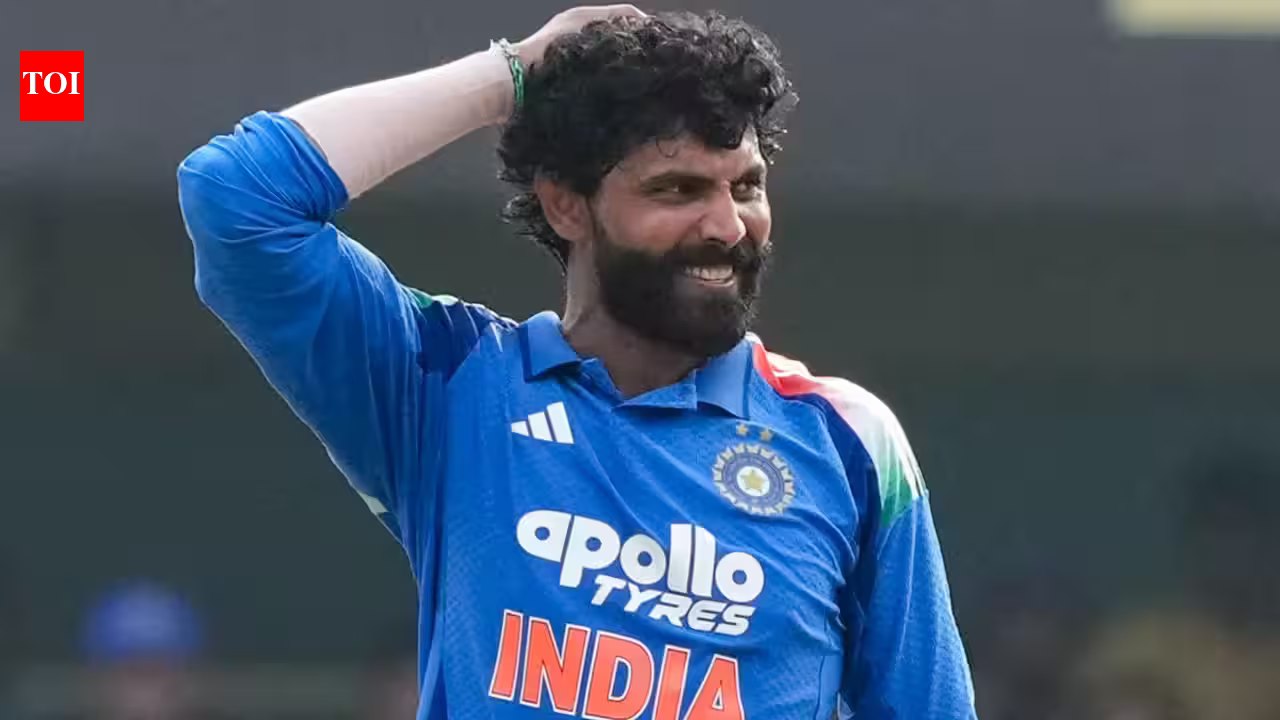
Sunlight is beginning to set on one of the most decorated white-ball careers in Indian cricketing history. As the Men in Blue pivot toward a new tactical horizon, the omission of veteran all-rounder Ravindra Jadeja from the upcoming ODI series against New Zealand has ignited a fierce debate regarding his future in the 50-over format. With the ODI World Cup looming on the horizon—to be co-hosted by South Africa, Zimbabwe, and Namibia—the decision to exclude the 37-year-old has left fans and pundits questioning whether the curtain has officially fallen on his legendary white-ball journey.
The current hierarchy within the Indian dressing room is clear: Axar Patel has solidified his position as the primary left-arm finger spinner and middle-order utility player. With Jadeja already having bid farewell to T20 Internationals, his absence from the ODI setup leaves him tethered primarily to the Test arena, a transition that many experts believe was a calculated move by the BCCI and team management.
The “End of the Road” Theory
Former India stalwart Cheteshwar Pujara, known for his analytical and pragmatic approach to the game, did not mince words when assessing the situation. For Pujara, the writing is on the wall. He suggests that the decision to leave Jadeja out of the squad for the New Zealand series was likely the result of direct, transparent communication between the selectors and the player.
“I believe so, because if you want to keep Ravindra Jadeja in ODI cricket, then he should have been selected,” Pujara stated during an appearance on JioStar. “I’m sure it was communicated to him that he might not be selected because Axar Patel has been the main all-rounder in ODI cricket and is being given more opportunities.”
Pujara’s assessment carries the weight of experience. He points to the confluence of age and tactical shifts as the primary drivers behind this exclusion. “Looking at his age, I feel the team management might have told him that he is now only a part of Test cricket, so he should focus there, and that they are not looking at him for white-ball cricket. It could be the end of the road because, obviously, he has retired from T20 Internationals. I feel he might not be selected just for the ODIs.”
The Case for the “Insurance Policy”
Contrasting Pujara’s definitive stance, former cricketer Abhishek Nayar offers a more nuanced, strategic perspective. While acknowledging that Jadeja is no longer the automatic first-choice starter, Nayar views the veteran as an essential safeguard for the Indian squad as they approach a high-stakes World Cup campaign.
In the high-pressure environment of ICC tournaments, depth is often the difference between a trophy and an early exit. Nayar characterizes Jadeja as an “insurance policy” that the team cannot afford to discard prematurely.
“Jaddu might not come back into the team, but if someone gets injured, the first name that will come to mind will be Jaddu,” Nayar argued. “Because after Axar, there is no one.”
Nayar’s logic centers on the lack of ready-made, high-level replacements in the current domestic pipeline. While the team is currently banking on Axar Patel’s form and fitness, the transition from him to the next in line is steep. “The valid question right now would be: After Axar, who is the frontrunner? Currently, the frontrunner is Axar Patel, and after him, Jaddu is still your insurance policy. If something happens to Axar Patel before the World Cup, Ravindra Jadeja will come into the team.”
The Road to the World Cup
The upcoming five-match ODI series against New Zealand, which kicks off on November 4, represents a crucial litmus test for the Indian team. Playing against the Black Caps in challenging, seam-friendly conditions will provide the management with a clearer picture of their squad balance ahead of the World Cup in Africa.
For India, the challenge lies in balancing the need for youthful energy with the necessity of big-match experience. Jadeja, a veteran of countless high-pressure encounters, brings a level of composure in the field and with the bat that remains world-class. However, the modern white-ball game demands high-intensity fitness and specific role definitions that the team management seems intent on building around players like Axar.
As the squad prepares for the rigors of the New Zealand tour, the “Jadeja Question” will linger. Whether he is viewed as a chapter closed or an emergency break-glass-in-case-of-emergency option, the reality remains that one of India’s greatest match-winners is slowly receding into the background of the 50-over format. For now, the spotlight remains firmly on the future, but the legacy of Ravindra Jadeja remains an undeniable factor in the tactical calculations of the selection committee.
As the series opener nears, all eyes will be on how the team compensates for the void left by such a colossal figure—and whether, in the coming months, the selectors decide to reach for their “insurance policy” or move forward with a new generation of talent.
Disclaimer: This content is auto-generated for informational purposes only.
Source: Read Original News