








No prosecutions have taken place over thousands of serious pollution incidents
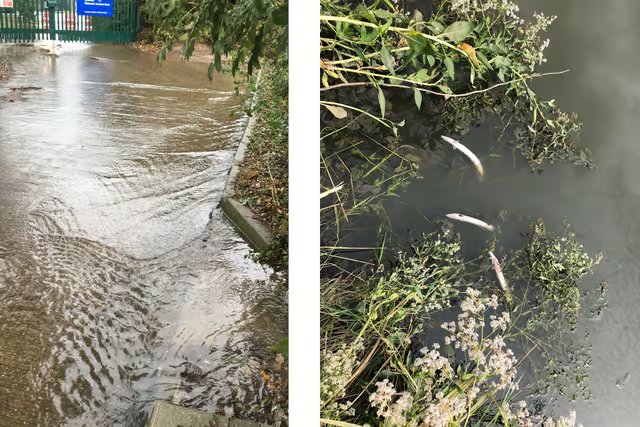
The Environment Agency (EA) has not completed a single prosecution of a water company for any pollution occurring in the last five years, despite almost two million sewage discharges.
A Channel 4 News investigation found none of the completed prosecutions relate to the thousands of serious pollution incidents that have happened since mid-2021.
The Environment Agency says this is due to investigations taking years to reach court and claim there is a viable, quicker alternative – the “Enforcement Undertaking” (EU).


Rather than face prosecution, undertakings mean water companies can offer to make payments, sometimes exceeding £1 million, to environmental trusts or charities to compensate for their offence.
But undertakings allow water companies to avoid criminal conviction entirely. By paying a charity for serious offences, they avoid a court appearance.
It comes as Southern Water recently admitted a further series of sewage pollution discharges. The company, which deals with waste water along the south coast including in Portsmouth and parts of Hampshire, has admitted fault over the incidents in Kent which took place weeks after it received a record £90m fine for illegal dumping.
Southern Water was also handed the multimillion-pound fine in July 2021 for 6,971 unpermitted sewage discharges in Hampshire, Sussex and Kent between 2010 and 2015.
The Channel 4 News probe worked with whistleblower Robert Forrester, an EA employee for more than 20 years. Forrester appeared in Channel 4’s recent docudrama “Dirty Business”, portrayed as a female Environment Agency employee who, like Forrester himself, leaked data to sewage campaigners. He left the agency in January.
“It’s not like these serious crimes aren’t happening. They’re actually happening more and more…[EUs mean] the deterrent effect is no longer there…It’s a way of avoiding the criminal system,” he said during his first in-depth TV interview.
Channel 4 News’ chief correspondent, Alex Thomson, put these exclusive findings to the EA’s Director of Water, Helen Wakeham, who defended their use:
“They are a brilliant tool for the Environment Agency. In the past year, the Environment Agency secured £8.5 million for the water environment through enforcement undertakings. The reason why we use them is they are faster than criminal prosecutions, so a prosecution can take us years to bring to court and take up a lot of our time,” Wakeham said.
“We do take action on every water pollution incident report that we receive. Some of those are exceptionally minor, a handful are serious, and those are the ones that we investigate very thoroughly.”
However, according to the EA’s own data, in the past decade there have been very few prosecutions. In a letter to parliament’s Environment Committee, the EA’s chief executive Philip Duffy said that between 2015-2025 there were 11,474 water company investigations, but only 58 of these resulted in a prosecution. That’s a prosecution rate of just 0.5%.
Many environmental campaigners say this entire system has no place with water companies. Forrester said EUs should be scrapped as an option for them.
Channel 4 News examined the Environment Agency’s rules on when undertakings should be applied and it appears that in some cases they are not following their own guidance. The law and EA policy state that serious offences and repeat offenders must be prosecuted. But Channel 4 News has discovered there are many cases where a charity payment has been offered instead.
The agency’s rules state they would not normally accept an EU for Category 1 and 2 incidents – the most serious. But FOI data shows they downgrade thousands of reported serious incidents to ‘minor’ problems without actually visiting the site where the pollution occurred, effectively ruling out any prospect of prosecution. Between 2016-2025, this happened 5,998 times.
The EA says all cases are thoroughly assessed and a precautionary system means many incidents are automatically called in as serious regardless of how dangerous they turn out to be.
The programme analysed publicly available EA data showing water companies paying EUs for the same repeated offence again and again – “water discharge activity”. Thomson asked the EA why repeat offenders still get this option.
“I don’t believe that to be the case. We make those decisions in the public interest. We take prosecution action – we do that for the most serious cases where we’ve got evidence of poor practice and where there is criminal wrongdoing,” Wakeham said.
National charity the Rivers Trust accepts millions of pounds in EU payments from the polluting water companies. So far this year they’ve already accepted almost £1.5 million.
“We are incredibly well placed to make sure the money goes to where it is needed the most,” Scott McKenzie, head of Rivers at Trent Rivers Trust, told Channel 4 News.
“The underlying issue with all of this is we’d rather the incidents didn’t happen at all, so it doesn’t preclude a wider clean up of the water industry,” McKenzie added.
Water UK, which represents the industry, told Channel 4 News: “The government’s independent review of the water sector concluded that the public interest was not always best served by years of court proceedings. Undertakings can ensure faster accountability and deliver funding directly into the environment.”