









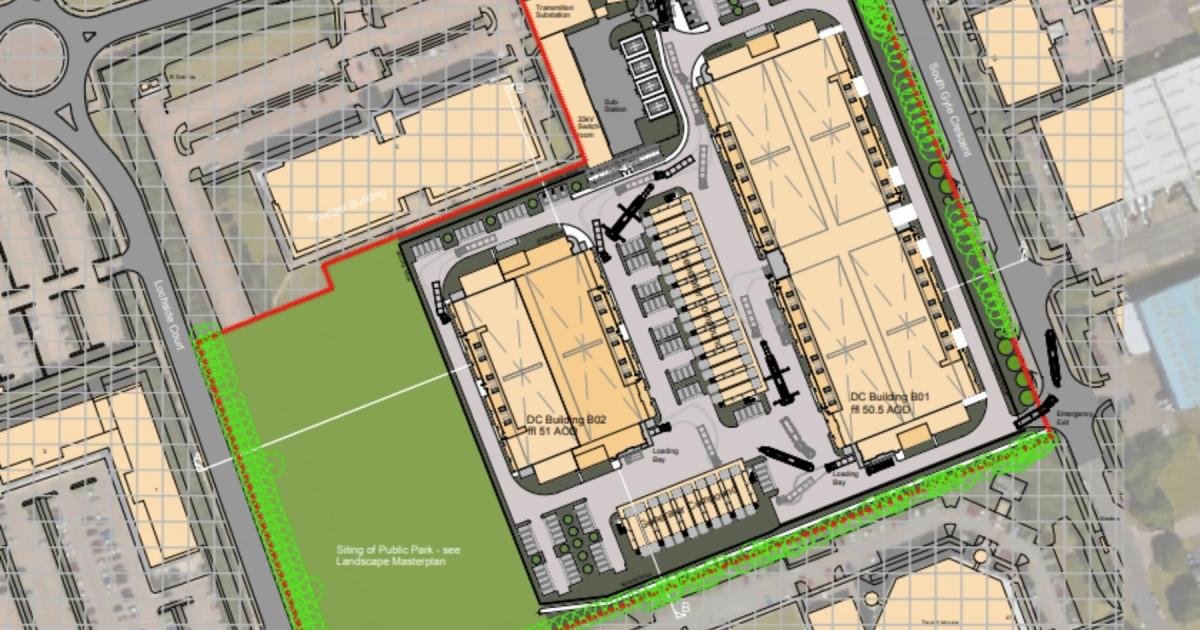
The Planning and Environmental Appeals Division ruled that the site would “be likely to have a significant effect on the environment”, and therefore a full assessment is required before the developer’s appeal can continue.
The developer will have 21 days, starting from July 30, to confirm whether or not it plans to submit an EIA. If no response is given, the appeal will no longer be considered.
There was outrage last year when the Edinburgh council decided no EIA was required, a decision the campaign group Action to Protect Rural Scotland (APRS) described as “gobsmacking”.
Despite initially ruling that no EIA was required, a council planning committee determined in February that an initial application by developers Shelborne Drummond Ltd for the 210MW site in South Gyle should be rejected.
READ MORE: Experts slam Google after AI image update sparks misinformation fears
This initial application for planning permission in principle was rejected on grounds that it did not address the site’s total greenhouse gas emissions and that it did not address the climate crisis, and that it did not align with a local regeneration project.
Campaigners had raised concerns over the site’s potential carbon emissions, after it was revealed the site’s projected carbon emissions are more than 200,000 tonnes of carbon per year; equivalent to building another Edinburgh Airport, which was recorded as emitting 181,201 tonnes in 2024.
APRS found that based on the size of the site, it would require around 200 diesel backup generators to provide a 24/7 supply of energy in case renewable supply ran low, as can happen in times of low sunshine and wind speed.
The Scottish Government planning reporter’s ruling on the appeal states that it is “not clear” how the developer’s suggestion that it will use renewable energy would be implemented.
“The degree of uncertainty on this matter, when interpreted in light of the precautionary principle, means that likely significant effects cannot be ruled out and an EIA is required,” the report says.

It also refers to the site’s potential use of diesel generators, saying: “These can have significant effects on the climate and environment through discharge of greenhouse gases”.
Further consideration was paid to the production of waste heat – an issue which could lead to warming of local areas as part of the mechanism to cool down the computer chips – to which the report says the resolution to the problem is “unclear” and could have a “significant effect”.
It criticises the developer’s statement that the site could support an alternative heat recovery plan, saying no details of any plan have been made available, and due to that uncertainty its effectiveness cannot be determined.
The impact on local businesses and residents was also used in the ruling, to which the report said “there are potential significant effects on occupants of nearby residential properties” – which include a mixed-use housing and office development also planned by the asset management arm of the data centre developer Shelborne Drummond – “and offices arising from noise during ‘normal’ operation and under ‘emergency’ conditions when the back-up generators are operational.”
READ MORE: MSP raises alarm as ‘Duke ushered to front of queue’ to lobby for £2bn AI data centre
A concern raised by campaigners that was echoed in the Scottish Government’s planning decision is that developers have been using label “green data centre” despite this – a term outlined in Scotland’s national planning guidance (NPF4) and classed as priorities for national infrastructure development – giving it favourable weighting in the planning process.
National Planning Framework 4 (NPF4) does not define “green data centres”, however, leaving the final decision to local authorities, which are tasked with ruling based on various factors like renewable energy use and energy efficient technology.
Campaigners have warned that a lack of definition of what constitutes a “green data centre” could lead to projects that would have a major negative impact on the environment being approved if local authorities are not given stronger guidance by the Scottish Government.
The report stated that the “appellant has relied on wording in NPF4 as justification that the proposal would not have effects on greenhouse gas emission reduction targets, but there is no evidence to support this.
“Such an approach is also inconsistent with Circular 1/2017 paragraph 35, which advises: “It is emphasised that the basic test of the need for EIA in a particular case is the likelihood of significant effects on the environment.
“It should not be assumed, for example, that conformity with a development plan rules out the need for EIA.”
The decision from the Planning and Environmental Appeals Division should serve as a precedent for future planning decisions, and lead to new national guidance that mandates EIA’s, Kat Jones, director of APRS told The National.
“The Scottish Government have evidently realised that, in order to make an informed decision in the planning appeal for the Edinburgh hyperscale data centre, they need to see an Environmental Impact Assessment,” she said.
“We now need to see the Scottish Government make EIAs mandatory for all similar developments so that local authorities also have access to adequate information for their own decision making.
“Environmental Rights Centre Scotland and ourselves have been calling for this to happen since late last year and, it is now becoming urgent, with two live applications which will require decisions from Fife and Falkirk councils in the autumn.”

Across Scotland there are 24 sites that are being targeted by developers for new AI data centre projects – including in Auchtertool, Fife, and Larbert, Falkirk, – which if all built would more than double Scotland’s peak energy demand.
Ben Christman, principal solicitor and legal director of Environmental Right Centre Scotland, the campaign group that provided legal support to challenge to the appeal and decision to not require an EIA, told The National: “We are relieved that the Scottish Government’s planning reporter has decided an EIA is required for this proposed data centre.
“We requested the reporter to intervene in this matter. Both the Council and the developer opposed our request.
“The reporter’s decision effectively overturns a previous screening opinion made by Edinburgh Council, where the council decided that no EIA was required. The reporter’s decision raises questions about the rigour of the council’s screening process.
“Data centres can have significant effects on the environment because of their vast demands for energy and water.
“It is vital that these effects are fully considered and understood during the planning process, so that the Scottish Government and members of the public can properly consider whether proposals for data centres should be granted planning permission.”
READ MORE: SNP back calls for temporary ban on AI data centre developments
Rupert Nash, who submitted the objection following ECRS guidance, added: “I am very pleased the Reporter largely agreed that an EIA is necessary, particularly that she rejected the applicants’ circular reasoning around NPF4 allowing them to assume greenhouse gas emissions are automatically negligible and, given emerging evidence of a data centre heat island effect, she ordered that waste heat be included.
“I am confident that, on completion, the EIA will show that the current proposals will have a significant negative environmental impact and thus Edinburgh Council were correct to refuse planning permission.”
Edinburgh Council became the first local authority in Scotland to call on a nationwide moratorium on data centre developments, also pursuing its own local equivalent. This was later found to be legally and practically impossible due to Scottish planning laws.
It has since been joined by East Ayrshire Council and the Scottish Greens in calling for a nationwide moratorium. We reported that the SNP’s National Council has also voted in favour of a moratorium, which is due to be brought to Holyrood when it returns from summer recess.
Shelborne Drummond has been approached for comment.