








The Environment Agency says it is taking action to protect water supplies, wildlife, agriculture and navigation in Lincolnshire as dry weather continues to place pressure on river levels.
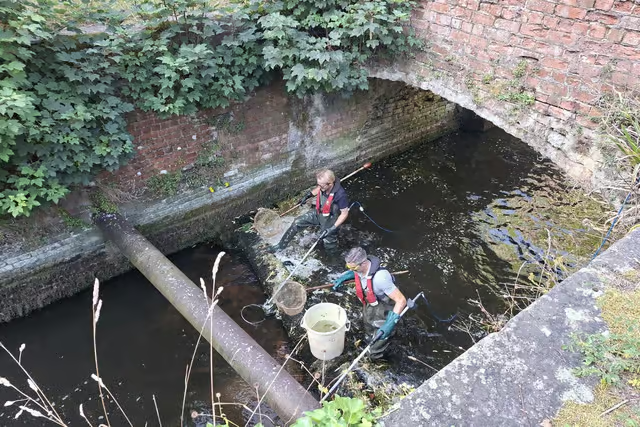
Fish rescue operations have been carried out on the River Slea and at a Lincoln & District Angling Association stillwater, with further sites being closely monitored.
The Environment Agency has also supported fish rescue efforts on Billing Brook, a tributary of the lower River Nene, and continues to respond to environmental pressures, including rising salinity levels on the Hob Hole and Lower Steeping River. Members of the public can report sightings of fish in distress to the Environment Agency incident hotline on 0800 80 70 60. An Environment Agency scheme is also swinging into action to keep the River Ancholme and River Witham topped up for wildlife and thousands of homes.
Owned and operated by the Agency since 1974, the scheme is a vital piece of infrastructure that helps manage surface water resources across Lincolnshire.


Thomas Enright, an Environment Manager for Lincolnshire and Northamptonshire, said: “We are working hard to maintain river levels for people, wildlife, navigation and agriculture. We will continue to monitor the conditions closely and will not hesitate to use our regulatory powers to mitigate the impacts of dry weather on the environment, water supplies and other sectors.”
The scheme supports more than 100 abstraction licences held by water companies, farmers, industrial users and other licensed abstractors who rely on water from the Rivers Ancholme and Witham.
The scheme transfers water between three of the region’s major waterways, the River Trent, the River Witham and the River Ancholme, to help ensure water demand can be met during dry weather.
The Agency explains that when water levels in the River Ancholme fall below the level needed to maintain navigation and support abstraction, water is pumped from the River Witham at Short Ferry and transferred through a 17.5-kilometre pipeline to the upper Ancholme.

If levels in the River Witham also become low, it is replenished with water pumped from the River Trent at Torksey via the Fossdyke Canal, which connects to the Witham at Lincoln.
The River Transfer Scheme can pump 60 Olympic sized pools of water daily if required, according to the Agency.
The scheme also includes the 16.5-hectare Toft Newton Reservoir, which stores up to 761,000 cubic metres of water. The reservoir provides an emergency reserve that can be released into the River Ancholme if pollution incidents or equipment failures disrupt normal river transfers.
The Environment Agency continuously monitors river flows and takes measures to ensure water needs are met while protecting the environment.

During prolonged dry weather duckweed often forms in Lincolnshire rivers, especially the River Witham. This is due to slow flows. The Agency is also working with farmers, growers and water companies to encourage sustainable water use during the dry weather. This includes placing temporary limits on abstraction licences and supporting water transfers between abstractors.
And it also ensures that water companies have robust drought plans in place. Decisions on hosepipe bans remain the responsibility of individual water companies.