









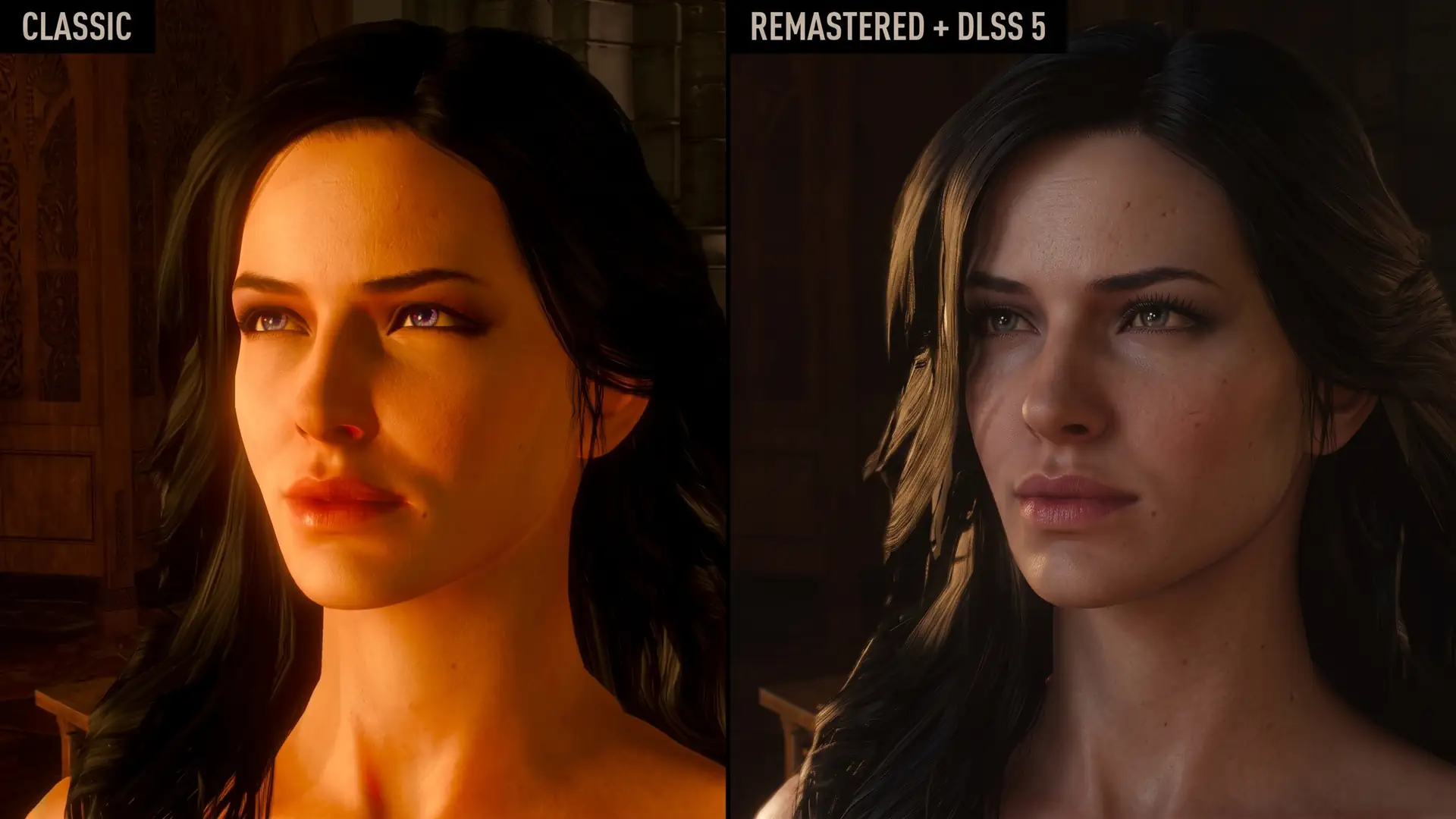
The Evolution of Scaling Technology: DLSS 5 Meets The Witcher 3
The landscape of PC gaming hardware continues to shift toward advanced computational reconstruction techniques, with NVIDIA’s DLSS 5 serving as the latest frontier in graphical fidelity. Recent technical benchmarks of The Witcher 3: Wild Hunt Remastered have brought this technology under the microscope. By comparing the Remastered edition against the established Next-Gen version, analysts have uncovered a complex relationship between neural network rendering, GPU overhead, and the pursuit of photorealistic image reconstruction.
In this context, DLSS 5 represents more than a standard resolution upscaler; it acts as an integrated suite of algorithms designed to manage complex lighting, material physics, and temporal stability. While the industry has long sought ways to balance high frame rates with high resolutions, the latest testing highlights a shift in priority. The focus is no longer purely on achieving higher frame counts, but on maximizing the per-pixel information density using neural processing units within modern graphics cards.
Performance Disparity in Remastered Architecture
One of the most striking findings in the recent performance analysis is the divergence in frame rates between the Next-Gen version and the Remastered edition of The Witcher 3. When both are configured with DLSS 5, the Next-Gen version maintains a stable 68 FPS, while the Remastered edition drops to 38 FPS. This variance is not an indicator of inefficiency, but rather a testament to the increased computational load introduced by the Remastered version’s underlying graphical upgrades.
The Remastered edition incorporates sophisticated shaders and higher-density geometry that require the DLSS 5 neural network to perform much more intensive reconstruction work. When the algorithm is disabled on the Remastered build, the engine manages 42 FPS on average. Interestingly, enabling DLSS 5 in this specific environment causes the frame rate to dip further to 38 FPS. This demonstrates that for certain highly demanding visual pipelines, the overhead required to run the advanced neural reconstruction models outweighs the traditional performance gains typically associated with upscaling technologies.
Decoding the Neural Reconstruction Process
The performance cost associated with DLSS 5 in the Remastered edition is directly tied to how the technology handles temporal data and lighting interactions. Unlike its predecessors, DLSS 5 utilizes deep learning models to predict frame information based on a smaller input buffer. In titles with complex, dynamic lighting—such as those present in the updated Witcher 3 engine—the neural network must process significantly more data to ensure that reflections, shadows, and light scattering remain consistent across frames.
By rendering at a lower base internal geometry resolution and relying on neural inference, the game can technically achieve higher detail levels. However, because the Remastered edition adds layers of high-fidelity environmental effects, the GPU resources are heavily taxed. The hardware must simultaneously manage the native rendering of these advanced assets and the heavy lifting performed by the tensor cores to reconstruct the final image. This creates a bottleneck where the computational cost of the upscale process becomes a significant factor in the final output.
Visual Fidelity and Material Accuracy
While frame rates are a critical metric for hardware enthusiasts, the visual results achieved by DLSS 5 in The Witcher 3 Remastered provide a compelling argument for its inclusion. The primary improvement lies in the reduction of common digital artifacts. The technology effectively cleans up specular highlights and eliminates the shimmer often found on fine textures like hair, beards, and metallic seams on leather armor.
Furthermore, the neural network contributes to superior skin shading. By utilizing accurate light scattering models, the engine creates more realistic human characters. The depth and cinematic contrast achieved through this process offer a distinct advantage over standard rendering techniques. The image stabilization provided by the algorithm ensures that moving objects, such as Geralt’s gear or the foliage of the Witcher world, remain crisp even during high-intensity combat scenes where motion blur would typically obscure detail.
Use-Cases and Industry Impact
The deployment of DLSS 5 in this title highlights a growing trend where developers and hardware manufacturers collaborate to define new standards for visual realism. This technology is particularly beneficial for titles where artistic intent relies on atmospheric lighting and texture complexity. For the end user, this means the choice between a raw, high-frame-rate output and a highly processed, visually dense output.
This shift suggests that future gaming hardware will be judged not only by raw rasterization power but also by the efficiency and quality of its neural inference hardware. As games become increasingly complex—incorporating more realistic physics and lighting—the ability of an upscaler to provide a stable, artifact-free image becomes just as important as the frame rate itself. The Witcher 3 Remastered demonstrates that we are entering an era where the software reconstruction of an image is becoming an integral part of the artistic delivery, rather than merely a performance optimization tool.
Technical Conclusion and Outlook
As the industry moves forward, the trade-off observed in these benchmarks serves as a blueprint for developers. The 38 FPS result in the Remastered edition serves as a benchmark for what happens when cutting-edge neural processing is applied to legacy engines that have been heavily modernized. While the frame rate decrease is significant, the visual stability and detail levels are undeniably superior to traditional rendering methods.
Hardware consumers should view these results as a preview of the computational demands of future gaming titles. As graphical realism continues to climb, the synergy between hardware-based neural processing and game engines will only tighten. Future updates to both drivers and game software are likely to optimize this interaction, but for now, The Witcher 3 Remastered stands as a primary case study in the power and the cost of AI-driven image reconstruction.
Disclaimer: This content is auto-generated for informational purposes only.
Source: Read Original News