







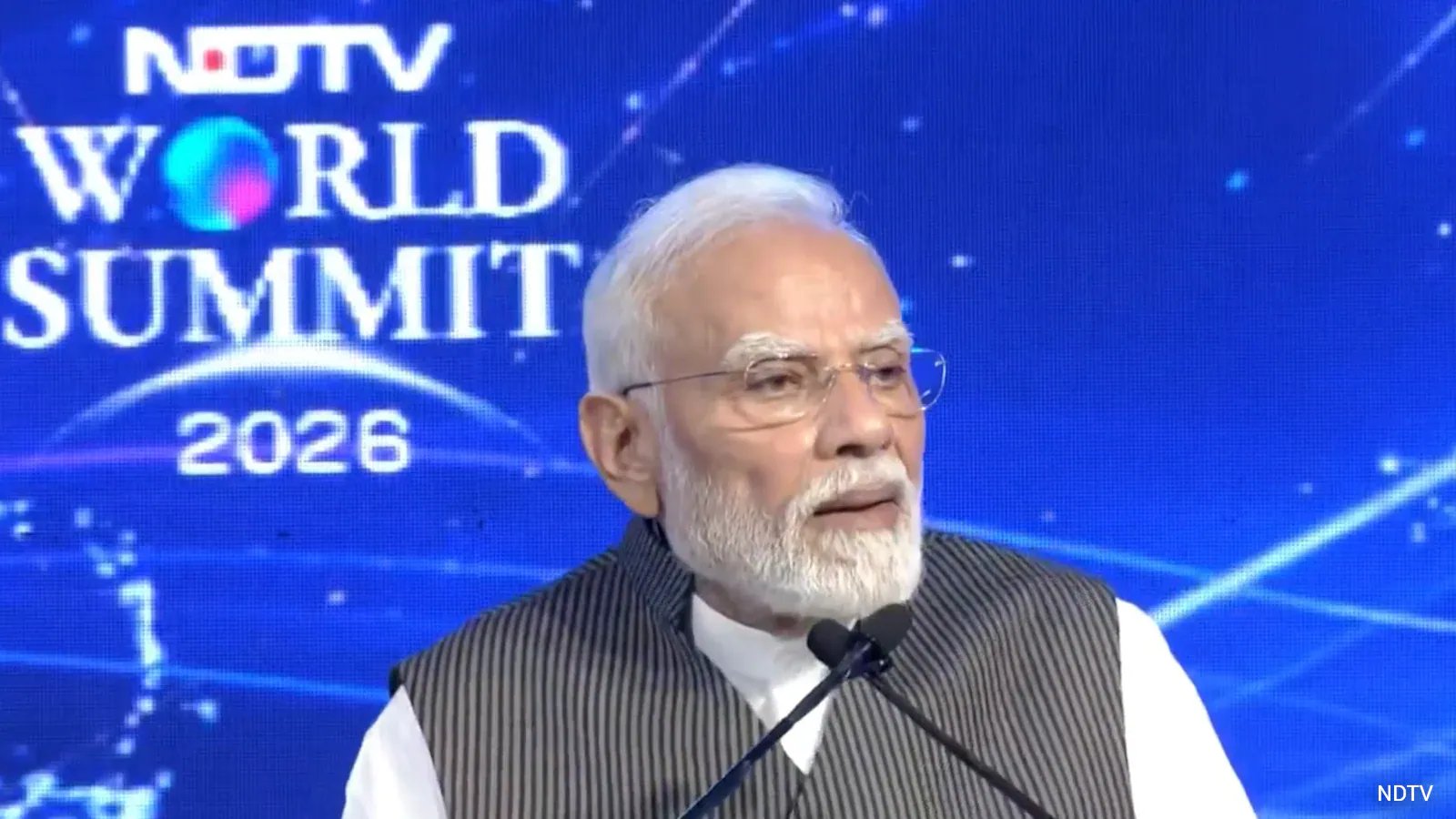
From ‘Back Office’ to ‘Brain Office’: PM Modi Outlines India’s Global Ambitions at NDTV World Summit
New Delhi: Prime Minister Narendra Modi addressed the shifting dynamics of global geopolitics on Thursday, emphasizing that while the world is undergoing a period of profound transformation, legacy international institutions—including the United Nations—are struggling to keep pace with these rapid changes.
Speaking at the NDTV World Summit 2026, the Prime Minister highlighted the growing instability in global corridors, noting that fundamental elements of modern commerce are being compromised. “Trade, technology, and sea routes are increasingly being weaponised,” he remarked, in an apparent allusion to the ongoing volatility in the Middle East and the ensuing impact on international stability.
Moving Beyond the Service Model
A core theme of the Prime Minister’s address was the evolution of India’s economic identity. For decades, India’s international reputation was tethered to the “back office” model, characterized by outsourced services like call centers and data processing. PM Modi signaled that this era is firmly in the rearview mirror.
“The world that once relied on India’s brainpower now trusts India’s mindpower as well,” he stated. “We are now working with the global community not just as a back office, but also as a brain office.”
This shift, the Prime Minister argued, is a direct result of India’s emergence as a premier hub for digital innovation and a burgeoning startup ecosystem. He reiterated that India remains the world’s fastest-growing major economy, serving as a beacon of collective development for the Global South.
Long-term Strategy and Self-Reliance
Outlining his government’s approach to policymaking, the Prime Minister explained that every investment and sector-specific reform is guided by a long-term vision of sovereignty and future-proofing. He noted that policy decisions are frequently designed to reduce dependence on external suppliers, ensuring that India remains resilient against unforeseen global crises.
“Whenever the government formulates policy or makes investment decisions, there is a strategic thought behind it: which capabilities can we build domestically? How can we reduce our reliance on other nations? We are preparing for the crises of tomorrow with the decisions we make today,” he said.
To demonstrate this shift toward self-reliance, the Prime Minister pointed to the pharmaceutical industry. While India has long been a global producer of finished medicines, the nation previously faced a significant bottleneck due to its heavy reliance on imported raw materials.
“You are all familiar with India’s pharmaceutical capabilities,” PM Modi said. “Until a few years ago, we depended heavily on imports for the ingredients required for our medicines. We are now fundamentally changing that situation, taking control of our supply chain from the ground up.”
The summit served as a platform for the Prime Minister to assert that India’s growth is no longer just a national success story but a necessary engine for the stability and prosperity of the global order.
Disclaimer: This content is auto-generated for informational purposes only.
Source: Read Original News