








ROHTAK: Some walls tell stories that words struggle to capture. Inside the storied wrestling academy at Sir Chhotu Ram Akhara, the brick and mortar resonate with the echoes of Olympic glory and world-class grit. The walls here serve as an informal hall of fame, adorned with the larger-than-life images of wrestling icons Sushil Kumar, Yogeshwar Dutt, and Sakshi Malik. It is a visual history of excellence, and today, a new space stands ready, awaiting the arrival of a portrait that will cement a new legend: Manisha Bhanwala.
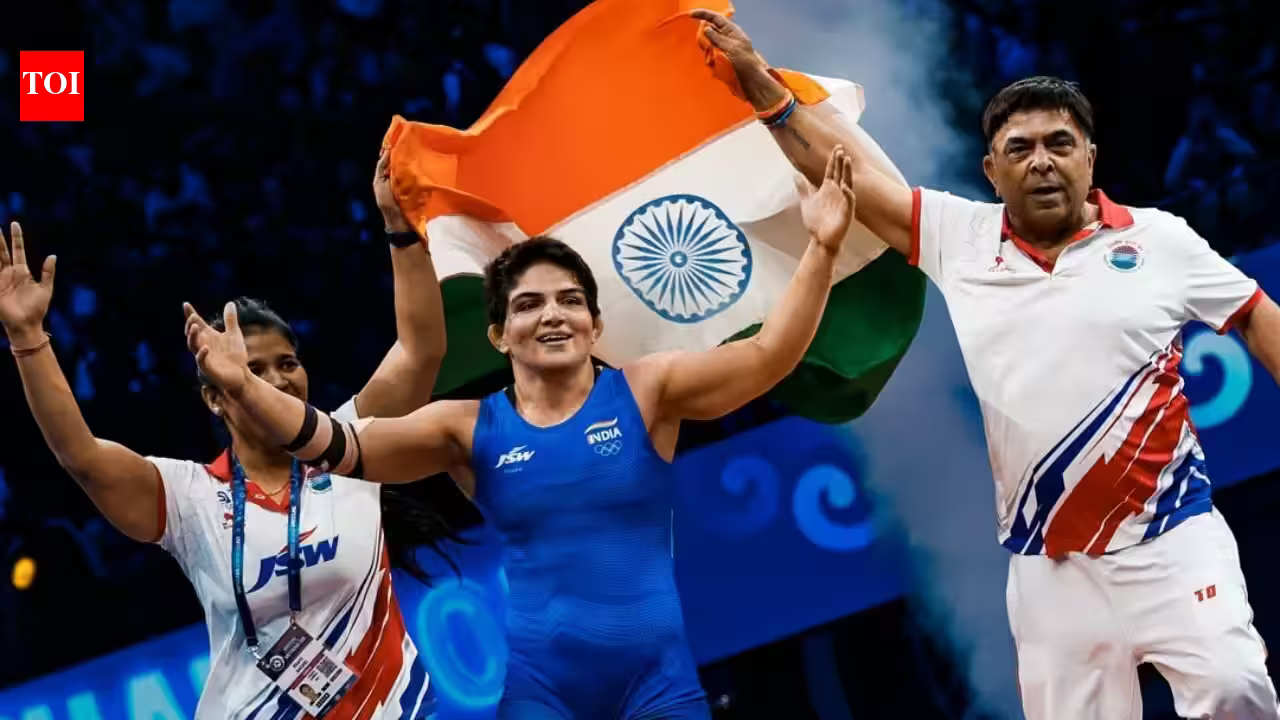
Following her sensational victory in the 59kg final at the Senior World Wrestling Championships in Astana, Bhanwala has not only secured gold for India but has firmly etched her name into the annals of wrestling history. While the mats have been cleared and the cheers in Kazakhstan have faded, the atmosphere at her home training ground in Rohtak is electric, pulsing with the pride of a community that watched her rise from a dedicated trainee to a world champion.
A Seat at the Table of Legends
For chief coach Mandeep Singh, who has steered the destiny of the Akhara since 2010, the anticipation surrounding the new photograph is about more than just decoration; it is about setting a standard.
“Yes, Manisha’s photograph will soon be up here,” Singh said, glancing at the wall with a knowing smile. “These photographs are reserved for our Indian wrestling’s extraordinary champions. You have to achieve something big to earn a place on this wall. When world champion Manisha returns to the academy, she will put up her own photograph. All the trainees will be there for that moment. Perhaps the next time you visit, you will find her photo there.”
The sentiment reflects the culture of the Akhara—an institution that has quietly evolved from a modest, tin-roofed facility into a powerhouse nursery for India’s top female wrestlers.
The Anatomy of a Comeback
Manisha’s path to gold in Astana was not paved with ease. Her journey to the world title was a testament to the discipline instilled by the coaches at Sir Chhotu Ram. Mandeep recalls a trainee who was defined by her ability to turn perceived weaknesses into absolute strengths.
“When she joined me some years ago, Manisha was regular, dedicated and always looking to improve,” the coach noted. “Her ground game, which was once a weakness, improved considerably through sheer repetition.”
The resilience Bhanwala showed was perhaps most evident after the Aichi-Nagoya Asian Games, where she narrowly missed out on a medal. Rather than letting the disappointment stifle her momentum, she returned to the training mat with a singular focus. The result was a world-class performance where she displayed the composure of a veteran, rallying from a 0-6 deficit in the final to claim a gritty 8-6 victory.
Mentorship Beyond the Mat
What makes Manisha Bhanwala a hero to the younger generation at the Akhara is not just her medal, but her accessibility. Now employed as a Haryana government coach under the sports quota, she balances her own competitive career with the responsibility of nurturing the next crop of talent.
For Komal, a 65kg wrestler and Bhanwala’s frequent sparring partner, the world champion is a constant source of technical insight. “She is powerful, but she also points out our mistakes and tells us how to correct them,” Komal shared. “We learn a lot from her.”
This sentiment is echoed by Deepanshi Phogat, a 50kg wrestler training at the facility for five years. For Phogat, Bhanwala is an elder sister who “teaches from the heart.” This mentorship culture creates a pipeline of ambition; for young trainees like Mahi Singh, watching Manisha’s success has transformed the elusive goal of Olympic glory into a tangible target. “I want to become a wrestler like Didi and win an Olympic medal,” Singh said, her eyes locked on the mat where her idol learned the ropes.
A Legacy of Persistence
The story of the Sir Chhotu Ram Akhara is one of defying the odds. In the early 2000s, coach Ishwar Singh Dahiya faced significant social resistance when he began training girls in what was then a male-only preserve. The facility’s trajectory changed forever when Sakshi Malik clinched a bronze medal at the 2016 Rio Olympics, bringing national attention—and the resources necessary to upgrade the gym into the modern, air-conditioned training hall it is today.
As the sun sets on another training day in Rohtak, the cycle of hard work continues. New trainees are already sweating on the same mats where Bhanwala sharpened her craft, their eyes periodically drifting to that empty space on the wall. For the coaches and the athletes at the Akhara, the gold medal in Astana is more than a trophy; it is proof that the path from this small Rohtak facility to the top of the world is open to anyone with the resolve to climb it.
When Manisha returns to pin her photo to the wall, she will be looking at more than just a gallery of past champions—she will be looking at her legacy, thriving in the sweat and dreams of the next generation.
Disclaimer: This content is auto-generated for informational purposes only.
Source: Read Original News