









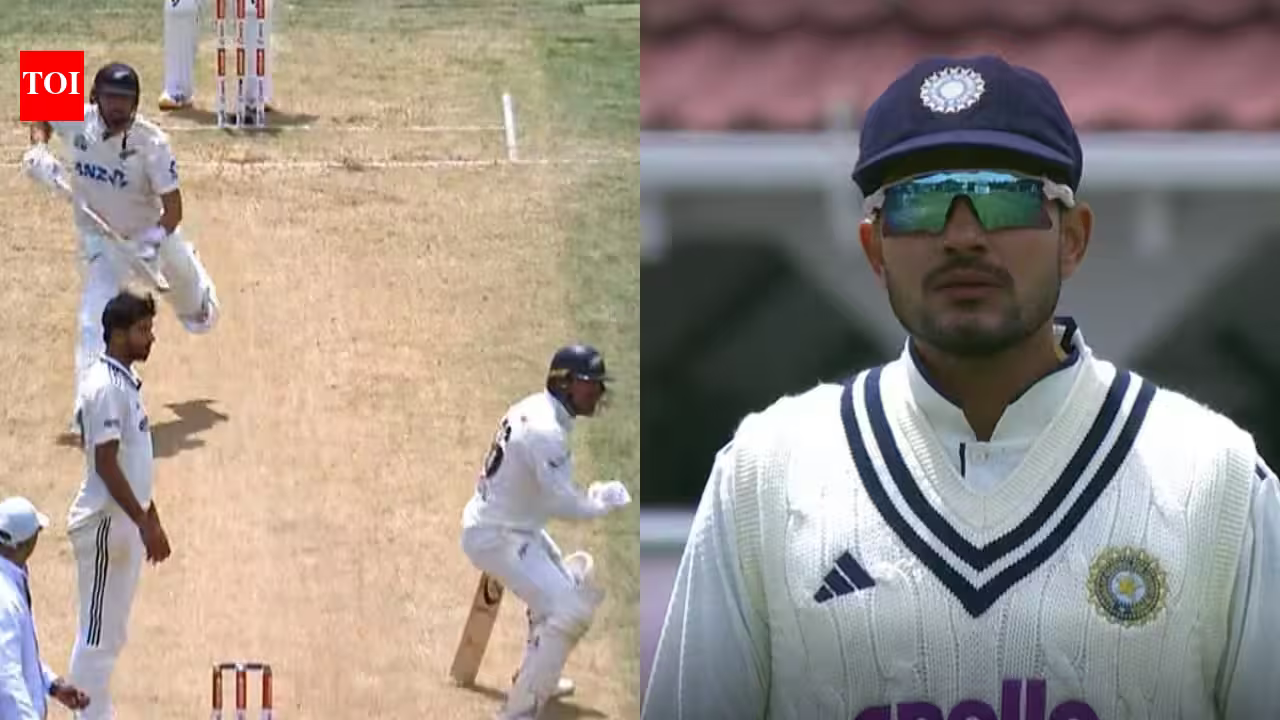
WELLINGTON – The tension at the Basin Reserve reached a fever pitch on the final day of the first Test between India and New Zealand, as a pivotal moment in the field sparked audible frustration from the Indian leadership. In a high-stakes scenario where every run and every wicket carries the weight of a Test match result, Akash Deep’s failure to execute a routine run-out handed Daryl Mitchell a lifeline that could have proved catastrophic for the hosts.
The incident unfolded in the 74th over, shortly after the players returned from the lunch break. With Washington Sundar operating from the pavilion end, Mitchell—seeking to rotate the strike—charged down the pitch after pushing the ball toward mid-on. It was a clear mix-up; Tom Blundell, stationed at the non-striker’s end, remained anchored to his crease, flatly refusing the call. Mitchell was left stranded, marooned more than halfway down the track in a “no-man’s land” that is typically a death sentence for a Test batter.
Akash Deep, positioned perfectly to capitalize on the hesitation, gathered the ball but suffered a calamitous lapse in concentration, failing to secure it cleanly. The fumble allowed Mitchell, who had essentially given up his wicket, to scramble back into his crease safely. The broadcast microphones picked up former New Zealand cricketer Ian Smith succinctly noting, “Mark that down,” as the gravity of the error became clear. India captain Shubman Gill, visibly incensed, was captured on camera expressing his exasperation at the botched opportunity, a reaction that underscored the desperation for a breakthrough on a stubborn pitch.
Strategic Bowling Keeps India in the Hunt
Despite the missed chance, the Indian bowling unit showed commendable discipline throughout the fifth day. Having entered the final morning with New Zealand trailing by 233 runs, the hosts were tasked with a Herculean effort to avoid an innings defeat. For a significant portion of the morning, Devon Conway and Rachin Ravindra acted as the bedrock of the New Zealand resistance, focusing on time-consumption rather than flair.
India’s game plan, as noted by wicketkeeper Dhruv Jurel on Sunday evening, shifted toward exploiting the overhead conditions and the biting breeze at the Basin Reserve. While the pitch itself remained remarkably true and showed little signs of deterioration, the movement generated in the air by Washington Sundar and the improved precision of Prasidh Krishna provided the visiting team with the tools to probe the Kiwi defenses.
Washington Sundar proved particularly effective, utilizing the breeze to generate significant drift. His persistence paid off when he drew the well-set Conway forward; the ball kicked off the deck more than the batter anticipated, leading to a sharp bat-pad catch expertly snaffled by a diving Rishabh Pant. Prasidh Krishna, whose performance had drawn scrutiny during the first innings, responded with a spell of improved accuracy. He accounted for the dangerous Rachin Ravindra, cramping the left-hander with a delivery short of a length that forced a thick edge, which KL Rahul swallowed at a wide second slip position.
The Resilience of the Black Caps
Before the afternoon drama, New Zealand had managed to navigate the opening spells from Jasprit Bumrah and Anshul Kamboj with relative ease. Conway, in particular, looked comfortable, finding the boundary seven times and maintaining a defensive shell that frustrated the Indian quicks. The 72-run partnership between Conway and Ravindra kept the scoreboard ticking just enough to suggest that a fightback was possible.
However, the pressure exerted by Washington and Prasidh meant that by the time the teams broke for lunch, New Zealand sat at 157/4, having managed only 38 runs in the morning session. With the run-out mishap occurring shortly after the break, the fragility of the Kiwi middle order was laid bare.
Anshul Kamboj Delivers the Breakthrough
While the Akash Deep incident threatened to derail India’s momentum, the bowlers proved resilient enough to rectify the situation shortly thereafter. Anshul Kamboj, showing great composure under the pressure of the missed opportunity, produced a probing delivery that finally ended Tom Blundell’s resistance. A fine catch behind the stumps finally dismantled the partnership, providing India with a much-needed morale boost and bringing the game back into a balance that heavily favors the visitors.
As the match heads into the final stages, India remains firmly in the driver’s seat. The ability of their bowling attack to create chances—and, occasionally, recover from the frustration of missing them—has been the defining narrative of this Wellington encounter. For New Zealand, the task remains arduous: survive the remaining sessions, ignore the mounting pressure, and hope that their lower order can navigate the treacherous breeze and the probing lines of an Indian attack that is now sniffing blood.
Disclaimer: This content is auto-generated for informational purposes only.
Source: Read Original News