







UNITED NATIONS – Warning that the world can no longer “allow countries and cultures to vanish beneath the waves,” U.N. Secretary-General Antonio Guterres presided over a historic shift in climate policy Thursday as the General Assembly approved its first formal declaration on sea-level rise.
The landmark resolution aims to transition the global response from a patchwork of fragmented, local initiatives to a sustained, coordinated, and adequately funded international framework. The move comes as world leaders at the General Assembly have spent the week delivering stark, somber warnings about the encroaching physical and economic toll of a warming planet.
The urgency of the moment was underscored by a chorus of leaders who described climate change not as a distant policy debate, but as an existential threat currently dismantling their nations. However, the unified call for action stands in sharp contrast to the rhetoric of U.S. President Donald Trump, who has consistently dismissed climate change as a “hoax” or a “con job.”
For many, the situation has already passed the point of abstract prediction. Fiji’s President, Naiqama Lalabalavu, told the assembly that his nation is already moving entire communities to escape the encroaching ocean. “For us, half a degree is not a rounding error,” Lalabalavu said. “It is the difference between adaptation and relocation.”
The human cost was echoed by Nepal’s foreign minister, Shisir Khanal, who pointed to the “Himalayan tsunami” that ravaged his country last month. With over 1,300 dead and 5,000 still missing following flooding exacerbated by melting glaciers, Khanal urged the global community to treat climate action as a matter of fundamental justice rather than charity.
“The sea has never been fragmented,” said Philip Davis, prime minister of the Bahamas, emphasizing the interconnected nature of the crisis. “Only we are.” Davis noted that the ocean does not distinguish between national borders, and that for many low-lying island nations, the economic burden of climate-driven disasters is becoming insurmountable.
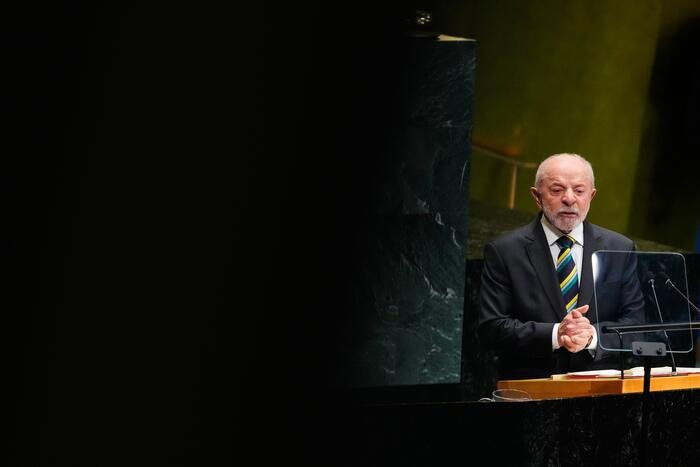
The call to action also found supporters among larger powers. Brazil’s President, Luiz Inácio Lula da Silva, issued a pointed challenge to the G7 and G20 nations, which have increasingly sidelined climate discussions. “It is time to resume the offensive and inflict a defeat on denialism,” Lula declared, highlighting the devastating impact of the Amazon’s changing climate.
Meanwhile, Ghana’s President, John Dramani Mahama, took aim at climate skeptics, noting that the scientific reality of record-breaking heatwaves and extreme weather is “unmistakable.”
Despite the broad consensus among the attending nations, the declaration highlights a widening divide between the international scientific and diplomatic community and the skepticism voiced by leaders like Donald Trump. As the assembly moves toward implementation, the fundamental question remains whether the world can overcome the “fragmented” political will that Guterres and others have identified as the greatest barrier to survival.
Disclaimer: This content is auto-generated for informational purposes only.
Source: Read Original News