








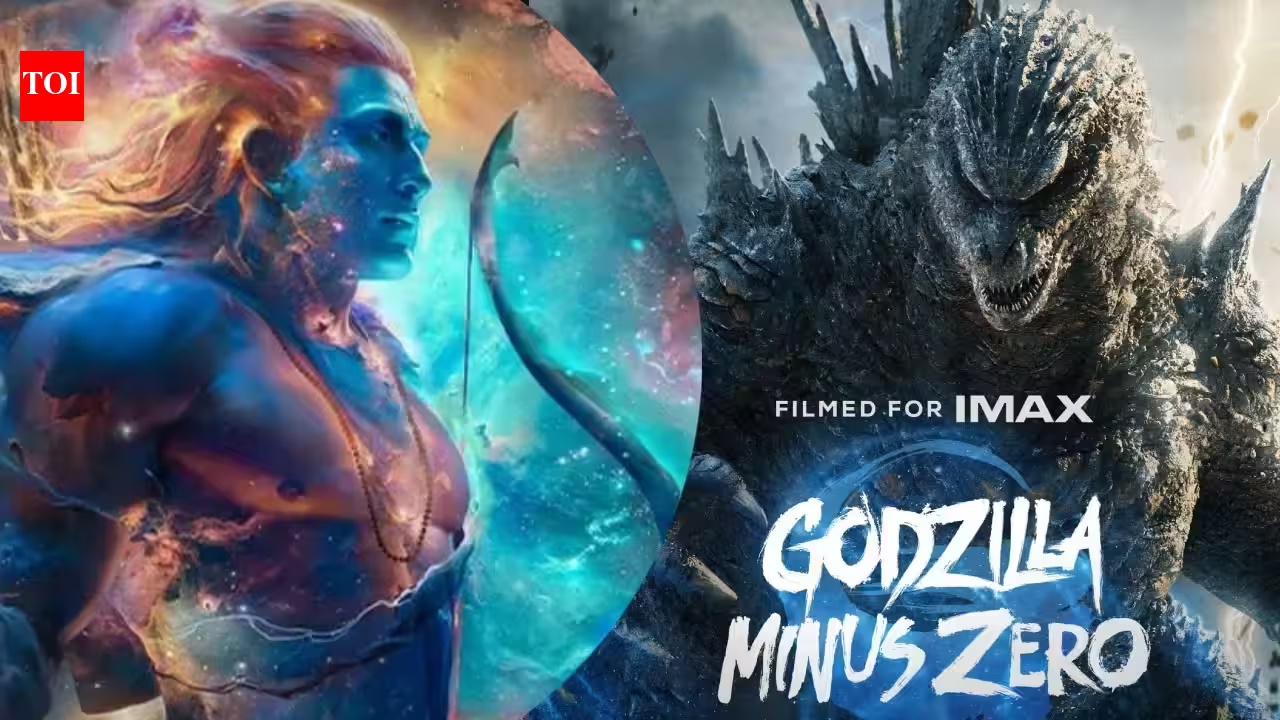
The monster movie landscape just got a lot more crowded, and the cinematic collision course set for November 6 is shaping up to be one of the most intriguing box office showdowns in recent memory. With the official trailer for Godzilla Minus Zero now circulating online, the global film community is reeling from the implications—both for the future of the Kaiju genre and the audacity of the studio’s scheduling strategy.
Following the seismic success of 2023’s Godzilla Minus One, which defied gravity and industry norms to claim an Academy Award for Best Visual Effects on a shoestring budget, director Takashi Yamazaki is returning to the director’s chair to continue the saga. If the new trailer is any indication, he isn’t just looking to replicate that success; he’s looking to dwarf it.
The Return of the King of the Monsters
The trailer opens with a haunting, gravelly narration: “We didn’t finish the job like we thought.” It’s a chilling reminder that in the world of post-war 1949 Japan, the scars of battle never truly heal—and evidently, neither does the threat of the world’s most famous radioactive lizard.
Ryunosuke Kamiki reprises his role as Kōichi Shikishima, the haunted pilot whose arc was central to the emotional core of Minus One. But this time, the stakes have shifted from personal trauma to an existential extinction event. The footage is dark, atmospheric, and visceral, maintaining that signature “grounded” aesthetic that made its predecessor a critical darling. However, the true showstopper arrives in the final seconds of the teaser. While the studio has been careful not to give away a full reveal, the unmistakable silhouette and sheer scale of King Ghidorah—the three-headed titan that has long been Godzilla’s most formidable nemesis—are heavily teased. Seeing a monster capable of physically toppling Godzilla is a shift in scale that has fans buzzing about the potential for a truly apocalyptic finale to this chapter.
A Technical Marvel for IMAX
Beyond the narrative beats, Godzilla Minus Zero is positioning itself as a technical benchmark. It is officially the first Japanese production ever to be filmed specifically for IMAX. For a franchise that relies on the “sense of scale”—the feeling of looking up at a beast that can level a city with a footfall—this is a massive selling point. The film is slated for a prestigious premiere at the New York Film Festival on September 26 before bowing in Japan on November 3 and reaching North American shores on November 6. By prioritizing the premium large-format experience, Toho is signaling that this isn’t just a creature feature; it’s an immersive cinematic event.
The Mythological Clash of the Century
The date of November 6 has become the focal point of a unique cultural phenomenon. As Godzilla Minus Zero prepares for its North American arrival, it finds itself sharing the spotlight with Nitesh Tiwari’s Ramayana: Part 1.
The contrast between these two projects is striking. On one side, you have the lean, mean, Oscar-winning efficiency of the Japanese monster saga. On the other, you have the sheer ambition of the Ramayana, a massive undertaking featuring Ranbir Kapoor, Sai Pallavi, and Yash. Positioned as a global-scale Indian epic, the Ramayana is steeped in profound cultural significance and high-stakes mythological storytelling.
It is a rare instance where the “Gods and Monsters” of two completely distinct cultures are going head-to-head for theater screens, particularly in international markets. For audiences, this presents a delicious dilemma. Do you opt for the gritty, visceral survival story of a post-war Japan battling a prehistoric force of nature, or do you step into the world of an ancient Indian epic, likely utilizing state-of-the-art visual effects to bring a legendary saga to life?
Budget vs. Impact: A Case Study in Filmmaking
Perhaps the most discussed aspect of this November showdown is the discrepancy in reported budgets. Ramayana has been the subject of massive industry buzz, with reports suggesting a staggering budget in the range of Rs 4,000 crore. This positions it as one of the most expensive productions in cinema history, with every cent likely visible in its set design, costumes, and grand-scale VFX.
Conversely, Godzilla Minus Zero is expected to operate in the $30 million to $50 million range. In Hollywood terms, that’s “pocket change” for a blockbuster, but in the hands of Takashi Yamazaki, it’s a fortune. Godzilla Minus One proved that high-quality visual storytelling doesn’t necessarily require a nine-figure price tag; it requires vision, precise editing, and a clear understanding of what scares and moves an audience.
Will the Ramayana’s immense scale dominate the global box office, or will the “little monster movie that could” continue to punch well above its weight class?
The Verdict: Why November 6 Matters
Regardless of which film takes the crown in terms of total ticket sales, the real winner is the audience. We are entering a period of theatrical release where diverse stories—from the high-fantasy mythological drama of India to the post-war monster horror of Japan—are commanding center stage alongside traditional Western tentpoles.
The rivalry between Godzilla Minus Zero and Ramayana represents a globalization of the blockbuster. It moves the focus away from the typical Hollywood studio system and highlights the storytelling prowess of international film industries. Fans are already picking sides on social media, comparing creature designs to deity portrayals, and debating whether the raw spectacle of a kaiju battle can outdo the epic scale of a thousand-year-old legend.
One thing is certain: November 6 won’t just be a date on the calendar; it will be a benchmark for how international cinema asserts its dominance in the modern age. As for Godzilla? If he can survive the atomic age, he can certainly survive a head-to-head with a mythological epic. But he’s certainly going to have a fight on his hands.
Disclaimer: This content is auto-generated for informational purposes only.
Source: Read Original News